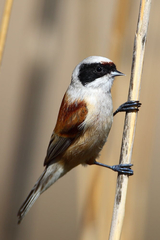
European Penduline Tit

European Penduline Tit

Remiz pendulinus

Silhouette: Sheatherius · PhyloPic

LCLeast ConcernNTVUENCR
Daily sighting probability <5% · Rare
at Helsinki

In 3 days <5%

33 Verified sightings at Helsinki
1,591 In all 12 parks From 2019 to 2026
June Best month
☀️ Diurnal When it's spotted

About the European Penduline Tit

The Eurasian penduline tit or European penduline tit (Remiz pendulinus) is a passerine bird of the genus Remiz. It is relatively widespread throughout the western Palearctic. It is migratory in the northern part of its range but resident in the southern part.

The breeding range in Western Europe experienced an expansion during the 1980s and 1990s. This was accompanied by an expansion of the species' winter range and reached as far south as northern Morocco. It builds an elaborate hanging nest, formerly used in Central Europe as children's slippers.

The Eurasian penduline tit was formally described by the Swedish naturalist Carl Linnaeus in 1758 in the tenth edition of his Systema Naturae under the binomial name Motacilla pedulinus. It is now placed in the genus Remiz that was introduced in 1819 by the Polish zoologist Feliks Paweł Jarocki. The genus name Remiz is the Polish word for the Eurasian penduline tit. The specific epithet is from Latin pendulus meaning "pendant" or "hanging down", referring to the nest.

Four subspecies are recognised: Wikipedia →

Sounds

Call0:07

France · 2026

© Thierry THOMAS · XC1186023 · CC BY-NC-SA 4.0

Flight call0:11

Netherlands · 2026

© Maarten Sluijter · XC1183522 · CC BY-NC-SA 4.0

Song0:28

Turkey · 2015

© Tero Linjama · XC1071025 · CC BY-NC-SA 4.0

Global Distribution

Parks Where Found

# Park Country Daily sighting probability
1 Hortobágy National Park 🇭🇺 Hungary
~40%
2 Kiskunság National Park 🇭🇺 Hungary
~30%
3 Biebrza National Park 🇵🇱 Poland
~20%
4 Fertő-Hanság National Park 🇭🇺 Hungary
~20%
5 Białowieża National Park 🇵🇱 Poland
~10%
6 Monfragüe National Park 🇪🇸 Spain
~10%
7 Doñana National Park 🇪🇸 Spain
~10%
8 Camargue 🇫🇷 France
<5%
9 Sierra Nevada National Park 🇪🇸 Spain
<5%
10 Bavarian Forest National Park 🇩🇪 Germany
<5%
11 Sierra de Guadarrama National Park 🇪🇸 Spain
<5%
12 Wadden Sea National Park 🇩🇪 Germany
<5%

Cities Where Found

# City Country Daily sighting probability
1 Novosibirsk 🇷🇺 Russia
~10%
2 Kazan 🇷🇺 Russia
~10%
3 Kyiv 🇺🇦 Ukraine
~10%
4 Antalya 🇹🇷 Turkey
~10%
5 Minsk 🇧🇾 Belarus
~10%
6 Yerevan 🇦🇲 Armenia
~10%
7 Bucharest 🇷🇴 Romania
~10%
8 Madrid 🇪🇸 Spain
<5%
9 Nizhny Novgorod 🇷🇺 Russia
<5%
10 Yekaterinburg 🇷🇺 Russia
<5%

Zoos & Centres Where Found

# Zoo / Centre Country
1 Ogród Zoologiczny w Katowicach 🇵🇱 Poland In captivity

Before you go

What are the chances of seeing a European Penduline Tit in Helsinki?

Rare

Under 5% of wildlife watchers report a European Penduline Tit sighting in Helsinki on a given day, based on 33 verified sightings from GBIF citizen-science data. It is the 189th most-seen of the 233 birds we can rate there. Over three days the chance rises to under 5%, if each day is a fresh chance.

When is the best time to see a European Penduline Tit in Helsinki?

Any time of year

In every month with enough records, under 5% of wildlife watchers report a European Penduline Tit in Helsinki on a given day, so our monthly data shows no clear season.

What time of day is best to see a European Penduline Tit?

Between 7 and 10 am

Across all the parks we cover, that three-hour window holds the most European Penduline Tit sightings with a recorded time, and about 9 in 10 of them come between 6 am and 6 pm: it is a daytime animal.

Is Helsinki the best place to see a European Penduline Tit?

23rd of 26

Of the 26 cities where we can rate European Penduline Tit sightings, Helsinki ranks 23rd at under 5%. The best odds are in Novosibirsk (Russia, about 10%), Kazan (Russia, about 10%) and Kyiv (Ukraine, about 10%).

Which relatives of the European Penduline Tit live in Helsinki?

Same order: Passeriformes

The closest relatives of the European Penduline Tit that you can see in Helsinki (order Passeriformes, Perching Birds) are Hooded Crow (about 80%), Great Tit (about 80%) and Eurasian Blackbird (about 80%), with each one's daily chance of a sighting.

Where does the European Penduline Tit sighting chance come from?

GBIF citizen-science records

It is estimated from how often the European Penduline Tit is recorded against all the birds logged in Helsinki (33 verified sightings), calibrated against known sighting rates. Figures are rounded to the nearest 10% because citizen-science data supports honest approximations, not decimals, and months with records from fewer than five people show "—". How it works.

← Back to Helsinki