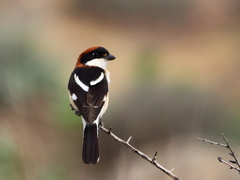
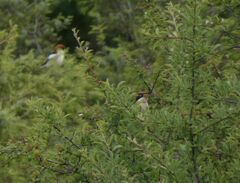
Woodchat Shrike

Woodchat Shrike

Lanius senator

Silhouette: Andy Wilson · PhyloPic

LCNTNear ThreatenedVUENCR
Daily sighting probability <5% · Rare
at Istanbul

In 3 days ~10%

87 Verified sightings at Istanbul
2,678 In all 11 parks From 2019 to 2026
April Best month
☀️ Diurnal When it's spotted

About the Woodchat Shrike

The woodchat shrike (Lanius senator) is a member of the shrike family Laniidae. It can be identified by its red-brown crown and nape. It is mainly insectivorous and favours open wooded areas with scattered trees such as orchards, particularly when there is bare or sandy ground. The woodchat shrike breeds in southern Europe, the Middle East and northwest Africa, and winters in tropical Africa.

The woodchat shrike was formally described by the Swedish naturalist Carl Linnaeus in 1758 in the tenth edition of his Systema Naturae under the binomial name Lanius senator. Linnaeus based his description on the "red headed butcher-bird" that had been described and illustrated in 1734 by the English naturalist Eleazar Albin in the second volume of his A Natural History of Birds. Linnaeus mistakenly specified the type locality as "Indiis". This was corrected to the River Rhine in Germany by Ernst Hartert in 1907. The genus name, Lanius, is derived from the Latin word for "butcher", and some shrikes are also known as "butcher birds" because of their feeding habits. The specific senator is Latin for "senator", so-named because its chestnut cap recalled the colour of the stripe on the... Wikipedia →

Sounds

Song0:27

France · 2023

© Greg P · XC982625 · CC BY-NC-SA 4.0

Call0:33

Portugal · 2024

© Jorge Leitão · XC901606 · CC BY-NC-SA 4.0

Alarm call0:13

Spain · 2023

© Marcin Sołowiej · XC826304 · CC BY-NC-SA 4.0

Global Distribution

Parks Where Found

# Park Country Daily sighting probability
1 Monfragüe National Park 🇪🇸 Spain
~20%
2 Awash National Park 🇪🇹 Ethiopia
~20%
3 Doñana National Park 🇪🇸 Spain
~20%
4 Sierra de Guadarrama National Park 🇪🇸 Spain
~10%
5 Kidepo Valley National Park 🇺🇬 Uganda
~10%
6 Sierra Nevada National Park 🇪🇸 Spain
~10%
7 Murchison Falls National Park 🇺🇬 Uganda
<5%
8 Niokolo-Koba National Park 🇸🇳 Senegal
<5%
9 Cévennes National Park 🇫🇷 France
<5%
10 Camargue 🇫🇷 France
<5%
11 Pyrénées National Park 🇫🇷 France
<5%

Cities Where Found

# City Country Daily sighting probability
1 Tangier 🇲🇦 Morocco
~10%
2 Riyadh 🇸🇦 Saudi Arabia
~10%
3 Antalya 🇹🇷 Turkey
~10%
4 Manama 🇧🇭 Bahrain
<5%
5 Ramallah 🇵🇸 Palestine
<5%
6 Marrakesh 🇲🇦 Morocco
<5%
7 Izmir 🇹🇷 Turkey
<5%
8 Rabat 🇲🇦 Morocco
<5%
9 Amman 🇯🇴 Jordan
<5%
10 Kuwait City 🇰🇼 Kuwait
<5%

Before you go

What are the chances of seeing a Woodchat Shrike in Istanbul?

Rare

Under 5% of wildlife watchers report a Woodchat Shrike sighting in Istanbul on a given day, based on 87 verified sightings from GBIF citizen-science data. It is the 129th most-seen of the 233 birds we can rate there. Over three days the chance rises to about 10%, if each day is a fresh chance.

When is the best time to see a Woodchat Shrike in Istanbul?

April

In that month about 10% of wildlife watchers report a Woodchat Shrike in Istanbul on a given day, against under 5% in May to March, the lowest months.

What time of day is best to see a Woodchat Shrike?

Between 8 and 11 am

Across all the parks we cover, that three-hour window holds the most Woodchat Shrike sightings with a recorded time, and about 8 in 10 of them come between 6 am and 6 pm: it is a daytime animal.

Is Istanbul the best place to see a Woodchat Shrike?

12th of 24

Of the 24 cities where we can rate Woodchat Shrike sightings, Istanbul ranks 12th at under 5%. The best odds are in Tangier (Morocco, about 10%), Riyadh (Saudi Arabia, about 10%) and Antalya (Turkey, about 10%).

Where does the Woodchat Shrike sighting chance come from?

GBIF citizen-science records

It is estimated from how often the Woodchat Shrike is recorded against all the birds logged in Istanbul (87 verified sightings), calibrated against known sighting rates. Figures are rounded to the nearest 10% because citizen-science data supports honest approximations, not decimals, and months with records from fewer than five people show "—". How it works.

← Back to Istanbul