Red-breasted Flycatcher

Red-breasted Flycatcher

Ficedula parva

Silhouette: Rachael Joakim · PhyloPic

LCLeast ConcernNTVUENCR
Daily sighting probability <5% · Rare
at Jammu

In 3 days ~10% in a week ~20%

5 Verified sightings at Jammu
4,650 In all 15 parks From 2019 to 2026
April Best month
🌅 Crepuscular When it's spotted

About the Red-breasted Flycatcher

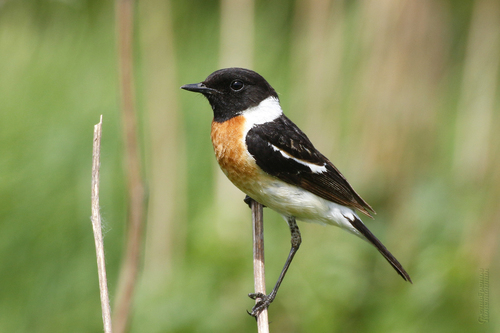
The red-breasted flycatcher (Ficedula parva) is a small passerine bird in the Old World flycatcher family. It breeds in eastern Europe and across Central Asia and is migratory, wintering in south Asia. The breeding male is mainly muted brown above and white below, with a grey head and an orange throat. Females and immatures are similarly colored but lack the orange throat patch. The red-breasted flycatcher is a regular passage migrant in western Europe, whereas the collared flycatcher, which has a different migration route (wintering in Sub-Saharan Africa), is scarce. It forms a superspecies with the closely related taiga flycatcher and Kashmir flycatcher and can be distinguished from the former by its different song, warmer-toned plumage and the more extensive orange throat patch.

The red-breasted flycatcher is one of about 30 species placed in the flycatcher genus Ficedula, along with other European species such as the collared flycatcher and the more widely distributed European pied flycatcher. The genus was introduced by the French naturalist Mathurin Jacques Brisson in 1760, with Ficedula being the Latin name for a small fig-eating bird (ficus, "fig") supposed to... Wikipedia →

Sounds

Call0:16

Sweden · 2026

© Kasper Wieck · XC1180609 · CC BY-NC-SA 4.0

Alarm call0:36

Sweden · 2026

© Magnus Wadstein · XC1151994 · CC BY-NC-SA 4.0

Song0:55

Netherlands · 2026

© Maarten Sluijter · XC1138798 · CC BY-NC-SA 4.0

Global Distribution

Parks Where Found

# Park Country Daily sighting probability
1 Keoladeo National Park 🇮🇳 India
~30%
2 Bandhavgarh National Park 🇮🇳 India
~20%
3 Białowieża National Park 🇵🇱 Poland
~20%
4 Satpura National Park 🇮🇳 India
~20%
5 Kanha National Park 🇮🇳 India
~20%
6 Ranthambore National Park 🇮🇳 India
~20%
7 Gir National Park 🇮🇳 India
~20%
8 Jim Corbett National Park 🇮🇳 India
<5%
9 Biebrza National Park 🇵🇱 Poland
<5%
10 Gauja National Park 🇱🇻 Latvia
<5%
11 Bandipur National Park 🇮🇳 India
<5%
12 Nagarhole National Park 🇮🇳 India
<5%
13 Mudumalai National Park 🇮🇳 India
<5%
14 Royal Manas National Park 🇧🇹 Bhutan
<5%
15 Cairngorms National Park 🇬🇧 United Kingdom
<5%

Cities Where Found

# City Country Daily sighting probability
1 Jabalpur 🇮🇳 India
~30%
2 Mashhad 🇮🇷 Iran
~20%
3 Gwalior 🇮🇳 India
~20%
4 Bhopal 🇮🇳 India
~20%
5 Chhatrapati Sambhajinagar 🇮🇳 India
~20%
6 Jaipur 🇮🇳 India
~10%
7 Pune 🇮🇳 India
~10%
8 Rajkot 🇮🇳 India
~10%
9 Surat 🇮🇳 India
~10%
10 Indore 🇮🇳 India
~10%

Before you go

What are the chances of seeing a Red-breasted Flycatcher in Jammu?

Rare

Under 5% of wildlife watchers report a Red-breasted Flycatcher sighting in Jammu on a given day, based on 5 verified sightings from GBIF citizen-science data. It is the 83rd most-seen of the 94 birds we can rate there. Over three days the chance rises to about 10%, and over a week to about 20%, if each day is a fresh chance.

When is the best time to see a Red-breasted Flycatcher in Jammu?

March–April and October

In those months about 10% of wildlife watchers report a Red-breasted Flycatcher in Jammu on a given day, against under 5% in May, August–September and November–February, the lowest months. Those are among Jammu's driest months, with about 40 mm of rain a month against 250 mm in July. June and July have too few records to rate.

What time of day is best to see a Red-breasted Flycatcher?

Between 4 and 7 am

Across all the parks we cover, that three-hour window holds the most Red-breasted Flycatcher sightings with a recorded time, and about half of them come between 6 am and 6 pm: it is most active around dawn and dusk.

Is Jammu the best place to see a Red-breasted Flycatcher?

36th of 64

Of the 64 cities where we can rate Red-breasted Flycatcher sightings, Jammu ranks 36th at under 5%. The best odds are in Jabalpur (India, about 30%), Mashhad (Iran, about 20%) and Gwalior (India, about 20%).

Which relatives of the Red-breasted Flycatcher live in Jammu?

Same family: Muscicapidae

The closest relatives of the Red-breasted Flycatcher that you can see in Jammu (family Muscicapidae, Old World Flycatchers, Robins, and Chats) are Oriental Magpie-Robin (about 40%), Indian Chat (about 30%) and Black Redstart (about 20%), with each one's daily chance of a sighting.

Where does the Red-breasted Flycatcher sighting chance come from?

GBIF citizen-science records

It is estimated from how often the Red-breasted Flycatcher is recorded against all the birds logged in Jammu (5 verified sightings), calibrated against known sighting rates. Figures are rounded to the nearest 10% because citizen-science data supports honest approximations, not decimals, and months with records from fewer than five people show "—". How it works.

← Back to Jammu