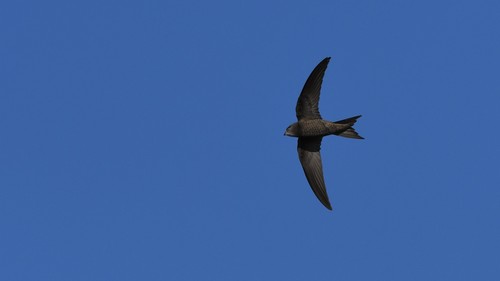
Water Rail

Water Rail

Rallus aquaticus

Silhouette: Ferran Sayol · PhyloPic

LCLeast ConcernNTVUENCR
Daily sighting probability <5% · Rare
at Kuwait City

In 3 days ~10% in a week ~30%

26 Verified sightings at Kuwait City
2,709 In all 14 parks From 2019 to 2026
January Best month
☀️ Diurnal When it's spotted

About the Water Rail

The water rail, western water rail or European water rail (Rallus aquaticus) is a bird of the rail family which breeds in well-vegetated wetlands across Europe, Asia and North Africa. Northern and eastern populations are migratory, but this species is a permanent resident in the warmer parts of its breeding range. The adult is 23–28 cm (9–11 in) long, and, like other rails, has a body that is flattened laterally, allowing it easier passage through the reed beds it inhabits. It has mainly brown upperparts and blue-grey underparts, black barring on the flanks, long toes, a short tail and a long reddish bill. Immature birds are generally similar in appearance to the adults, but the blue-grey in the plumage is replaced by buff. The downy chicks are black, as with all rails. The former subspecies R. indicus has distinctive markings and a call that is very different from the pig-like squeal of the western rails, and is now usually split as a separate species, the brown-cheeked rail.

The water rail breeds in reed beds and other marshy sites with tall, dense vegetation, building its nest a little above the water level from whatever plants are available nearby. The off-white, blotched eggs are incubated mainly by the female, and the precocial downy chicks hatch in 19–22 days. The female will defend her eggs and brood against intruders, or move them to another location if they are discovered. This species can breed after its first year, and it normally raises two clutches in each season. Water rails are omnivorous, feeding mainly on invertebrates during summer and berries or plant stems towards winter. They are territorial even after breeding, and will aggressively defend feeding areas in winter.

These rails are vulnerable to flooding or freezing conditions, loss of habitat and predation by mammals and large birds. The introduced American mink has exterminated some island populations, but overall the species' huge range and large numbers mean that it is not considered to be threatened. Wikipedia →

Sounds

Call1:10

Italy · 2026

© Francesco Sottile · XC1077705 · CC BY-NC-SA 4.0

Plik call1:15

Spain · 2025

© Jacobo Ramil Millarengo · XC991944 · CC BY-NC-SA 4.0

Song0:33

Sweden · 2025

© Tomas Berg · XC991827 · CC BY-NC-SA 4.0

Global Distribution

Parks Where Found

# Park Country Daily sighting probability
1 Hortobágy National Park 🇭🇺 Hungary
~30%
2 Kiskunság National Park 🇭🇺 Hungary
~20%
3 Camargue 🇫🇷 France
~20%
4 Sierra Nevada National Park 🇪🇸 Spain
~20%
5 Monfragüe National Park 🇪🇸 Spain
~10%
6 Fertő-Hanság National Park 🇭🇺 Hungary
~10%
7 Biebrza National Park 🇵🇱 Poland
~10%
8 Białowieża National Park 🇵🇱 Poland
~10%
9 Wadden Sea National Park 🇩🇪 Germany
~10%
10 Doñana National Park 🇪🇸 Spain
~10%
11 Snowdonia National Park 🇬🇧 United Kingdom
<5%
12 Bavarian Forest National Park 🇩🇪 Germany
<5%
13 Keoladeo National Park 🇮🇳 India
<5%
14 Cairngorms National Park 🇬🇧 United Kingdom
<5%

Cities Where Found

# City Country Daily sighting probability
1 Helsinki 🇫🇮 Finland
~10%
2 Antalya 🇹🇷 Turkey
~10%
3 Almaty 🇰🇿 Kazakhstan
~10%
4 Sofia 🇧🇬 Bulgaria
~10%
5 Manchester 🇬🇧 United Kingdom
~10%
6 Birmingham 🇬🇧 United Kingdom
~10%
7 Liverpool 🇬🇧 United Kingdom
~10%
8 Kuwait City 🇰🇼 Kuwait
<5%
9 Seoul 🇰🇷 South Korea
<5%
10 Srinagar 🇮🇳 India
<5%

Before you go

What are the chances of seeing a Water Rail in Kuwait City?

Rare

Under 5% of wildlife watchers report a Water Rail sighting in Kuwait City on a given day, based on 26 verified sightings from GBIF citizen-science data. It is the 96th most-seen of the 157 birds we can rate there. Over three days the chance rises to about 10%, and over a week to about 30%, if each day is a fresh chance.

When is the best time to see a Water Rail in Kuwait City?

January

In that month about 20% of wildlife watchers report a Water Rail in Kuwait City on a given day, against under 5% in February to December, the lowest months.

What time of day is best to see a Water Rail?

Between 8 and 11 am

Across all the parks we cover, that three-hour window holds the most Water Rail sightings with a recorded time, and about 8 in 10 of them come between 6 am and 6 pm: it is a daytime animal.

Is Kuwait City the best place to see a Water Rail?

8th of 42

Of the 42 cities where we can rate Water Rail sightings, Kuwait City ranks 8th at under 5%. The best odds are in Helsinki (Finland, about 10%), Antalya (Turkey, about 10%) and Almaty (Kazakhstan, about 10%).

Where does the Water Rail sighting chance come from?

GBIF citizen-science records

It is estimated from how often the Water Rail is recorded against all the birds logged in Kuwait City (26 verified sightings), calibrated against known sighting rates. Figures are rounded to the nearest 10% because citizen-science data supports honest approximations, not decimals, and months with records from fewer than five people show "—". How it works.

← Back to Kuwait City