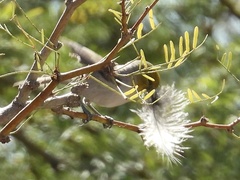
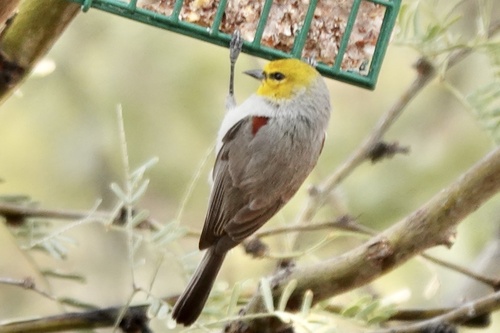
Verdin

Verdin

Auriparus flaviceps

Silhouette: Sheatherius · PhyloPic

LCLeast ConcernNTVUENCR
Daily sighting probability <5% · Rare
at Los Angeles

In 3 days <5%

45 Verified sightings at Los Angeles
14,608 In all 10 parks From 2019 to 2026
January Best month
☀️ Diurnal When it's spotted

About the Verdin

The verdin (Auriparus flaviceps) is a species of penduline tit. It is the only species in the genus Auriparus and the only representative of the Old World family Remizidae to be found in North America. The verdin was formally described in 1850 by the Swedish zoologist Carl Jakob Sundevall under the binomial name Aegithalus flaviceps. It is now the only species placed in the genus Auriparus that was introduced in 1864 by the American naturalist Spencer Fullerton Baird. The genus name combines the Latin aurum, auri meaning "gold" with the genus name Parus that was introduced by Carl Linnaeus in 1758 for the tits. The specific epithet flaviceps combines the Latin flavis meaning "yellow" with -ceps meaning "-capped".

Six subspecies are recognised: Wikipedia →

Sounds

Call0:33

United States · 2017

© Pat Goltz · XC1151109 · CC BY-NC-SA 4.0

Alarm call0:36

United States · 2023

© Sue Riffe · XC860388 · CC BY-NC-SA 4.0

Begging call0:30

United States · 2021

© Bobby Wilcox · XC642030 · CC BY-NC-SA 4.0

Global Distribution

Parks Where Found

# Park Country Daily sighting probability
1 Saguaro National Park 🇺🇸 United States
~80%
2 Cabo Pulmo National Park 🇲🇽 Mexico
~60%
3 Bahía de Loreto National Park 🇲🇽 Mexico
~60%
4 Joshua Tree National Park 🇺🇸 United States
~50%
5 Death Valley National Park 🇺🇸 United States
~50%
6 Big Bend National Park 🇺🇸 United States
~40%
7 El Vizcaíno Biosphere Reserve 🇲🇽 Mexico
~20%
8 Cumbres de Monterrey National Park 🇲🇽 Mexico
<5%
9 Zion National Park 🇺🇸 United States
<5%
10 Guadalupe Mountains National Park 🇺🇸 United States
<5%

Cities Where Found

# City Country Daily sighting probability
1 Mesa 🇺🇸 United States
~80%
2 Las Vegas 🇺🇸 United States
~80%
3 Phoenix 🇺🇸 United States
~80%
4 Torreón 🇲🇽 México
~70%
5 León 🇲🇽 México
~30%
6 Ciudad Juárez 🇲🇽 México
~30%
7 San Luis Potosí 🇲🇽 México
~20%
8 San Diego 🇺🇸 United States
<5%
9 Monterrey 🇲🇽 México
<5%
10 San Antonio 🇺🇸 United States
<5%

Zoos & Centres Where Found

# Zoo / Centre Country
1 Living Desert Zoo and Gardens 🇺🇸 United States In captivity
2 Arizona-Sonora Desert Museum 🇺🇸 United States In captivity

Before you go

What are the chances of seeing a Verdin in Los Angeles?

Rare

Under 5% of wildlife watchers report a Verdin sighting in Los Angeles on a given day, based on 45 verified sightings from GBIF citizen-science data. It is the 373rd most-seen of the 426 birds we can rate there. Over three days the chance rises to under 5%, if each day is a fresh chance.

When is the best time to see a Verdin in Los Angeles?

Any time of year

In every month with enough records, under 5% of wildlife watchers report a Verdin in Los Angeles on a given day, so our monthly data shows no clear season.

What time of day is best to see a Verdin?

Between 6 and 9 am

Across all the parks we cover, that three-hour window holds the most Verdin sightings with a recorded time, and about 7 in 10 of them come between 6 am and 6 pm: it is a daytime animal.

Is Los Angeles the best place to see a Verdin?

11th of 11

Of the 11 cities where we can rate Verdin sightings, Los Angeles ranks 11th at under 5%. The best odds are in Mesa (United States, about 80%), Las Vegas (United States, about 80%) and Phoenix (United States, about 80%).

Which relatives of the Verdin live in Los Angeles?

Same order: Passeriformes

The closest relatives of the Verdin that you can see in Los Angeles (order Passeriformes, Perching Birds) are House Finch (about 80%), Black Phoebe (about 80%) and American Crow (about 70%), with each one's daily chance of a sighting.

Where does the Verdin sighting chance come from?

GBIF citizen-science records

It is estimated from how often the Verdin is recorded against all the birds logged in Los Angeles (45 verified sightings), calibrated against known sighting rates. Figures are rounded to the nearest 10% because citizen-science data supports honest approximations, not decimals, and months with records from fewer than five people show "—". How it works.
← Back to Los Angeles