White-crowned Sparrow

White-crowned Sparrow

Zonotrichia leucophrys

Silhouette: Matt Wilkins · PhyloPic

LCLeast ConcernNTVUENCR
Daily sighting probability ~40% · Likely
at Los Angeles

In 3 days ~80% in a week >90%

42,315 Verified sightings at Los Angeles
40,050 In all 44 parks From 2019 to 2026
November Best month
☀️ Diurnal When it's spotted

About the White-crowned Sparrow

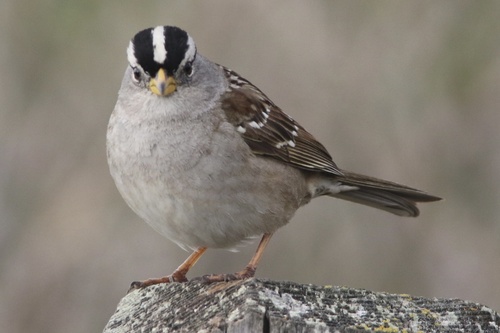
The white-crowned sparrow (Zonotrichia leucophrys) is a species of passerine bird native to North America. A medium-sized member of the New World sparrow family, this species is marked by a grey face and black and white streaking on the upper head. It breeds in brushy areas in the taiga and tundra of the northernmost parts of the continent and in the Rocky Mountains and Pacific coast. While southerly populations in the Rocky Mountains and coast are largely resident, the breeding populations of the northerly part of its range are migratory and can be found as wintering or passage visitors through most of North America south to central Mexico.

The scientific name is from Ancient Greek. The genus name Zonotrichia is from Ancient Greek ζώνη (zone, transl. band) and θρίξ (thrix, transl. hair). The species name leucophrys is from λευκός (leukos, transl. white) and ὀφρῡ́ς (ophrus, transl. eyebrow).

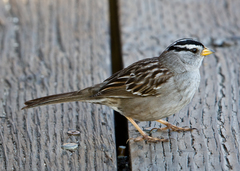
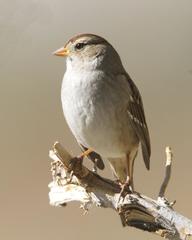
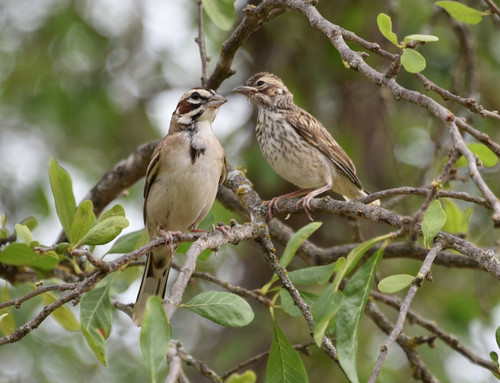
Adults have black and white stripes on their head, a gray face, brown streaked upper parts and a long tail. The wings are brown with bars and the underparts are gray. Their bill is pink or yellow. They are similar in appearance to the white-throated sparrow, but... Wikipedia →

Sounds

Call1:05

United States · 2026

© Ed Pandolfino · XC1153734 · CC BY-NC-SA 4.0

Song0:26

United States · 2026

© Greg Irving · XC1150047 · CC BY-NC-SA 4.0

Alarm call0:34

United States · 2024

© Sue Riffe · XC961061 · CC BY-NC-SA 4.0

Global Distribution

Parks Where Found

# Park Country Daily sighting probability
1 Denali National Park 🇺🇸 United States
~80%
2 Joshua Tree National Park 🇺🇸 United States
~60%
3 Katmai National Park 🇺🇸 United States
~50%
4 Death Valley National Park 🇺🇸 United States
~50%
5 Wrangell-St. Elias National Park 🇺🇸 United States
~50%
6 Redwood National Park 🇺🇸 United States
~50%
7 Point Pelee National Park 🇨🇦 Canada
~50%
8 Glacier National Park 🇺🇸 United States
~50%
9 Banff National Park 🇨🇦 Canada
~50%
10 Grand Teton National Park 🇺🇸 United States
~40%
11 Bahía de Loreto National Park 🇲🇽 Mexico
~40%
12 Kluane National Park 🇨🇦 Canada
~40%
13 Olympic National Park 🇺🇸 United States
~40%
14 Yellowstone National Park 🇺🇸 United States
~40%
15 Big Bend National Park 🇺🇸 United States
~30%
16 Rocky Mountain National Park 🇺🇸 United States
~30%
17 Guadalupe Mountains National Park 🇺🇸 United States
~30%
18 Jasper National Park 🇨🇦 Canada
~30%
19 Channel Islands National Park 🇺🇸 United States
~30%
20 Saguaro National Park 🇺🇸 United States
~30%
21 Cabo Pulmo National Park 🇲🇽 Mexico
~30%
22 Zion National Park 🇺🇸 United States
~30%
23 Pacific Rim National Park Reserve 🇨🇦 Canada
~20%
24 El Vizcaíno Biosphere Reserve 🇲🇽 Mexico
~20%
25 Great Bear Rainforest 🇨🇦 Canada
~20%
26 Grand Canyon National Park 🇺🇸 United States
~20%
27 Sequoia and Kings Canyon National Parks 🇺🇸 United States
~10%
28 Yosemite National Park 🇺🇸 United States
~10%
29 Wood Buffalo National Park 🇨🇦 Canada
~10%
30 Riding Mountain National Park 🇨🇦 Canada
~10%
31 Kenai Fjords National Park 🇺🇸 United States
<5%
32 Elk Island National Park 🇨🇦 Canada
<5%
33 Badlands National Park 🇺🇸 United States
<5%
34 Gros Morne National Park 🇨🇦 Canada
<5%
35 Isle Royale National Park 🇺🇸 United States
<5%
36 Voyageurs National Park 🇺🇸 United States
<5%
37 Celestún Biosphere Reserve 🇲🇽 Mexico
<5%
38 Cape Breton Highlands National Park 🇨🇦 Canada
<5%
39 Acadia National Park 🇺🇸 United States
<5%
40 Great Smoky Mountains National Park 🇺🇸 United States
<5%
41 Everglades National Park 🇺🇸 United States
<5%
42 Shenandoah National Park 🇺🇸 United States
<5%
43 Cumbres de Monterrey National Park 🇲🇽 Mexico
<5%
44 Merritt Island National Wildlife Refuge 🇺🇸 United States
<5%

Cities Where Found

# City Country Daily sighting probability
1 San Francisco 🇺🇸 United States
~50%
2 Mesa 🇺🇸 United States
~50%
3 Sacramento 🇺🇸 United States
~40%
4 Las Vegas 🇺🇸 United States
~40%
5 Los Angeles 🇺🇸 United States
~40%
6 Anchorage 🇺🇸 United States
~40%
7 San Diego 🇺🇸 United States
~30%
8 Tijuana 🇲🇽 México
~30%
9 Vancouver 🇨🇦 Canada
~30%
10 Seattle 🇺🇸 United States
~20%

Zoos & Centres Where Found

# Zoo / Centre Country
1 Arizona-Sonora Desert Museum 🇺🇸 United States In captivity

Before you go

What are the chances of seeing a White-crowned Sparrow in Los Angeles?

Likely

About 40% of wildlife watchers report a White-crowned Sparrow sighting in Los Angeles on a given day, based on 42,315 verified sightings from GBIF citizen-science data. It is the 21st most-seen of the 426 birds we can rate there. Over three days the chance rises to about 80%, and over a week to over 90%, if each day is a fresh chance.

When is the best time to see a White-crowned Sparrow in Los Angeles?

November and December

In those months about 70% of wildlife watchers report a White-crowned Sparrow in Los Angeles on a given day, against under 5% in May to August, the lowest months. Those are among Los Angeles's wettest months, with about 45 mm of rain a month against almost none in June.

What time of day is best to see a White-crowned Sparrow?

Between 8 and 11 am

Across all the parks we cover, that three-hour window holds the most White-crowned Sparrow sightings with a recorded time, and about 9 in 10 of them come between 6 am and 6 pm: it is a daytime animal.

Is Los Angeles the best place to see a White-crowned Sparrow?

5th of 34

Of the 34 cities where we can rate White-crowned Sparrow sightings, Los Angeles ranks 5th at about 40%. The best odds are in San Francisco (United States, about 50%), Mesa (United States, about 50%) and Sacramento (United States, about 40%).

Where does the White-crowned Sparrow sighting chance come from?

GBIF citizen-science records

It is estimated from how often the White-crowned Sparrow is recorded against all the birds logged in Los Angeles (42,315 verified sightings), calibrated against known sighting rates. Figures are rounded to the nearest 10% because citizen-science data supports honest approximations, not decimals, and months with records from fewer than five people show "—". How it works.

← Back to Los Angeles