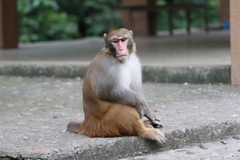
Rhesus Macaque

Rhesus Macaque

Macaca mulatta

Silhouette: PhyloPic

LCLeast ConcernNTVUENCR
Daily sighting probability ~40% · Likely
at Lucknow

In 3 days ~80% in a week >90%

9 Verified sightings at Lucknow
336 In all 10 parks From 2019 to 2026
October Best month
🌅 Crepuscular When it's spotted

About the Rhesus Macaque

The rhesus macaque (Macaca mulatta), colloquially rhesus monkey, is a species of Old World monkey in the Macaca genus. There are between six and nine recognised subspecies split between two groups, the Chinese-derived and the Indian-derived. Generally brown or grey in colour, it is 47–53 cm (19–21 in) in length with a 20.7–22.9 cm (8.1–9.0 in) tail and weighs 5.3–7.7 kg (12–17 lb). It is native to South, Central, and Southeast Asia and has the widest geographic range of all non-human primates, occupying a great diversity of altitudes and habitats.

The rhesus macaque is diurnal, arboreal, and terrestrial. It is mostly herbivorous, feeding mainly on fruit, but also eating seeds, roots, buds, bark, and cereals. Rhesus macaques living in cities also eat human food and trash. They are gregarious, with troops comprising 20–200 individuals. The social groups are matrilineal. Individuals communicate with a variety of facial expressions, vocalisations, body postures, and gestures.

As a result of the rhesus macaque's relatively easy upkeep, wide availability, and closeness to humans anatomically and physiologically, it has been used extensively in medical and biological research. It has facilitated many scientific breakthroughs including vaccines for rabies, smallpox, polio, and antiretroviral medication to treat HIV/AIDS. A rhesus macaque became the first primate astronaut in 1948.

The rhesus is listed as Least Concern in the IUCN Red List. Wikipedia →

Sounds

Agonistic call0:17

China · 2025

© Dave Guo · XC1047250 · CC BY-NC-SA 4.0

Alarm call0:07

Myanmar · 2025

© Ding Li Yong · XC1044523 · CC BY-NC-ND 4.0

Call0:30

Nepal · 2023

© Marc Anderson · XC960761 · CC BY-NC-ND 4.0

Global Distribution

Parks Where Found

# Park Country Daily sighting probability
1 Kaziranga National Park 🇮🇳 India
~70%
2 Keoladeo National Park 🇮🇳 India
~70%
3 Sundarbans National Park 🇮🇳 India
~70%
4 Bandhavgarh National Park 🇮🇳 India
~60%
5 Chitwan National Park 🇳🇵 Nepal
~60%
6 Jim Corbett National Park 🇮🇳 India
~60%
7 Royal Bardia National Park 🇳🇵 Nepal
~40%
8 Satpura National Park 🇮🇳 India
~40%
9 Ranthambore National Park 🇮🇳 India
~30%
10 Kanha National Park 🇮🇳 India
~20%

Cities Where Found

# City Country Daily sighting probability
1 Agra 🇮🇳 India
~90%
2 Kathmandu 🇳🇵 Nepal
~80%
3 Guiyang 🇨🇳 China
~80%
4 Guwahati 🇮🇳 India
~70%
5 Varanasi 🇮🇳 India
~70%
6 Dehradun 🇮🇳 India
~60%
7 Jaipur 🇮🇳 India
~60%
8 Islamabad 🇵🇰 Pakistan
~50%
9 Kota 🇮🇳 India
~50%
10 New Delhi 🇮🇳 India
~50%

Zoos & Centres Where Found

# Zoo / Centre Country
1 Moscow Zoo 🇷🇺 Russia In captivity
2 Yangon Zoological Gardens 🇲🇲 Myanmar (Burma) In captivity
3 Leipzig Zoological Garden 🇩🇪 Germany In captivity
4 Copenhagen Zoo 🇩🇰 Denmark In captivity
5 La Tanière 🇫🇷 France In captivity
6 Zoobotanic Park of Brusque 🇧🇷 Brazil In captivity
7 Knuthenborg Safaripark 🇩🇰 Denmark In captivity
8 Sri Venkateswara Zoological Park 🇮🇳 India In captivity
9 Beijing Wildlife Park 🇨🇳 China In captivity
10 Xi'an Qinling Wildlife Park 🇨🇳 China In captivity
11 Longleat Safari and Adventure Park 🇬🇧 United Kingdom In captivity
12 Kadoorie Farm and Botanic Garden 🇭🇰 Hong Kong SAR China In captivity
13 Planète Sauvage 🇫🇷 France In captivity
14 Beijing Zoo 🇨🇳 China In captivity
15 Indira Gandhi Zoological Park 🇮🇳 India In captivity
16 Shenzhen Safari Park 🇨🇳 China In captivity
17 Maitri Baagh Zoo 🇮🇳 India In captivity
18 Карельский зоопарк 🇷🇺 Russia In captivity
19 Fuzhou Zoo 🇨🇳 China In captivity
20 Nanning Zoo 🇨🇳 China In captivity
21 Guangzhou Zoo 🇨🇳 China In captivity
22 Yerevan Zoo 🇦🇲 Armenia In captivity
23 无锡动物园 🇨🇳 China In captivity
24 Zoologischer Garten Leipzig 🇩🇪 Germany In captivity
25 Zhengzhou Zoo 🇨🇳 China In captivity
26 Europaradise Park 🇵🇹 Portugal In captivity
27 Jijamata Udyaan 🇮🇳 India In captivity
28 La Palmyre Zoo 🇫🇷 France In captivity
29 Chapultepec Zoo 🇲🇽 Mexico In captivity
30 Zoo d'Amnéville 🇫🇷 France In captivity
31 杭州动物园 🇨🇳 China In captivity
32 Kharkiv Zoo 🇺🇦 Ukraine In captivity
33 Thiruvananthapuram Zoo 🇮🇳 India In captivity
34 Rio de Janeiro Zoological Garden 🇧🇷 Brazil In captivity
35 Children's Park, Guindy 🇮🇳 India In captivity
36 Sayaji Baug Zoo 🇮🇳 India In captivity
37 Paphos Zoo 🇨🇾 Cyprus In captivity
38 Rahim Yar Khan Wildlife Park 🇵🇰 Pakistan In captivity
39 Research Institute of Experimental Pathology and Therapy, Academy of Sciences of Abkhazia 🇬🇪 Georgia In captivity
40 Tbilisi Zoo 🇬🇪 Georgia In captivity
41 Van Blanckendaell Park 🇳🇱 Netherlands In captivity
42 Inokashira Park Zoo 🇯🇵 Japan In captivity
43 Loi Bher Wildlife Park 🇵🇰 Pakistan In captivity
44 Tierpark Görlitz 🇩🇪 Germany In captivity
45 Kecskeméti Vadaskert 🇭🇺 Hungary In captivity
46 Guilin Old Zoo 🇨🇳 China In captivity
47 Hartbeespoort Dam Snake and Animal Park 🇿🇦 South Africa In captivity
48 Macau Zoo 🇲🇴 Macao SAR China In captivity
49 Raritätenzoo Ebbs 🇦🇹 Austria In captivity
50 Castellar Zoo 🇪🇸 Spain In captivity

Before you go

What are the chances of seeing a Rhesus Macaque in Lucknow?

Likely

About 40% of wildlife watchers report a Rhesus Macaque sighting in Lucknow on a given day, based on 9 verified sightings from GBIF citizen-science data. Over three days the chance rises to about 80%, and over a week to over 90%, if each day is a fresh chance.

When is the best time to see a Rhesus Macaque in Lucknow?

October

In that month about 70% of wildlife watchers report a Rhesus Macaque in Lucknow on a given day, against about 10% in February–April, June and August–September, the lowest months. That is one of Lucknow's driest months, with about 35 mm of rain against 320 mm in July.

What time of day is best to see a Rhesus Macaque?

Between 4 and 7 am

Across all the parks we cover, that three-hour window holds the most Rhesus Macaque sightings with a recorded time, and about 7 in 10 of them come between 6 am and 6 pm: it is most active around dawn and dusk.

Is Lucknow the best place to see a Rhesus Macaque?

11th of 21

Of the 21 cities where we can rate Rhesus Macaque sightings, Lucknow ranks 11th at about 40%. The best odds are in Agra (India, about 90%), Kathmandu (Nepal, about 80%) and Guiyang (China, about 80%).

Where does the Rhesus Macaque sighting chance come from?

GBIF citizen-science records

It is estimated from how often the Rhesus Macaque is recorded against all the mammals logged in Lucknow (9 verified sightings), calibrated against known sighting rates. Figures are rounded to the nearest 10% because citizen-science data supports honest approximations, not decimals, and months with records from fewer than five people show "—". How it works.

← Back to Lucknow