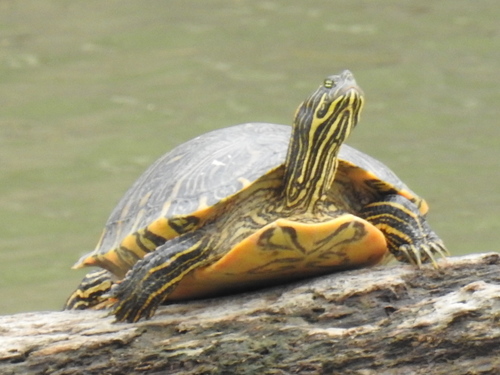
Viperine Snake

Viperine Snake

Natrix maura

Silhouette: Danny S. · PhyloPic

LCLeast ConcernNTVUENCR
Daily sighting probability <5% · Rare
at Madrid

In 3 days ~10% in a week ~30%

8 Verified sightings at Madrid
370 In all 9 parks From 2019 to 2026
September Best month
☀️ Diurnal When it's spotted

About the Viperine Snake

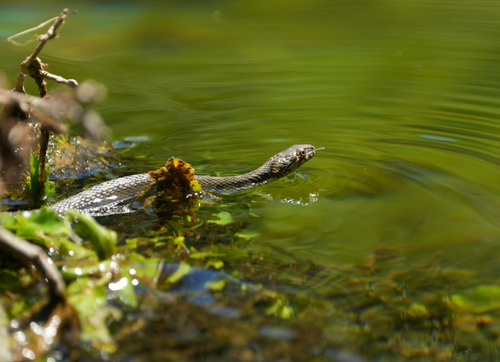
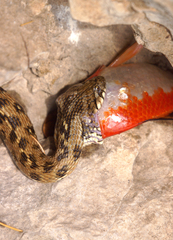
The viperine water snake or viperine snake (Natrix maura) is a semiaquatic, fish-eating natricine water snake. Despite its common names, it is not a member of the subfamily Viperinae. It was given its common names due to exhibiting a dorsal colour pattern that superficially resembles that of sympatric adder species. In comparison to other Natrix species its head is also somewhat wider and more distinct from the neck. Like most members of the Natricinae it possesses a venom gland on each side of the upper jaw (Duvernoy's gland) that produces a mild venom that may play a role in swallowing or digestion. The gland is not associated with an enlarged specialized tooth and the venom has to be applied by chewing. The species usually does not bite as a means of defense, and the effect of a bite would be harmless to humans.

The viperine snake looks like an adder and occasionally behaves like one. It is known to strike like an adder, but not to bite. It spends most of its time in water hunting fish, frogs and other aquatic animals. The species is diurnal.

Fossils of the viperine snake are known from El Chaparral, a fossil site in Villaluenga del Rosario that... Wikipedia →

Global Distribution

Parks Where Found

# Park Country Daily sighting probability
1 Cévennes National Park 🇫🇷 France
~40%
2 Monfragüe National Park 🇪🇸 Spain
~30%
3 Doñana National Park 🇪🇸 Spain
~30%
4 Pyrénées National Park 🇫🇷 France
~20%
5 Camargue 🇫🇷 France
~20%
6 Mercantour National Park 🇫🇷 France
~20%
7 Sierra Nevada National Park 🇪🇸 Spain
~20%
8 Aigüestortes National Park 🇪🇸 Spain
~20%
9 Sierra de Guadarrama National Park 🇪🇸 Spain
~10%

Cities Where Found

# City Country Daily sighting probability
1 Valencia 🇪🇸 Spain
~10%
2 Lisbon 🇵🇹 Portugal
~10%
3 Barcelona 🇪🇸 Spain
~10%
4 Porto 🇵🇹 Portugal
<5%
5 Madrid 🇪🇸 Spain
<5%

Zoos & Centres Where Found

# Zoo / Centre Country
1 Paris Zoological Park 🇫🇷 France In captivity
2 Aquarium du palais de la Porte Dorée 🇫🇷 France In captivity
3 Tierpark Herborn 🇩🇪 Germany In captivity
4 Aquarium of Gijón 🇪🇸 Spain In captivity
5 Fluviário de Mora 🇵🇹 Portugal In captivity
6 Reptiland 🇫🇷 France In captivity

Before you go

What are the chances of seeing a Viperine Snake in Madrid?

Rare

Under 5% of wildlife watchers report a Viperine Snake sighting in Madrid on a given day, based on 8 verified sightings from GBIF citizen-science data. It is the 13th most-seen of the 15 reptiles we can rate there. Over three days the chance rises to about 10%, and over a week to about 30%, if each day is a fresh chance.

When is the best time to see a Viperine Snake in Madrid?

January, June and August–September

In those months about 10% of wildlife watchers report a Viperine Snake in Madrid on a given day, against under 5% in February–May, July and October–December, the lowest months.

What time of day is best to see a Viperine Snake?

Between noon and 3 pm

Across all the parks we cover, that three-hour window holds the most Viperine Snake sightings with a recorded time, and about 7 in 10 of them come between 6 am and 6 pm: it is a daytime animal.

Is Madrid the best place to see a Viperine Snake?

5th of 5

Of the 5 cities where we can rate Viperine Snake sightings, Madrid ranks 5th at under 5%. The best odds are in Valencia (Spain, about 10%), Lisbon (Portugal, about 10%) and Barcelona (Spain, about 10%).

Where does the Viperine Snake sighting chance come from?

GBIF citizen-science records

It is estimated from how often the Viperine Snake is recorded against all the reptiles logged in Madrid (8 verified sightings), calibrated against known sighting rates. Figures are rounded to the nearest 10% because citizen-science data supports honest approximations, not decimals, and months with records from fewer than five people show "—". How it works.

← Back to Madrid