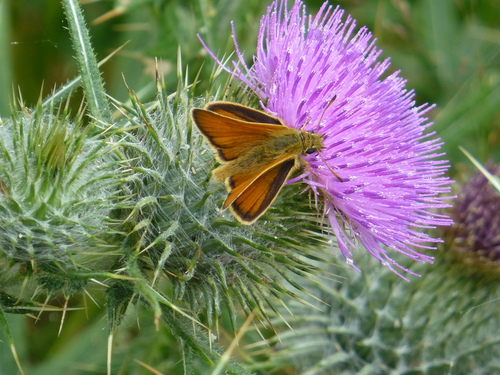
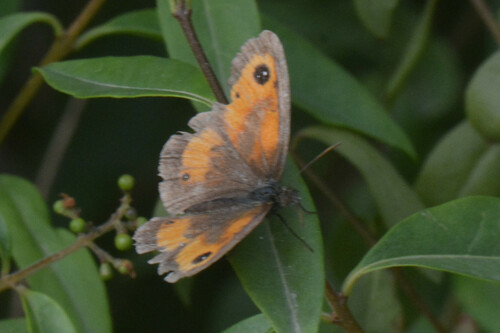
Far Eastern Large Skipper

Far Eastern Large Skipper

Ochlodes venata

Daily sighting probability ~20% · Possible
at Manchester

In 3 days ~50% in a week ~80%

107 Verified sightings at Manchester
774 In all 20 parks From 2019 to 2026
June Best month
☀️ Diurnal When it's spotted

About the Far Eastern Large Skipper

Ochlodes venatus, commonly known as the far eastern large skipper, is a skipper butterfly species in the family Hesperiidae. The name was long used for the large skipper of Europe, but it actually refers to its Far Eastern sister species and the large skipper is now called O. sylvanus. There is some dispute however about whether the large skipper should not better placed in O. venatus as a subspecies sylvanus or faunus. An ICZN Opinion in 1944 noted that the genus name Ochlodes is masculine, so the correct epithet for this species is venatus. However, many sources continue to list it as Ochlodes venata.

These two skippers are possibly sympatric in China. Ochlodes venatus occurs from there eastwards to Korea and Japan. Jennifer Owen. The Ecology of a Garden: The First Fifteen Years. Cambridge University Press, 1991. ISBN 978-0-521-34335-0; p. 88 Wikipedia →

Global Distribution

Parks Where Found

# Park Country Daily sighting probability
1 Plitvice Lakes National Park 🇭🇷 Croatia
~40%
2 Triglav National Park 🇸🇮 Slovenia
~30%
3 Aigüestortes National Park 🇪🇸 Spain
~30%
4 Ordesa y Monte Perdido National Park 🇪🇸 Spain
~30%
5 Picos de Europa National Park 🇪🇸 Spain
~30%
6 Hohe Tauern National Park 🇦🇹 Austria
~20%
7 Bavarian Forest National Park 🇩🇪 Germany
~20%
8 Biebrza National Park 🇵🇱 Poland
~20%
9 Vanoise National Park 🇫🇷 France
~20%
10 Pyrénées National Park 🇫🇷 France
~20%
11 Ecrins National Park 🇫🇷 France
~20%
12 Cévennes National Park 🇫🇷 France
~20%
13 Mercantour National Park 🇫🇷 France
~20%
14 Tatra National Park 🇸🇰 Slovakia
~10%
15 Fertő-Hanság National Park 🇭🇺 Hungary
~10%
16 Białowieża National Park 🇵🇱 Poland
~10%
17 Camargue 🇫🇷 France
~10%
18 Snowdonia National Park 🇬🇧 United Kingdom
~10%
19 Sierra de Guadarrama National Park 🇪🇸 Spain
~10%
20 Wadden Sea National Park 🇩🇪 Germany
<5%

Cities Where Found

# City Country Daily sighting probability
1 Manchester 🇬🇧 United Kingdom
~20%
2 Birmingham 🇬🇧 United Kingdom
~20%
3 Leeds 🇬🇧 United Kingdom
~20%
4 Liverpool 🇬🇧 United Kingdom
~10%
5 London 🇬🇧 United Kingdom
~10%
6 Milan 🇮🇹 Italy
~10%
7 Kharkiv 🇺🇦 Ukraine
~10%
8 Naples 🇮🇹 Italy
~10%
9 Budapest 🇭🇺 Hungary
~10%
10 Prague 🇨🇿 Czechia
~10%

Before you go

What are the chances of seeing a Far Eastern Large Skipper in Manchester?

Possible

About 20% of wildlife watchers report a Far Eastern Large Skipper sighting in Manchester on a given day, based on 107 verified sightings from GBIF citizen-science data. It is the 39th most-seen of the 458 insects we can rate there. Over three days the chance rises to about 50%, and over a week to about 80%, if each day is a fresh chance.

When is the best time to see a Far Eastern Large Skipper in Manchester?

June

In that month about 40% of wildlife watchers report a Far Eastern Large Skipper in Manchester on a given day, against under 5% in August to April, the lowest months.

What time of day is best to see a Far Eastern Large Skipper?

Between 11 am and 2 pm

Across all the parks we cover, that three-hour window holds the most Far Eastern Large Skipper sightings with a recorded time, and about 9 in 10 of them come between 6 am and 6 pm: it is a daytime animal.

Is Manchester the best place to see a Far Eastern Large Skipper?

Yes

Of the 33 cities where we can rate Far Eastern Large Skipper sightings, Manchester has the highest daily chance: about 20%. Next come Birmingham (United Kingdom, about 20%) and Leeds (United Kingdom, about 20%).

Where does the Far Eastern Large Skipper sighting chance come from?

GBIF citizen-science records

It is estimated from how often the Far Eastern Large Skipper is recorded against all the insects logged in Manchester (107 verified sightings), calibrated against known sighting rates. Figures are rounded to the nearest 10% because citizen-science data supports honest approximations, not decimals, and months with records from fewer than five people show "—". How it works.

← Back to Manchester