Striped Marsh Frog

Striped Marsh Frog

Limnodynastes peronii

Silhouette: Jose Carlos Arenas-Monroy · PhyloPic

LCLeast ConcernNTVUENCR Endemic
Daily sighting probability ~20% · Possible
at Melbourne

In 3 days ~40% in a week ~70%

485 Verified sightings at Melbourne
237 In all 7 parks From 2019 to 2026
September Best month
🌅 Crepuscular When it's spotted

About the Striped Marsh Frog

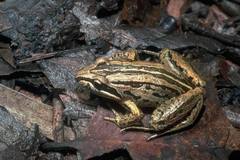
The striped marsh frog or brown-striped frog (Limnodynastes peronii) is a predominantly aquatic frog native to coastal Eastern Australia. It is a common species in urban habitats. The striped marsh frog was described by French naturalists André Marie Constant Duméril and Gabriel Bibron in 1841.

Females may reach a length of 75 millimetres (3.0 in) and males 70 millimetres (2.8 in). They are a shade of brown on the dorsal surface. This colour can be light or dark; they can also be a red-brown on the dorsal surface. There are distinct darker stripes running down the frogs back (giving this species its name), there is normally a paler mid-dorsal stripe running down the back. There is a black "mask" that runs from the nostril, through the eye and down to the shoulder. This "mask" is followed by a thick light golden line that runs underneath the "mask" and terminates at the end of the mouth. Breeding males develop thick arms, these are used in "wrestling" matches with other frogs, the throat of males is yellow in colour. The belly is white.

It is distributed from the southern parts of the Cape York Peninsula in North Queensland... Wikipedia →

Sounds

Advertisement call0:48

Australia · 2012

© Marc Anderson · XC883180 · CC BY-NC-ND 4.0

Uncertain0:13

Australia · 2024

© Nick Talbot · XC988815 · CC BY-NC-SA 4.0

Recording1:04

Australia · 2026

© chris · iNaturalist · CC BY-NC 4.0

Global Distribution

Parks Where Found

# Park Country Daily sighting probability
1 Booderee National Park 🇦🇺 Australia
~30%
2 Blue Mountains National Park 🇦🇺 Australia
~30%
3 Royal National Park 🇦🇺 Australia
~20%
4 Lamington National Park 🇦🇺 Australia
~20%
5 Wilsons Promontory National Park 🇦🇺 Australia
~10%
6 Springbrook National Park 🇦🇺 Australia
~10%
7 Great Otway National Park 🇦🇺 Australia
~10%

Cities Where Found

# City Country Daily sighting probability
1 Sydney 🇦🇺 Australia
~20%
2 Brisbane 🇦🇺 Australia
~20%
3 Melbourne 🇦🇺 Australia
~20%

Before you go

What are the chances of seeing a Striped Marsh Frog in Melbourne?

Possible

About 20% of wildlife watchers report a Striped Marsh Frog sighting in Melbourne on a given day, based on 485 verified sightings from GBIF citizen-science data. It is the 2nd most-seen of the 9 amphibians we can rate there. Over three days the chance rises to about 40%, and over a week to about 70%, if each day is a fresh chance.

When is the best time to see a Striped Marsh Frog in Melbourne?

September

In that month about 30% of wildlife watchers report a Striped Marsh Frog in Melbourne on a given day, against about 10% in January–March and May–July, the lowest months.

What time of day is best to see a Striped Marsh Frog?

Between 5 and 8 pm

Across all the parks we cover, that three-hour window holds the most Striped Marsh Frog sightings with a recorded time, and about 7 in 10 of them come between 6 am and 6 pm: it is most active around dawn and dusk.

Is Melbourne the best place to see a Striped Marsh Frog?

Among the best

Of the 3 cities where we can rate Striped Marsh Frog sightings, Melbourne ranks 3rd at about 20%, level with the leaders once rounded. The best odds are in Sydney (Australia, about 20%) and Brisbane (Australia, about 20%).

Which relatives of the Striped Marsh Frog live in Melbourne?

Same genus: Limnodynastes

The closest relatives of the Striped Marsh Frog that you can see in Melbourne (genus Limnodynastes, Banjo and Marsh Frogs) are Pobblebonk (about 10%) and Spotted Grass Frog (about 10%), with each one's daily chance of a sighting.

Where does the Striped Marsh Frog sighting chance come from?

GBIF citizen-science records

It is estimated from how often the Striped Marsh Frog is recorded against all the amphibians logged in Melbourne (485 verified sightings), calibrated against known sighting rates. Figures are rounded to the nearest 10% because citizen-science data supports honest approximations, not decimals, and months with records from fewer than five people show "—". How it works.

← Back to Melbourne