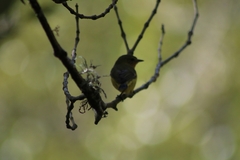
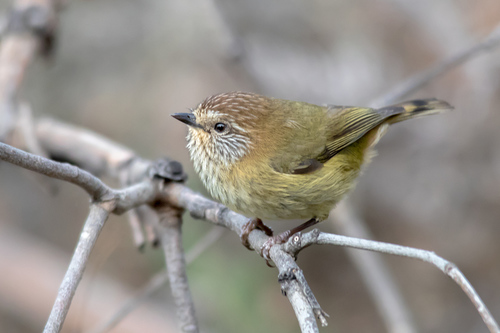
Yellow Thornbill

Yellow Thornbill

Acanthiza nana

Silhouette: Matt Wilkins (photo by Patrick Kavanagh) · PhyloPic

LCLeast ConcernNTVUENCR Endemic
Daily sighting probability <5% · Rare
at Melbourne

In 3 days <5% in a week ~10%

521 Verified sightings at Melbourne
1,143 In all 7 parks From 2019 to 2026
October Best month
☀️ Diurnal When it's spotted

About the Yellow Thornbill

The yellow thornbill (Acanthiza nana), formerly known as the little thornbill, is a tiny passerine bird endemic to the eastern coast of Australia. While currently listed as Least Concern by the IUCN, the general consensus is that the population is decreasing.

Acanthiza nana was named by Irish zoologist N. A. Vigors and American naturalist Dr Thomas Horsfield in 1827, with the bird noted in the Sydney Cove area. However, the earliest field notes with type description record the yellow thornbill in 1803, with records sent at the time to the Linnean Society of London. The generic name Acanthiza derives from Ancient Greek akantheōn 'thorn-brake' and zaō 'live, inhabit'. The specific epithet nana is Latin for a 'female dwarf'. The yellow thornbill is one of 13 currently recognised species of thornbill within the genus Acanthiza. There are five species groups recognised within this genus, with the yellow thornbill (Acanthiza nana) most closely related to the striated thornbill (Acanthiza lineata). The only Acanthiza species which occurs outside Australia, the New Guinea thornbill (Acanthiza murina), also bears close molecular similarities to both the yellow and striated thornbills... Wikipedia →

Sounds

Call1:00

Australia · 2022

© Richard Boon · XC772335 · CC BY-NC-SA 4.0

Uncertain0:17

Australia · 2021

© nick talbot · XC678502 · CC BY-NC-SA 4.0

Song0:29

Australia · 2021

© James Lambert · XC628842 · CC BY-NC-SA 4.0

Global Distribution

Parks Where Found

# Park Country Daily sighting probability
1 Blue Mountains National Park 🇦🇺 Australia
~20%
2 Hattah-Kulkyne National Park 🇦🇺 Australia
~10%
3 Booderee National Park 🇦🇺 Australia
~10%
4 Grampians National Park 🇦🇺 Australia
<5%
5 Royal National Park 🇦🇺 Australia
<5%
6 Lamington National Park 🇦🇺 Australia
<5%
7 Great Otway National Park 🇦🇺 Australia
<5%

Cities Where Found

# City Country Daily sighting probability
1 Sydney 🇦🇺 Australia
~10%
2 Brisbane 🇦🇺 Australia
<5%
3 Melbourne 🇦🇺 Australia
<5%

Before you go

What are the chances of seeing a Yellow Thornbill in Melbourne?

Rare

Under 5% of wildlife watchers report a Yellow Thornbill sighting in Melbourne on a given day, based on 521 verified sightings from GBIF citizen-science data. It is the 117th most-seen of the 236 birds we can rate there. Over three days the chance rises to under 5%, and over a week to about 10%, if each day is a fresh chance.

When is the best time to see a Yellow Thornbill in Melbourne?

Any time of year

In every month with enough records, under 5% of wildlife watchers report a Yellow Thornbill in Melbourne on a given day, so our monthly data shows no clear season.

What time of day is best to see a Yellow Thornbill?

Between 11 am and 2 pm

Across all the parks we cover, that three-hour window holds the most Yellow Thornbill sightings with a recorded time, and nearly all of them come between 6 am and 6 pm: it is a daytime animal.

Is Melbourne the best place to see a Yellow Thornbill?

3rd of 3

Of the 3 cities where we can rate Yellow Thornbill sightings, Melbourne ranks 3rd at under 5%. The best odds are in Sydney (Australia, about 10%) and Brisbane (Australia, under 5%).

Where does the Yellow Thornbill sighting chance come from?

GBIF citizen-science records

It is estimated from how often the Yellow Thornbill is recorded against all the birds logged in Melbourne (521 verified sightings), calibrated against known sighting rates. Figures are rounded to the nearest 10% because citizen-science data supports honest approximations, not decimals, and months with records from fewer than five people show "—". How it works.

← Back to Melbourne