About the Yellow-rumped Thornbill
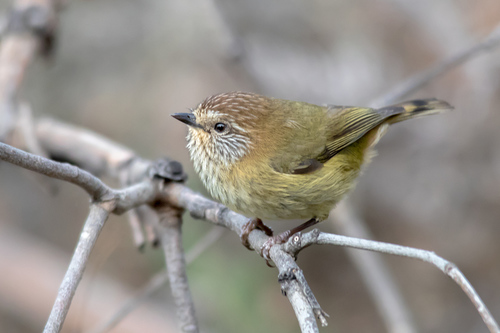
The yellow-rumped thornbill (Acanthiza chrysorrhoa) is a species of passerine bird from the genus Acanthiza. The genus was once placed in the family Pardalotidae but that family was split and it is now in the family Acanthizidae. There are four subspecies of yellow-rumped thornbill. It is a small, brownish bird with a distinctive yellow rump and thin dark bill. It inhabits savannah, scrub and forests across most of Australia and eats insects. The species engages in cooperative breeding.
The yellow-rumped thornbill was described as Saxicola chrysorrhoa by the French naturalists Jean René Constant Quoy and Joseph Paul Gaimard in 1830, from a specimen collected in King George Sound. The specific epithet derives from Ancient Greek khrysos 'gold' and orrhos 'rump'. Four subspecies are recognised: the nominate chrysorrhoa of Western Australia, leachi of Tasmania, leighi of eastern Australia, and normantoni of central and northern Australia. Butterbum is a colloquial name used by Australian birdwatchers.
A 2017 genetic study using both mitochondrial and nuclear DNA found the yellow-rumped thornbill was an early offshoot within the thornbill genus, its ancestor diverging from... Wikipedia →