Brown Thrasher

Brown Thrasher

Toxostoma rufum

Silhouette: Sheatherius · PhyloPic

LCLeast ConcernNTVUENCR
Daily sighting probability <5% · Rare
at New York City

In 3 days ~10% in a week ~30%

5,177 Verified sightings at New York City
4,330 In all 14 parks From 2019 to 2026
September Best month
☀️ Diurnal When it's spotted

About the Brown Thrasher

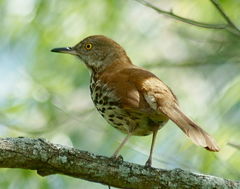
The brown thrasher (Toxostoma rufum), sometimes erroneously called the brown thrush or fox-coloured thrush, is a bird in the family Mimidae, which also includes the New World catbirds and mockingbirds. The brown thrasher is abundant throughout the eastern and central United States and southern and central Canada, and it is the only thrasher to live primarily east of the Rockies and central Texas. It is the state bird of Georgia.

As a member of the genus Toxostoma, the bird is relatively large-sized among the other thrashers. It has brown upper parts with a white under part with dark streaks. Because of this, it is often confused with the smaller wood thrush (Hylocichla mustelina), among other species. The brown thrasher is noted for having over 1,000 song types, and the largest song repertoire of birds. However, each note is usually repeated in two or three phrases.

The brown thrasher is an omnivore, with its diet ranging from insects to fruits and nuts. The usual nesting areas are shrubs, small trees, or at times on ground level. Brown thrashers are generally inconspicuous but territorial birds, especially when defending their nests, and will attack species as large as humans.

��2... Wikipedia →

Sounds

Song0:15

United States · 2026

© Sydney Grant · XC1181409 · CC BY-NC-SA 4.0

Call0:28

United States · 2023

© Bates Estabrooks · XC776518 · CC BY-NC-SA 4.0

Alarm call0:37

United States · 2020

The Nunn Guy · XC584454 · CC0

Global Distribution

Parks Where Found

# Park Country Daily sighting probability
1 Badlands National Park 🇺🇸 United States
~20%
2 Shenandoah National Park 🇺🇸 United States
~10%
3 Point Pelee National Park 🇨🇦 Canada
~10%
4 Great Smoky Mountains National Park 🇺🇸 United States
~10%
5 Congaree National Park 🇺🇸 United States
~10%
6 Everglades National Park 🇺🇸 United States
~10%
7 Merritt Island National Wildlife Refuge 🇺🇸 United States
<5%
8 Big Bend National Park 🇺🇸 United States
<5%
9 Big Cypress National Preserve 🇺🇸 United States
<5%
10 Riding Mountain National Park 🇨🇦 Canada
<5%
11 Death Valley National Park 🇺🇸 United States
<5%
12 Guadalupe Mountains National Park 🇺🇸 United States
<5%
13 Acadia National Park 🇺🇸 United States
<5%
14 Rocky Mountain National Park 🇺🇸 United States
<5%

Cities Where Found

# City Country Daily sighting probability
1 Orlando 🇺🇸 United States
~30%
2 Dallas 🇺🇸 United States
~20%
3 Miami 🇺🇸 United States
~10%
4 Baltimore 🇺🇸 United States
~10%
5 Chicago 🇺🇸 United States
~10%
6 Washington 🇺🇸 United States
~10%
7 New York City 🇺🇸 United States
<5%
8 Minneapolis [Saint Paul] 🇺🇸 United States
<5%
9 Toronto 🇨🇦 Canada
<5%
10 Philadelphia 🇺🇸 United States
<5%

Before you go

What are the chances of seeing a Brown Thrasher in New York City?

Rare

Under 5% of wildlife watchers report a Brown Thrasher sighting in New York City on a given day, based on 5,177 verified sightings from GBIF citizen-science data. It is the 120th most-seen of the 359 birds we can rate there. Over three days the chance rises to about 10%, and over a week to about 30%, if each day is a fresh chance.

When is the best time to see a Brown Thrasher in New York City?

April–May and September–October

In those months about 10% of wildlife watchers report a Brown Thrasher in New York City on a given day, against under 5% in June–August and November–March, the lowest months.

What time of day is best to see a Brown Thrasher?

Between 8 and 11 am

Across all the parks we cover, that three-hour window holds the most Brown Thrasher sightings with a recorded time, and about 9 in 10 of them come between 6 am and 6 pm: it is a daytime animal.

Is New York City the best place to see a Brown Thrasher?

7th of 18

Of the 18 cities where we can rate Brown Thrasher sightings, New York City ranks 7th at under 5%. The best odds are in Orlando (United States, about 30%), Dallas (United States, about 20%) and Miami (United States, about 10%).

Which relatives of the Brown Thrasher live in New York City?

Same family: Mimidae

The closest relatives of the Brown Thrasher that you can see in New York City (family Mimidae, Mockingbirds and Thrashers) are Northern Mockingbird (about 40%) and Gray Catbird (about 40%), with each one's daily chance of a sighting.

Where does the Brown Thrasher sighting chance come from?

GBIF citizen-science records

It is estimated from how often the Brown Thrasher is recorded against all the birds logged in New York City (5,177 verified sightings), calibrated against known sighting rates. Figures are rounded to the nearest 10% because citizen-science data supports honest approximations, not decimals, and months with records from fewer than five people show "—". How it works.

← Back to New York City