Northern Mockingbird

Northern Mockingbird

Mimus polyglottos

Silhouette: Andy Wilson · PhyloPic

LCLeast ConcernNTVUENCR
Daily sighting probability ~40% · Likely
at New York City

In 3 days ~80% in a week >90%

67,809 Verified sightings at New York City
33,030 In all 29 parks From 2019 to 2026
July Best month
☀️ Diurnal When it's spotted

About the Northern Mockingbird

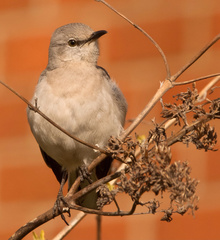
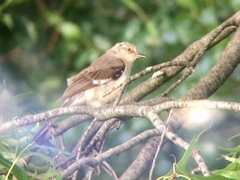
The northern mockingbird (Mimus polyglottos) is a mockingbird commonly found in North America, of the family Mimidae. The species is also found in some parts of the Caribbean, as well as on the Hawaiian Islands. It is typically a permanent resident across much of its range, but northern mockingbirds may move farther south during inclement weather or prior to the onset of winter. The northern mockingbird has gray to brown upper feathers and a paler belly. Its tail and wings have white patches which are visible in flight.

The species is known for its ability to mimic bird calls and other types of sound, including artificial and electronic noises. Studies have shown its ability to identify individual humans and treat them differently based on learned threat assessments. It is an omnivore and consumes fruit, invertebrates, and small vertebrates. It is often found in open areas, open woodlands and forest edges, and is quite common in urbanized areas. The species breeds from southeastern Canada throughout the United States to the Greater Antilles. It is listed as a species of least concern by the International Union for Conservation of Nature.

The mockingbird is influential in United States culture, being the state bird of five states, appearing in book titles, songs and lullabies, and making other appearances in popular culture. Wikipedia →

Sounds

Call0:54

Mexico · 2026

© Manuel Grosselet · XC1176764 · CC BY-NC-SA 4.0

Song0:39

Mexico · 2026

© Manuel Grosselet - Eva Lepiz · XC1084110 · CC BY-NC-SA 4.0

Alarm call0:37

Cuba · 2025

© FREDERIC Lionel · XC997265 · CC BY-NC-SA 4.0

Global Distribution

Parks Where Found

# Park Country Daily sighting probability
1 Los Haitises National Park 🇩🇴 Dominican Republic
~70%
2 Everglades National Park 🇺🇸 United States
~70%
3 Big Bend National Park 🇺🇸 United States
~60%
4 Cabo Pulmo National Park 🇲🇽 Mexico
~60%
5 Bahía de Loreto National Park 🇲🇽 Mexico
~60%
6 Big Cypress National Preserve 🇺🇸 United States
~50%
7 El Vizcaíno Biosphere Reserve 🇲🇽 Mexico
~40%
8 Joshua Tree National Park 🇺🇸 United States
~40%
9 Merritt Island National Wildlife Refuge 🇺🇸 United States
~40%
10 Guadalupe Mountains National Park 🇺🇸 United States
~40%
11 Ciénaga de Zapata 🇨🇺 Cuba
~40%
12 Jaragua National Park 🇩🇴 Dominican Republic
~30%
13 Channel Islands National Park 🇺🇸 United States
~30%
14 Saguaro National Park 🇺🇸 United States
~30%
15 Death Valley National Park 🇺🇸 United States
~20%
16 Blue and John Crow Mountains National Park 🇯🇲 Jamaica
~20%
17 Shenandoah National Park 🇺🇸 United States
~10%
18 Congaree National Park 🇺🇸 United States
~10%
19 Great Smoky Mountains National Park 🇺🇸 United States
~10%
20 Cumbres de Monterrey National Park 🇲🇽 Mexico
~10%
21 Point Pelee National Park 🇨🇦 Canada
<5%
22 Zion National Park 🇺🇸 United States
<5%
23 Padre Island National Seashore 🇺🇸 United States
<5%
24 Grand Canyon National Park 🇺🇸 United States
<5%
25 Sequoia and Kings Canyon National Parks 🇺🇸 United States
<5%
26 Acadia National Park 🇺🇸 United States
<5%
27 Olympic National Park 🇺🇸 United States
<5%
28 Yosemite National Park 🇺🇸 United States
<5%
29 Rocky Mountain National Park 🇺🇸 United States
<5%

Cities Where Found

# City Country Daily sighting probability
1 Santo Domingo 🇩🇴 Dominican Republic
~80%
2 Las Vegas 🇺🇸 United States
~80%
3 Mesa 🇺🇸 United States
~80%
4 Phoenix 🇺🇸 United States
~80%
5 Miami 🇺🇸 United States
~80%
6 San Antonio 🇺🇸 United States
~80%
7 Austin 🇺🇸 United States
~70%
8 Havana 🇨🇺 Cuba
~70%
9 Houston 🇺🇸 United States
~70%
10 Orlando 🇺🇸 United States
~60%

Zoos & Centres Where Found

# Zoo / Centre Country
1 Busch Gardens Williamsburg 🇺🇸 United States In captivity

Before you go

What are the chances of seeing a Northern Mockingbird in New York City?

Likely

About 40% of wildlife watchers report a Northern Mockingbird sighting in New York City on a given day, based on 67,809 verified sightings from GBIF citizen-science data. It is the 15th most-seen of the 359 birds we can rate there. Over three days the chance rises to about 80%, and over a week to over 90%, if each day is a fresh chance.

When is the best time to see a Northern Mockingbird in New York City?

June–August and October–December

In those months about 50% of wildlife watchers report a Northern Mockingbird in New York City on a given day, against about 40% in January–May and September, the lowest months.

What time of day is best to see a Northern Mockingbird?

Between 7 and 10 am

Across all the parks we cover, that three-hour window holds the most Northern Mockingbird sightings with a recorded time, and about 8 in 10 of them come between 6 am and 6 pm: it is a daytime animal.

Is New York City the best place to see a Northern Mockingbird?

15th of 39

Of the 39 cities where we can rate Northern Mockingbird sightings, New York City ranks 15th at about 40%. The best odds are in Santo Domingo (Dominican Republic, about 80%), Las Vegas (United States, about 80%) and Mesa (United States, about 80%).

Where does the Northern Mockingbird sighting chance come from?

GBIF citizen-science records

It is estimated from how often the Northern Mockingbird is recorded against all the birds logged in New York City (67,809 verified sightings), calibrated against known sighting rates. Figures are rounded to the nearest 10% because citizen-science data supports honest approximations, not decimals, and months with records from fewer than five people show "—". How it works.

← Back to New York City