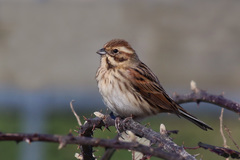
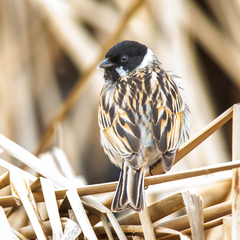
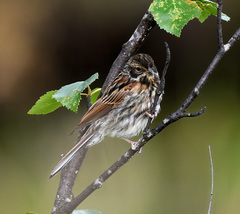
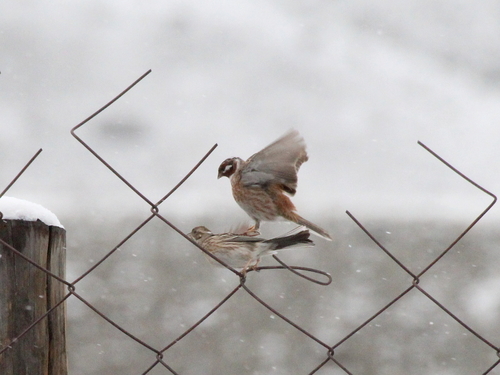
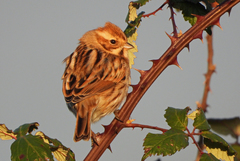
Reed Bunting

Reed Bunting

Emberiza schoeniclus

Silhouette: Zeynel Cebeci · PhyloPic

LCLeast ConcernNTVUENCR
Daily sighting probability ~20% · Possible
at Novosibirsk

In 3 days ~40% in a week ~70%

58 Verified sightings at Novosibirsk
5,061 In all 14 parks From 2019 to 2026
September Best month
☀️ Diurnal When it's spotted

About the Reed Bunting

The common reed bunting (Emberiza schoeniclus), or simply reed bunting, is a passerine bird in the bunting family Emberizidae. This species breeds throughout Europe and much of the Palearctic region. While most individuals migrate south in winter, those in the milder south and west of the range are resident. It is a common sight in reedbeds, but also breeds in drier open areas such as moorland and arable land. For example, it inhabits purple moor grass and rush pastures, which are designated as a Biodiversity Action Plan habitat in the UK. It occurs on poorly drained neutral and acid soils of the lowlands and upland fringe.

The common reed bunting was described by the Swedish naturalist Carl Linnaeus in 1758 in the tenth edition of his Systema Naturae under the binomial name Fringilla schoeniclus. This bunting is now placed in the genus Emberiza that Linnaeus had introduced in the same edition of his Systema Naturae. The genus name Emberiza is from Old German Embritz, a bunting. The specific epithet schoeniclus is from the Ancient Greek skhoiniklos, a word that was used by Greek authors for an unidentified bird. Linnaeus specified the type locality as Europe but this... Wikipedia →

Sounds

Call0:23

Norway · 2026

© Teet Sirotkin · XC1157224 · CC BY-SA 4.0

Song1:26

Sweden · 2026

© Lars Edenius · XC1097172 · CC BY-NC-SA 4.0

Flight call1:04

Mongolia · 2022

© Stanislas Wroza · XC765516 · CC BY-NC-SA 4.0

Global Distribution

Parks Where Found

# Park Country Daily sighting probability
1 Biebrza National Park 🇵🇱 Poland
~60%
2 Kiskunság National Park 🇭🇺 Hungary
~40%
3 Hortobágy National Park 🇭🇺 Hungary
~40%
4 Białowieża National Park 🇵🇱 Poland
~30%
5 Fertő-Hanság National Park 🇭🇺 Hungary
~30%
6 Wadden Sea National Park 🇩🇪 Germany
~20%
7 Snowdonia National Park 🇬🇧 United Kingdom
~10%
8 Camargue 🇫🇷 France
~10%
9 Bavarian Forest National Park 🇩🇪 Germany
~10%
10 Cairngorms National Park 🇬🇧 United Kingdom
~10%
11 Monfragüe National Park 🇪🇸 Spain
<5%
12 Sierra Nevada National Park 🇪🇸 Spain
<5%
13 Gauja National Park 🇱🇻 Latvia
<5%
14 Doñana National Park 🇪🇸 Spain
<5%

Cities Where Found

# City Country Daily sighting probability
1 Helsinki 🇫🇮 Finland
~30%
2 Manchester 🇬🇧 United Kingdom
~30%
3 Liverpool 🇬🇧 United Kingdom
~20%
4 Novosibirsk 🇷🇺 Russia
~20%
5 Birmingham 🇬🇧 United Kingdom
~10%
6 Milan 🇮🇹 Italy
~10%
7 Minsk 🇧🇾 Belarus
~10%
8 Saint Petersburg 🇷🇺 Russia
~10%
9 London 🇬🇧 United Kingdom
~10%
10 Bucharest 🇷🇴 Romania
~10%

Zoos & Centres Where Found

# Zoo / Centre Country
1 Dresden Zoo 🇩🇪 Germany In captivity
2 Ogród Zoologiczny w Katowicach 🇵🇱 Poland In captivity

Before you go

What are the chances of seeing a Reed Bunting in Novosibirsk?

Possible

About 20% of wildlife watchers report a Reed Bunting sighting in Novosibirsk on a given day, based on 58 verified sightings from GBIF citizen-science data. It is the 38th most-seen of the 123 birds we can rate there. Over three days the chance rises to about 40%, and over a week to about 70%, if each day is a fresh chance.

When is the best time to see a Reed Bunting in Novosibirsk?

September

In that month about 40% of wildlife watchers report a Reed Bunting in Novosibirsk on a given day, against under 5% in July and November–March, the lowest months.

What time of day is best to see a Reed Bunting?

Between 7 and 10 am

Across all the parks we cover, that three-hour window holds the most Reed Bunting sightings with a recorded time, and about 9 in 10 of them come between 6 am and 6 pm: it is a daytime animal.

Is Novosibirsk the best place to see a Reed Bunting?

4th of 49

Of the 49 cities where we can rate Reed Bunting sightings, Novosibirsk ranks 4th at about 20%. The best odds are in Helsinki (Finland, about 30%), Manchester (United Kingdom, about 30%) and Liverpool (United Kingdom, about 20%).

Which relatives of the Reed Bunting live in Novosibirsk?

Same genus: Emberiza

The closest relatives of the Reed Bunting that you can see in Novosibirsk (genus Emberiza, Old World Buntings) are Little Bunting (about 10%), Pine Bunting (about 10%) and Pallas's Bunting (about 10%), with each one's daily chance of a sighting.

Where does the Reed Bunting sighting chance come from?

GBIF citizen-science records

It is estimated from how often the Reed Bunting is recorded against all the birds logged in Novosibirsk (58 verified sightings), calibrated against known sighting rates. Figures are rounded to the nearest 10% because citizen-science data supports honest approximations, not decimals, and months with records from fewer than five people show "—". How it works.

← Back to Novosibirsk