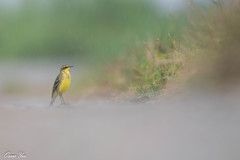
Eastern Yellow Wagtail

Eastern Yellow Wagtail

Motacilla tschutschensis

Silhouette: Martin Bulla, based on Ren Hathway's illustration · PhyloPic

LCLeast ConcernNTVUENCR
Daily sighting probability ~40% · Likely
at Quanzhou

In 3 days ~70% in a week >90%

23 Verified sightings at Quanzhou
799 In all 13 parks From 2019 to 2026
April Best month
☀️ Diurnal When it's spotted

About the Eastern Yellow Wagtail

The eastern yellow wagtail (Motacilla tschutschensis) is a small passerine in the wagtail family Motacillidae, which also includes the pipits and longclaws. It was formerly usually classified as a subspecies of the western yellow wagtail, but was split from it in 2003 when genetic data showed this classification to be paraphyletic with respect to the citrine wagtail. It breeds in the eastern Palearctic and Alaska and migrates to South Asia and Australia.

The eastern yellow wagtail was formally described in 1789 by the German naturalist Johann Friedrich Gmelin in his revised and expanded edition of Carl Linnaeus's Systema Naturae. He placed it with the wagtails in the genus Motacilla and coined the binomial name Motacilla tschutschensis. The specific epithet tschutschensis is from the locality, the Chukchi Peninsula is eastern Russia. Gmelin based his account on the "Tchutschi wagtail" that had been described by John Latham in 1783 and by Thomas Pennant in 1785. In his description Pennant wrote "Taken off the Tchutschi coat, with the Streights of Bering, Lat. 66, north". This is almost certainly the bird captured in 1778 during James Cook's third voyage to the Pacific... Wikipedia →

Sounds

Call0:28

Mongolia · 2026

© Ding Li Yong · XC1138310 · CC BY-NC-ND 4.0

Flight call0:12

Malaysia · 2026

© Lim Ying Hien 林勇贤 · XC1071358 · CC BY-NC-ND 4.0

Song1:20

Mongolia · 2005

© Geoff Carey · XC729721 · CC BY-NC-SA 4.0

Global Distribution

Parks Where Found

# Park Country Daily sighting probability
1 Kaziranga National Park 🇮🇳 India
~30%
2 Gobi Gurvansaikhan National Park 🇲🇳 Mongolia
~10%
3 Sundarbans National Park 🇮🇳 India
~10%
4 Raja Ampat 🇮🇩 Indonesia
<5%
5 Udawalawe National Park 🇱🇰 Sri Lanka
<5%
6 Manas National Park 🇮🇳 India
<5%
7 Kaeng Krachan National Park 🇹🇭 Thailand
<5%
8 Kinabalu Park 🇲🇾 Malaysia
<5%
9 Taroko National Park 🇹🇼 Taiwan
<5%
10 Nagarhole National Park 🇮🇳 India
<5%
11 Kinabatangan Wildlife Sanctuary 🇲🇾 Malaysia
<5%
12 Khao Yai National Park 🇹🇭 Thailand
<5%
13 Doi Inthanon National Park 🇹🇭 Thailand
<5%

Cities Where Found

# City Country Daily sighting probability
1 Quanzhou 🇨🇳 China
~40%
2 Taipei 🇹🇼 Taiwan
~30%
3 Taichung 🇹🇼 Taiwan
~20%
4 Tamluk 🇮🇳 India
~10%
5 Tuen Mun 🇨🇳 China
~10%
6 Kolkata 🇮🇳 India
~10%
7 Kaohsiung 🇹🇼 Taiwan
~10%
8 Novosibirsk 🇷🇺 Russia
~10%
9 Fuzhou 🇨🇳 China
~10%
10 Xiuying District 🇨🇳 China
~10%

Before you go

What are the chances of seeing an Eastern Yellow Wagtail in Quanzhou?

Likely

About 40% of wildlife watchers report an Eastern Yellow Wagtail sighting in Quanzhou on a given day, based on 23 verified sightings from GBIF citizen-science data. It is the 27th most-seen of the 85 birds we can rate there. Over three days the chance rises to about 70%, and over a week to over 90%, if each day is a fresh chance.

When is the best time to see an Eastern Yellow Wagtail in Quanzhou?

April

In that month about 60% of wildlife watchers report an Eastern Yellow Wagtail in Quanzhou on a given day, against about 20% in July and November, the lowest months. June, August and October have too few records to rate.

What time of day is best to see an Eastern Yellow Wagtail?

Between 7 and 10 am

Across all the parks we cover, that three-hour window holds the most Eastern Yellow Wagtail sightings with a recorded time, and about 8 in 10 of them come between 6 am and 6 pm: it is a daytime animal.

Is Quanzhou the best place to see an Eastern Yellow Wagtail?

Yes

Of the 36 cities where we can rate Eastern Yellow Wagtail sightings, Quanzhou has the highest daily chance: about 40%. Next come Taipei (Taiwan, about 30%) and Taichung (Taiwan, about 20%).

Where does the Eastern Yellow Wagtail sighting chance come from?

GBIF citizen-science records

It is estimated from how often the Eastern Yellow Wagtail is recorded against all the birds logged in Quanzhou (23 verified sightings), calibrated against known sighting rates. Figures are rounded to the nearest 10% because citizen-science data supports honest approximations, not decimals, and months with records from fewer than five people show "—". How it works.

← Back to Quanzhou