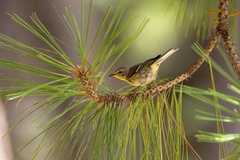
About the Grace's Warbler
Grace's warbler (Setophaga graciae) is a small New World warbler that specializes in pine woods. Grace's warbler was discovered by Elliott Coues in the Rocky Mountains in 1864. He requested that the new species be named after his 18-year-old sister, Grace Darling Coues, and his request was honored when Spencer Fullerton Baird described the species scientifically in 1865.
Grace's warbler is a small bird, 11–13 cm long. It is mostly gray on top, with broken black streaks across the back and flanks and two white bars on the wings. The throat and breast are a vibrant yellow, and the rest of the underparts are white. It has a yellow half-eye ring under the eye and a long yellow "eyebrow" stripe that starts at the base of the beak and runs above the eye, fading to white after it passes the eye.
Grace's warblers breed from the south-western United States to Nicaragua and winter in their breeding range from north-eastern Sinaloa and north-western Durango south. They are almost always found in pine forests, even in migration, though at the northern end of their range (in southern Nevada and Utah and southwestern Colorado) they... Wikipedia →