Least Tern

Least Tern

Sternula antillarum

Silhouette: Sheatherius · PhyloPic

LCLeast ConcernNTVUENCR
Daily sighting probability <5% · Rare
at San Francisco

In 3 days <5% in a week ~10%

1,076 Verified sightings at San Francisco
2,497 In all 17 parks From 2019 to 2026
July Best month
☀️ Diurnal When it's spotted

About the Least Tern

The least tern (Sternula antillarum) is a species of tern that breeds in North America and locally in northern South America. It is closely related to, and was formerly often considered conspecific with, the little tern of the Old World. Other close relatives include the yellow-billed tern and Peruvian tern, both from South America.

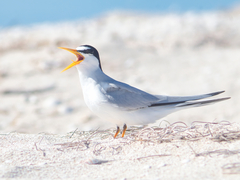
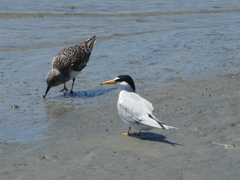
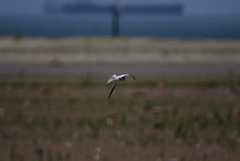
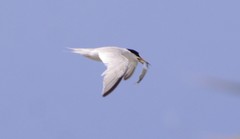
It is a small tern, 22–24 cm (8.7–9.4 in) long, with a wingspan of 50 cm (20 in), and weighing 39–52 g (1.4–1.8 oz). The upper parts are a fairly uniform pale gray, and the underparts white. The head is white, with a black cap and line through the eye to the base of the bill, and a small white forehead patch above the bill; in winter, the white forehead is more extensive, with a smaller and less sharply defined black cap. The bill is yellow with a small black tip in summer, all blackish in winter. The legs are yellowish. The wings are mostly pale gray, but with conspicuous black markings on their outermost primaries. It flies over water with fast, jerky wingbeats and a distinctive hunchback appearance, with the bill pointing slightly downward.

It is migratory, wintering in Central America, the Caribbean and northern South America. Many spend their whole first year in their wintering area. It has occurred as a vagrant to Europe, with one record in Great Britain and one in Ireland.

It differs from the little tern mainly in that its rump and tail are gray, not white, and it has a different, more squeaking call; from the yellow-billed tern in being paler gray above and having a black tip to the bill; and from the Peruvian tern in being paler gray above and white (not pale gray) below and having a shorter black tip to the bill. Wikipedia →

Sounds

Call0:49

United States · 2025

© Paul Driver · XC1027108 · CC BY-NC-SA 4.0

Flight call0:08

Ireland · 2022

© Paul Kelly · XC741197 · CC BY-NC-SA 4.0

Alarm call0:26

Netherlands · 2021

© Joost van Bruggen · XC669354 · CC BY-NC-ND 4.0

Global Distribution

Parks Where Found

# Park Country Daily sighting probability
1 Padre Island National Seashore 🇺🇸 United States
~30%
2 Jaragua National Park 🇩🇴 Dominican Republic
~10%
3 Ría Lagartos Biosphere Reserve 🇲🇽 Mexico
~10%
4 Channel Islands National Park 🇺🇸 United States
~10%
5 Celestún Biosphere Reserve 🇲🇽 Mexico
~10%
6 Arrecifes de Cozumel National Park 🇲🇽 Mexico
~10%
7 El Vizcaíno Biosphere Reserve 🇲🇽 Mexico
<5%
8 Merritt Island National Wildlife Refuge 🇺🇸 United States
<5%
9 Everglades National Park 🇺🇸 United States
<5%
10 Sian Ka'an Biosphere Reserve 🇲🇽 Mexico
<5%
11 Cabo Blanco Absolute Nature Reserve 🇨🇷 Costa Rica
<5%
12 Ciénaga de Zapata 🇨🇺 Cuba
<5%
13 Tayrona National Natural Park 🇨🇴 Colombia
<5%
14 Big Cypress National Preserve 🇺🇸 United States
<5%
15 Bastimentos Island National Marine Park 🇵🇦 Panama
<5%
16 La Amistad International Park (Panama) 🇵🇦 Panama
<5%
17 Carara National Park 🇨🇷 Costa Rica
<5%

Cities Where Found

# City Country Daily sighting probability
1 Miami 🇺🇸 United States
<5%
2 Baltimore 🇺🇸 United States
<5%
3 Los Angeles 🇺🇸 United States
<5%
4 San Diego 🇺🇸 United States
<5%
5 Mexico City 🇲🇽 México
<5%
6 Barranquilla 🇨🇴 Colombia
<5%
7 New York City 🇺🇸 United States
<5%
8 Boston 🇺🇸 United States
<5%
9 Dallas 🇺🇸 United States
<5%
10 San Francisco 🇺🇸 United States
<5%

Zoos & Centres Where Found

# Zoo / Centre Country
1 Key West Butterfly and Nature Conservatory 🇺🇸 United States In captivity

Before you go

What are the chances of seeing a Least Tern in San Francisco?

Rare

Under 5% of wildlife watchers report a Least Tern sighting in San Francisco on a given day, based on 1,076 verified sightings from GBIF citizen-science data. It is the 194th most-seen of the 375 birds we can rate there. Over three days the chance rises to under 5%, and over a week to about 10%, if each day is a fresh chance.

When is the best time to see a Least Tern in San Francisco?

July

In that month about 10% of wildlife watchers report a Least Tern in San Francisco on a given day, against under 5% in August to June, the lowest months. That is one of San Francisco's driest months, with almost no rain against 110 mm in December.

What time of day is best to see a Least Tern?

Between 7 and 10 am

Across all the parks we cover, that three-hour window holds the most Least Tern sightings with a recorded time, and about 9 in 10 of them come between 6 am and 6 pm: it is a daytime animal.

Is San Francisco the best place to see a Least Tern?

Among the best

Of the 14 cities where we can rate Least Tern sightings, San Francisco ranks 10th at under 5%, level with the leaders once rounded. The best odds are in Miami (United States, under 5%), Baltimore (United States, under 5%) and Los Angeles (United States, under 5%).

Which relatives of the Least Tern live in San Francisco?

Same family: Laridae

The closest relatives of the Least Tern that you can see in San Francisco (family Laridae, Gulls, Terns, and Skimmers) are California Gull (about 40%), Western Gull (about 30%) and Ring-billed Gull (about 20%), with each one's daily chance of a sighting.

Where does the Least Tern sighting chance come from?

GBIF citizen-science records

It is estimated from how often the Least Tern is recorded against all the birds logged in San Francisco (1,076 verified sightings), calibrated against known sighting rates. Figures are rounded to the nearest 10% because citizen-science data supports honest approximations, not decimals, and months with records from fewer than five people show "—". How it works.

← Back to San Francisco