
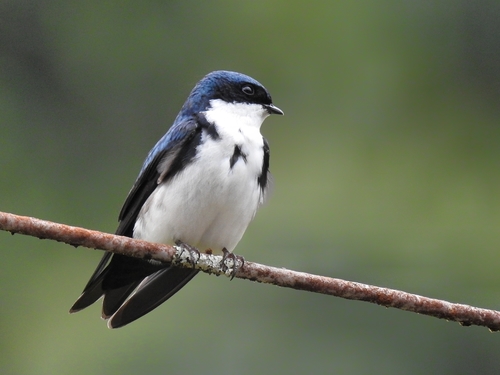
White-Throated Magpie-Jay

White-Throated Magpie-Jay

Calocitta formosa

Silhouette: Peileppe · PhyloPic

Daily sighting probability <5% · Rare
at San José

In 3 days <5%

91 Verified sightings at San José
7,714 In all 15 parks From 2019 to 2026
February Best month
☀️ Diurnal When it's spotted

About the White-Throated Magpie-Jay

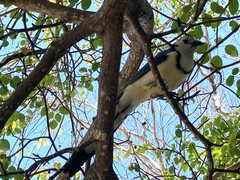
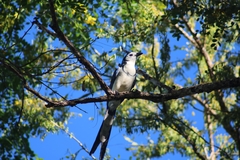
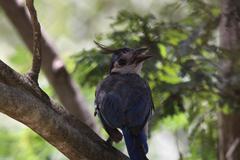
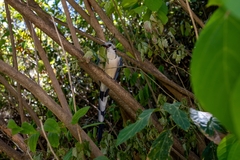
The white-throated magpie-jay (Cyanocorax formosus) is a large Central American species of magpie-jay. It ranges in Pacific-slope thorn forest from Jalisco, Mexico, to Northern Puntarenas, Costa Rica. Magpie-jays are noisy, gregarious birds, often traveling in easy-to-find flocks, mobbing their observers.

The white-throated magpie-jay was formally described in 1827 by the English naturalist William Swainson from a specimen that had been collected by the naturalist William Bullock in Temascaltepec, Mexico. Swainson coined the binomial name Pica formosa. The specific epithet is from the Latin formosus meaning "beautiful". The white-throated magpie-jay and the black-throated magpie-jay were formerly placed in their own genus Calocitta. When molecular phylogenetic studies found that the genus Cyanocorax was paraphyletic relative to Calocitta, the two species were subsumed into Cyanocorax to resolve the paraphyly. Wikipedia →

Sounds

Call0:13

Costa Rica · 2017

© Albert Lastukhin · XC1094587 · CC BY-NC-ND 4.0

Alarm call0:27

Guatemala · 2024

© Leander Khil · XC957965 · CC BY-NC-SA 4.0

Aberrant0:23

Mexico · 2021

© Manuel Grosselet · XC691919 · CC BY-NC-SA 4.0

Global Distribution

Parks Where Found

# Park Country Daily sighting probability
1 Rincón de la Vieja National Park 🇨🇷 Costa Rica
~70%
2 Santa Rosa National Park 🇨🇷 Costa Rica
~50%
3 Cabo Blanco Absolute Nature Reserve 🇨🇷 Costa Rica
~40%
4 Las Baulas Marine National Park 🇨🇷 Costa Rica
~30%
5 Ostional Wildlife Refuge 🇨🇷 Costa Rica
~30%
6 Cañón del Sumidero National Park 🇲🇽 Mexico
~30%
7 Masaya Volcano National Park 🇳🇮 Nicaragua
~20%
8 Palo Verde National Park 🇨🇷 Costa Rica
~20%
9 El Triunfo 🇲🇽 Mexico
~10%
10 Carara National Park 🇨🇷 Costa Rica
~10%
11 Tenorio Volcano National Park 🇨🇷 Costa Rica
~10%
12 Tapantí-Macizo de la Muerte National Park 🇨🇷 Costa Rica
~10%
13 Arenal Volcano National Park 🇨🇷 Costa Rica
~10%
14 Monteverde Cloud Forest Reserve 🇨🇷 Costa Rica
~10%
15 La Tigra National Park 🇭🇳 Honduras
<5%

Cities Where Found

# City Country Daily sighting probability
1 San Salvador 🇸🇻 El Salvador
~20%
2 Managua 🇳🇮 Nicaragua
~10%
3 Tegucigalpa 🇭🇳 Honduras
<5%
4 Guadalajara 🇲🇽 México
<5%
5 San José 🇨🇷 Costa Rica
<5%

Zoos & Centres Where Found

# Zoo / Centre Country
1 Guadalajara Zoo 🇲🇽 Mexico In captivity
2 Lisbon Zoo 🇵🇹 Portugal In captivity
3 San Antonio Zoo 🇺🇸 United States In captivity
4 Chapultepec Zoo 🇲🇽 Mexico In captivity
5 Zoológico Thomas Belt 🇳🇮 Nicaragua In captivity
6 Tracy Aviary 🇺🇸 United States In captivity
7 Zoológico Miguél Álvarez del Toro 🇲🇽 Mexico In captivity

Before you go

What are the chances of seeing a White-Throated Magpie-Jay in San José?

Rare

Under 5% of wildlife watchers report a White-Throated Magpie-Jay sighting in San José on a given day, based on 91 verified sightings from GBIF citizen-science data. It is the 229th most-seen of the 379 birds we can rate there. Over three days the chance rises to under 5%, if each day is a fresh chance.

When is the best time to see a White-Throated Magpie-Jay in San José?

Any time of year

In every month with enough records, under 5% of wildlife watchers report a White-Throated Magpie-Jay in San José on a given day, so our monthly data shows no clear season.

What time of day is best to see a White-Throated Magpie-Jay?

Between 6 and 9 am

Across all the parks we cover, that three-hour window holds the most White-Throated Magpie-Jay sightings with a recorded time, and about 9 in 10 of them come between 6 am and 6 pm: it is a daytime animal.

Is San José the best place to see a White-Throated Magpie-Jay?

5th of 5

Of the 5 cities where we can rate White-Throated Magpie-Jay sightings, San José ranks 5th at under 5%. The best odds are in San Salvador (El Salvador, about 20%), Managua (Nicaragua, about 10%) and Tegucigalpa (Honduras, under 5%).

Where does the White-Throated Magpie-Jay sighting chance come from?

GBIF citizen-science records

It is estimated from how often the White-Throated Magpie-Jay is recorded against all the birds logged in San José (91 verified sightings), calibrated against known sighting rates. Figures are rounded to the nearest 10% because citizen-science data supports honest approximations, not decimals, and months with records from fewer than five people show "—". How it works.

← Back to San José