Variegated Fritillary

Variegated Fritillary

Euptoieta claudia

Daily sighting probability ~10% · With luck
at San Luis Potosí

In 3 days ~20% in a week ~40%

7 Verified sightings at San Luis Potosí
787 In all 16 parks From 2019 to 2026
July Best month
☀️ Diurnal When it's spotted

About the Variegated Fritillary

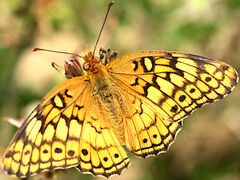
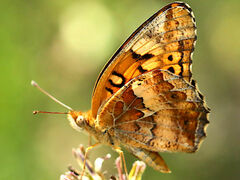
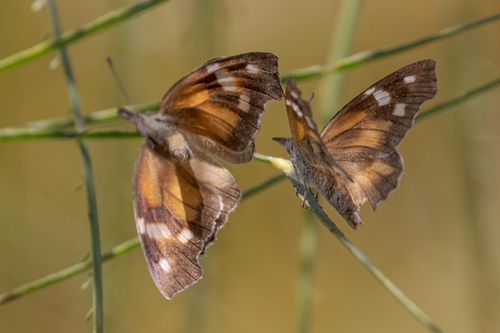
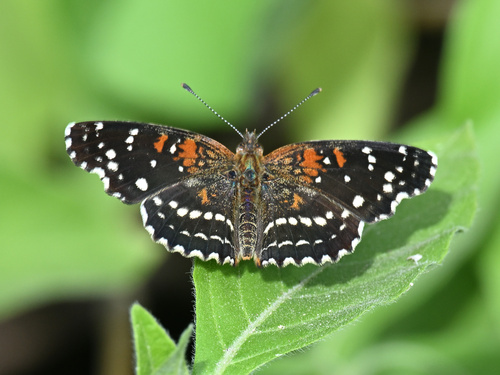
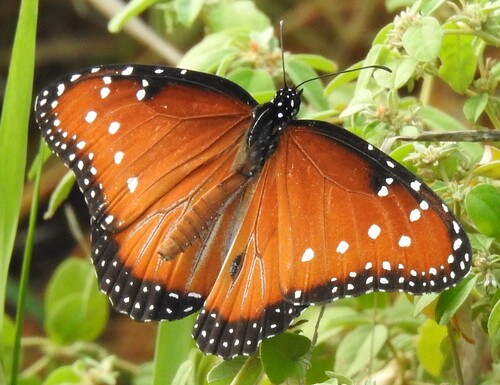
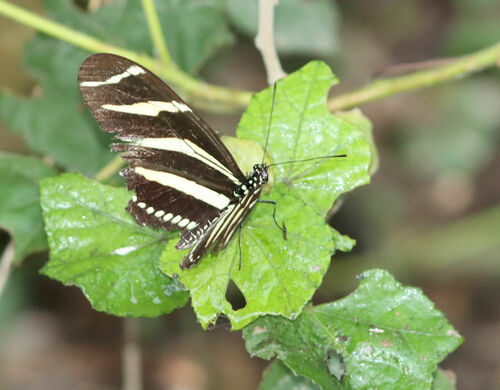
Euptoieta claudia, the variegated fritillary, is a North and South American butterfly in the family Nymphalidae. Though the variegated fritillary has some very different characteristics from the Speyeria fritillaries, it is still closely related to them. Some of the differences include variegated fritillaries have two or three broods per year vs. one per year in Speyeria; they are nomadic vs. sedentary; and they use a wide range of host plants vs. just violets. And because of their use of passionflowers as a host plant, variegated fritillaries also have taxonomic links to the heliconians. Their flight is low and swift, but even when resting or nectaring, this species is extremely difficult to approach, so its genus name was taken from the Greek word euptoietos meaning "easily scared".

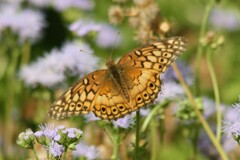
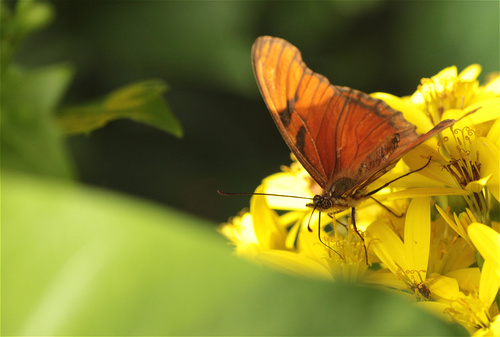
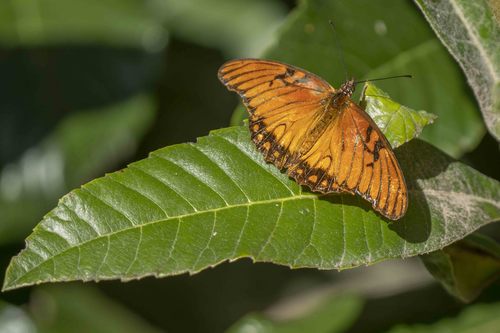
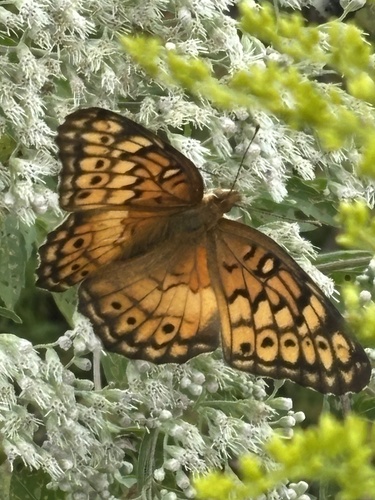
The upperside of the wings is checkered with orange and black. Both the forewing and hindwing have a row of submarginal black spots and black median lines running across the wings. The underside of the forewing is orange with a pale orange spot rimmed in black in the forewing cell. The underside of the hindwing is mottled with browns and grays with a pale postmedian band. There is no... Wikipedia →

Global Distribution

Parks Where Found

# Park Country Daily sighting probability
1 Guadalupe Mountains National Park 🇺🇸 United States
~30%
2 Badlands National Park 🇺🇸 United States
~30%
3 Big Bend National Park 🇺🇸 United States
~20%
4 Congaree National Park 🇺🇸 United States
~20%
5 Padre Island National Seashore 🇺🇸 United States
~20%
6 Great Smoky Mountains National Park 🇺🇸 United States
~20%
7 Grand Canyon National Park 🇺🇸 United States
~10%
8 Shenandoah National Park 🇺🇸 United States
~10%
9 Rocky Mountain National Park 🇺🇸 United States
~10%
10 Cumbres de Monterrey National Park 🇲🇽 Mexico
~10%
11 Saguaro National Park 🇺🇸 United States
~10%
12 Zion National Park 🇺🇸 United States
~10%
13 Big Cypress National Preserve 🇺🇸 United States
~10%
14 Yellowstone National Park 🇺🇸 United States
~10%
15 Everglades National Park 🇺🇸 United States
~10%
16 Banff National Park 🇨🇦 Canada
~10%

Cities Where Found

# City Country Daily sighting probability
1 San Antonio 🇺🇸 United States
~20%
2 Dallas 🇺🇸 United States
~20%
3 Ciudad Juárez 🇲🇽 México
~20%
4 Austin 🇺🇸 United States
~10%
5 Baltimore 🇺🇸 United States
~10%
6 Washington 🇺🇸 United States
~10%
7 Denver 🇺🇸 United States
~10%
8 Philadelphia 🇺🇸 United States
~10%
9 Monterrey 🇲🇽 México
~10%
10 Houston 🇺🇸 United States
~10%

Before you go

What are the chances of seeing a Variegated Fritillary in San Luis Potosí?

With luck

About 10% of wildlife watchers report a Variegated Fritillary sighting in San Luis Potosí on a given day, based on 7 verified sightings from GBIF citizen-science data. It is the 58th most-seen of the 91 insects we can rate there. Over three days the chance rises to about 20%, and over a week to about 40%, if each day is a fresh chance.

When is the best time to see a Variegated Fritillary in San Luis Potosí?

January, July and September–October

In those months about 10% of wildlife watchers report a Variegated Fritillary in San Luis Potosí on a given day, against under 5% in February–June, August and November–December, the lowest months. Those are among San Luis Potosí's wettest months, with about 60 mm of rain a month against 5 mm in April.

What time of day is best to see a Variegated Fritillary?

Between 10 am and 1 pm

Across all the parks we cover, that three-hour window holds the most Variegated Fritillary sightings with a recorded time, and nearly all of them come between 6 am and 6 pm: it is a daytime animal.

Is San Luis Potosí the best place to see a Variegated Fritillary?

11th of 25

Of the 25 cities where we can rate Variegated Fritillary sightings, San Luis Potosí ranks 11th at about 10%. The best odds are in San Antonio (United States, about 20%), Dallas (United States, about 20%) and Ciudad Juárez (México, about 20%).

Which relatives of the Variegated Fritillary live in San Luis Potosí?

Same family: Nymphalidae

The closest relatives of the Variegated Fritillary that you can see in San Luis Potosí (family Nymphalidae, Brush-footed Butterflies) are Monarch (about 40%), Juno Silverspot (about 20%) and American Snout (about 20%), with each one's daily chance of a sighting.

Where does the Variegated Fritillary sighting chance come from?

GBIF citizen-science records

It is estimated from how often the Variegated Fritillary is recorded against all the insects logged in San Luis Potosí (7 verified sightings), calibrated against known sighting rates. Figures are rounded to the nearest 10% because citizen-science data supports honest approximations, not decimals, and months with records from fewer than five people show "—". How it works.
← Back to San Luis Potosí