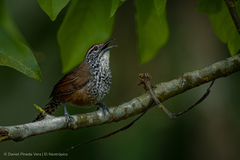
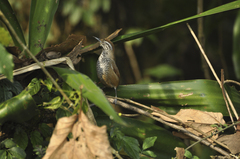
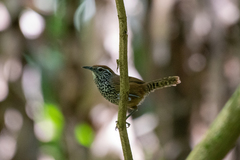

Spot-breasted Wren

Spot-breasted Wren

Pheugopedius maculipectus

Silhouette: Matt Wilkins · PhyloPic

LCLeast ConcernNTVUENCR
Daily sighting probability ~10% · With luck
at San Salvador

In 3 days ~20% in a week ~30%

161 Verified sightings at San Salvador
5,648 In all 15 parks From 2019 to 2026
September Best month
☀️ Diurnal When it's spotted

About the Spot-breasted Wren

The spot-breasted wren (Pheugopedius maculipectus) is a species of bird in the family Troglodytidae. It is found in Belize, Costa Rica, El Salvador, Guatemala, Honduras, Mexico, and Nicaragua. The spot-breasted wren has at times been treated as conspecific with rufous-breasted wren (P. rutilus) and speckle-breasted wren (P. sclateri). They do form a superspecies.

The International Ornithological Committee (IOC) recognizes five subspecies: BirdLife International (BLI) does not recognize either petersi or varians, considering them "indistinguishable from umbrinus". The spot-breasted wren is 12.5 to 14 cm (4.9 to 5.5 in) long; males weigh 14.3 to 16.8 g (0.50 to 0.59 oz) and females 12.4 to 16.2 g (0.44 to 0.57 oz). Adults of the nominate subspecies have a reddish brown crown and upperparts; the rump is more chestnut. Their tail is dull brown with narrow dark bars. They have a white supercilium... Wikipedia →

Sounds

Song0:38

Belize · 2023

© Paul Driver · XC998037 · CC BY-NC-SA 4.0

Call0:09

Mexico · 2023

© Leonardo Guzman Hernandez · XC858728 · CC BY-NC-SA 4.0

Uncertain0:19

Mexico · 2020

© Alfredo Dorantes Euan · XC580750 · CC BY-NC-SA 4.0

Global Distribution

Parks Where Found

# Park Country Daily sighting probability
1 Cockscomb Basin Wildlife Sanctuary 🇧🇿 Belize
~70%
2 Pico Bonito National Park 🇭🇳 Honduras
~60%
3 Tikal National Park 🇬🇹 Guatemala
~50%
4 Cusuco National Park 🇭🇳 Honduras
~50%
5 Calakmul Biosphere Reserve 🇲🇽 Mexico
~40%
6 Montes Azules Biosphere Reserve 🇲🇽 Mexico
~40%
7 Lago de Yojoa 🇭🇳 Honduras
~40%
8 Cerro Azul Meámbar National Park 🇭🇳 Honduras
~30%
9 Cañón del Sumidero National Park 🇲🇽 Mexico
~30%
10 El Triunfo 🇲🇽 Mexico
~30%
11 Biotopo Cerro Cahuí 🇬🇹 Guatemala
~20%
12 Sian Ka'an Biosphere Reserve 🇲🇽 Mexico
~20%
13 Cumbres de Monterrey National Park 🇲🇽 Mexico
~20%
14 Ría Lagartos Biosphere Reserve 🇲🇽 Mexico
<5%
15 Celestún Biosphere Reserve 🇲🇽 Mexico
<5%

Cities Where Found

# City Country Daily sighting probability
1 San Salvador 🇸🇻 El Salvador
~10%
2 San Pedro Sula 🇭🇳 Honduras
<5%
3 Guatemala City 🇬🇹 Guatemala
<5%

Before you go

What are the chances of seeing a Spot-breasted Wren in San Salvador?

With luck

About 10% of wildlife watchers report a Spot-breasted Wren sighting in San Salvador on a given day, based on 161 verified sightings from GBIF citizen-science data. It is the 64th most-seen of the 153 birds we can rate there. Over three days the chance rises to about 20%, and over a week to about 30%, if each day is a fresh chance.

When is the best time to see a Spot-breasted Wren in San Salvador?

May and July–November

In those months about 10% of wildlife watchers report a Spot-breasted Wren in San Salvador on a given day, against under 5% in June and December–April, the lowest months. Those are among San Salvador's wettest months, with about 200 mm of rain a month against almost none in January.

What time of day is best to see a Spot-breasted Wren?

Between 7 and 10 am

Across all the parks we cover, that three-hour window holds the most Spot-breasted Wren sightings with a recorded time, and about 9 in 10 of them come between 6 am and 6 pm: it is a daytime animal.

Is San Salvador the best place to see a Spot-breasted Wren?

Yes

Of the 3 cities where we can rate Spot-breasted Wren sightings, San Salvador has the highest daily chance: about 10%. Next come San Pedro Sula (Honduras, under 5%) and Guatemala City (Guatemala, under 5%).

Which relatives of the Spot-breasted Wren live in San Salvador?

Same family: Troglodytidae

The closest relatives of the Spot-breasted Wren that you can see in San Salvador (family Troglodytidae, Wrens) are Rufous-backed Wren (about 60%), Southern House Wren (about 20%) and Cabanis's Wren (about 10%), with each one's daily chance of a sighting.

Where does the Spot-breasted Wren sighting chance come from?

GBIF citizen-science records

It is estimated from how often the Spot-breasted Wren is recorded against all the birds logged in San Salvador (161 verified sightings), calibrated against known sighting rates. Figures are rounded to the nearest 10% because citizen-science data supports honest approximations, not decimals, and months with records from fewer than five people show "—". How it works.

← Back to San Salvador