Grassland Yellow-Finch

Grassland Yellow-Finch

Sicalis luteola

Silhouette: Sheatherius · PhyloPic

LCLeast ConcernNTVUENCR
Daily sighting probability <5% · Rare
at São Paulo

In 3 days <5%

19 Verified sightings at São Paulo
828 In all 11 parks From 2019 to 2026
October Best month
☀️ Diurnal When it's spotted

About the Grassland Yellow-Finch

The grassland yellow finch (Sicalis luteola) is a small passerine bird. Despite its name, it is not a finch, but is a seedeater. These were formerly united with the buntings and American sparrows in the Emberizidae, but are now known to be tanagers.

It is a resident in tropical South America, from Colombia south and east to the Guianas and central Ecuador, Peru and Brazil. Birds which breed further south in Argentina and Uruguay migrate to Bolivia and southern Brazil, (the cerrado etc.), in the austral winter. There are also isolated populations in Central America and Mexico. It was discovered on Trinidad in 2004, presumably having colonised from nearby Venezuela. Also known from Barbados, certainly since 1960 if not earlier.

The grassland yellow finch, as its name implies, is found in fields and other open grassland. The female lays 3 brown-speckled pale blue-green eggs in a grassy cup nest in tall grass, and several pairs may breed close to each other in suitable areas.

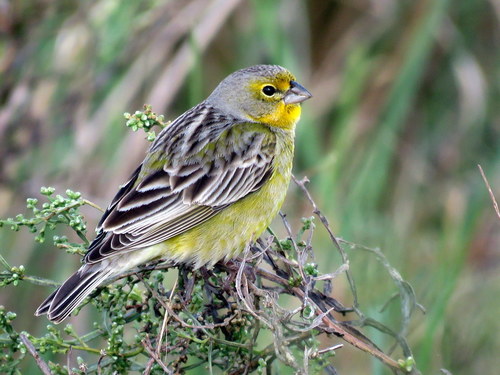
The grassland yellow finch is about 12 cm long and weighs 13 g. The males have bright yellow underparts and rump, and olive yellow upperparts. The crown and nape have dark streaking, and there is yellow around the eye. Females have dark-streaked pale brown upperparts and dull yellow underparts. The call is a sharp te-tsip, and the male's song, given from a perch or in a display flight, is a series of chips, buzzes and trills.

Grassland yellow finches eat seeds and insects, and are usually seen in pairs or small groups. Wikipedia →
Sounds

Call0:15

Brazil · 2022

© Robson Silva e Silva · XC1018936 · CC BY-NC-SA 4.0

Duet0:12

Colombia · 2023

© David Monroy Rengifo · XC793146 · CC BY-NC-SA 4.0

Alarm call0:39

Argentina · 2022

© Guillermo Treboux · XC777631 · CC BY-NC-SA 4.0

Global Distribution

Parks Where Found

# Park Country Daily sighting probability
1 Iberá National Park 🇦🇷 Argentina
~30%
2 Vicente Pérez Rosales National Park 🇨🇱 Chile
~20%
3 Nahuel Huapi National Park 🇦🇷 Argentina
~10%
4 Península Valdés 🇦🇷 Argentina
~10%
5 Serra da Canastra National Park 🇧🇷 Brazil
~10%
6 Chapada Diamantina National Park 🇧🇷 Brazil
<5%
7 El Palmar National Park 🇦🇷 Argentina
<5%
8 Serra dos Órgãos National Park 🇧🇷 Brazil
<5%
9 Iguaçu National Park 🇧🇷 Brazil
<5%
10 Iguazú National Park 🇦🇷 Argentina
<5%
11 Los Nevados National Natural Park 🇨🇴 Colombia
<5%

Cities Where Found

# City Country Daily sighting probability
1 Santiago 🇨🇱 Chile
~20%
2 Lima 🇵🇪 Peru
~10%
3 Rosario 🇦🇷 Argentina
~10%
4 Bogota 🇨🇴 Colombia
~10%
5 Buenos Aires 🇦🇷 Argentina
~10%
6 Cochabamba 🇧🇴 Bolivia
<5%
7 Mendoza 🇦🇷 Argentina
<5%
8 Santa Cruz de la Sierra 🇧🇴 Bolivia
<5%
9 Montevideo 🇺🇾 Uruguay
<5%
10 Campinas 🇧🇷 Brazil
<5%

Before you go

What are the chances of seeing a Grassland Yellow-Finch in São Paulo?

Rare

Under 5% of wildlife watchers report a Grassland Yellow-Finch sighting in São Paulo on a given day, based on 19 verified sightings from GBIF citizen-science data. It is the 284th most-seen of the 353 birds we can rate there. Over three days the chance rises to under 5%, if each day is a fresh chance.

When is the best time to see a Grassland Yellow-Finch in São Paulo?

Any time of year

In every month with enough records, under 5% of wildlife watchers report a Grassland Yellow-Finch in São Paulo on a given day, so our monthly data shows no clear season.

What time of day is best to see a Grassland Yellow-Finch?

Between 9 am and noon

Across all the parks we cover, that three-hour window holds the most Grassland Yellow-Finch sightings with a recorded time, and about 9 in 10 of them come between 6 am and 6 pm: it is a daytime animal.

Is São Paulo the best place to see a Grassland Yellow-Finch?

15th of 16

Of the 16 cities where we can rate Grassland Yellow-Finch sightings, São Paulo ranks 15th at under 5%. The best odds are in Santiago (Chile, about 20%), Lima (Peru, about 10%) and Rosario (Argentina, about 10%).

Where does the Grassland Yellow-Finch sighting chance come from?

GBIF citizen-science records

It is estimated from how often the Grassland Yellow-Finch is recorded against all the birds logged in São Paulo (19 verified sightings), calibrated against known sighting rates. Figures are rounded to the nearest 10% because citizen-science data supports honest approximations, not decimals, and months with records from fewer than five people show "—". How it works.

← Back to São Paulo

