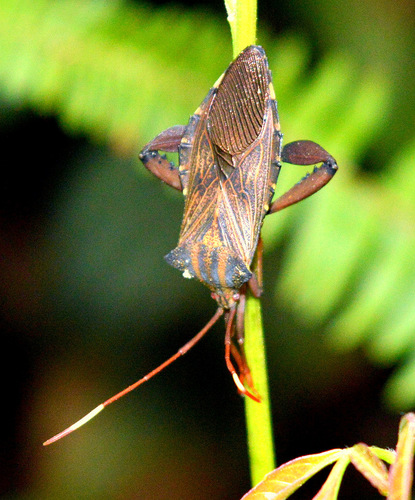
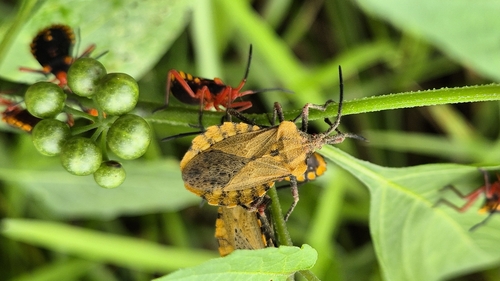
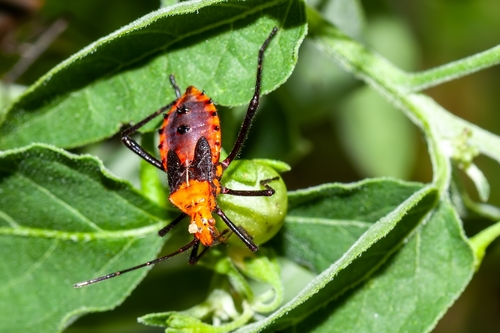
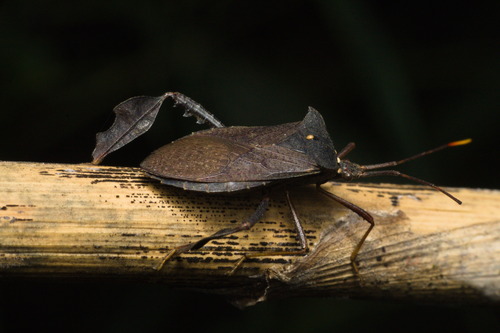
Western Conifer Seed Bug

Western Conifer Seed Bug

Leptoglossus occidentalis

Daily sighting probability <5% · Rare
at São Paulo

In 3 days ~10% in a week ~20%

5 Verified sightings at São Paulo
499 In all 19 parks From 2019 to 2026
August Best month
☀️ Diurnal When it's spotted

About the Western Conifer Seed Bug

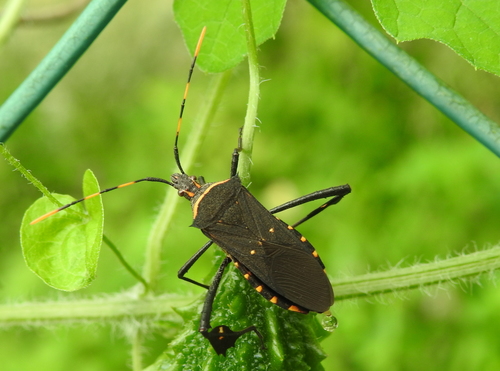
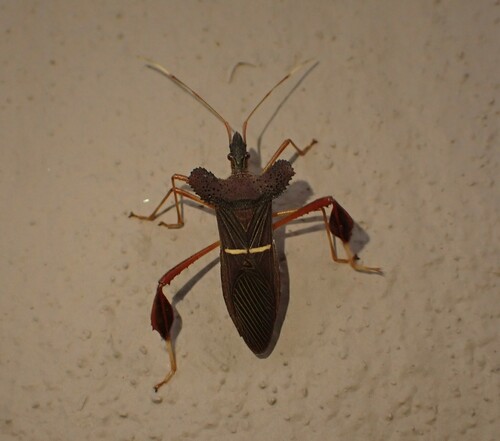
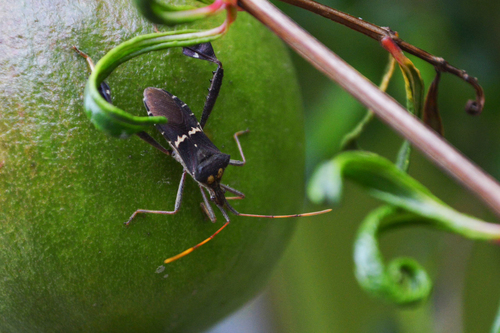
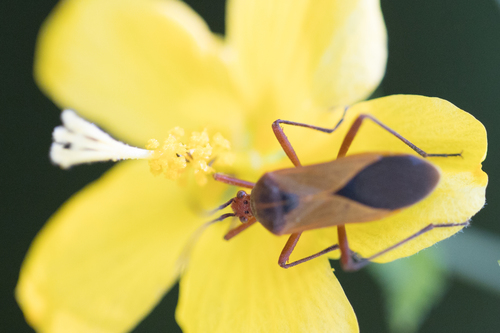
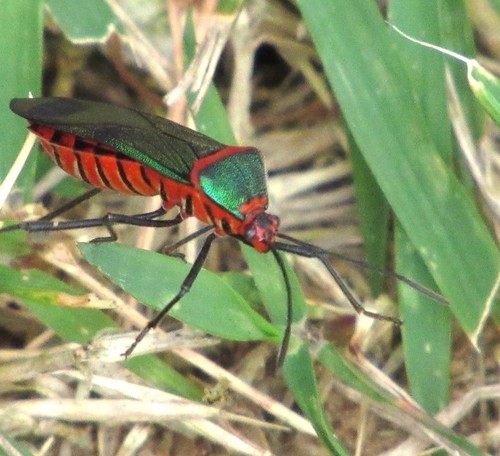
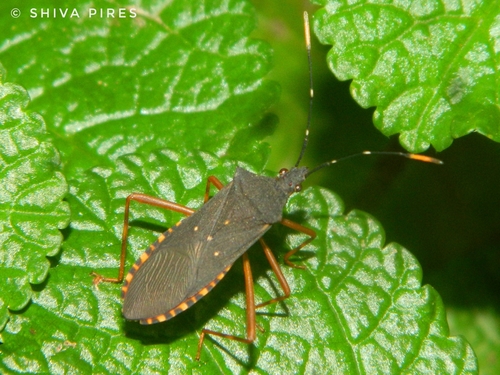
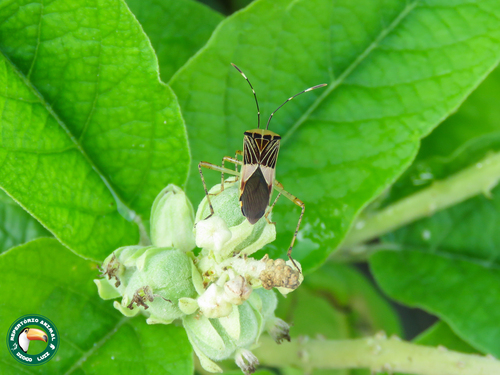
The western conifer seed bug (Leptoglossus occidentalis), sometimes called the pine-beetle, or abbreviated as WCSB, is a species of true bug (Hemiptera) in the family Coreidae. It is native to North America west of the Rocky Mountains (California to British Columbia, east to Idaho, Minnesota, and Nevada) but has in recent times expanded its range to eastern North America, to include Ontario, Québec, New Brunswick, Nova Scotia, Prince Edward Island, Michigan, Maine, Pennsylvania, New York, New Jersey, Connecticut, Massachusetts, Rhode Island, New Hampshire, Vermont, Ohio, Indiana, Kentucky, and Wisconsin, and has become an accidental introduced species in parts of Europe and Argentina.

This species is a member of the insect family Coreidae, or leaf-footed bugs, which also includes the similar Leptoglossus phyllopus and Acanthocephala femorata, both known as the "Florida leaf-footed bug". Western conifer seed bugs are sometimes colloquially called stink bugs. While they do use a foul-smelling spray as a defense, they are not classified in the stink bug family Pentatomidae. In Chile, it has been confused with kissing bugs (Triatominae), causing unjustified alarm.

The... Wikipedia →

Global Distribution

Parks Where Found

# Park Country Daily sighting probability
1 Cape Breton Highlands National Park 🇨🇦 Canada
~20%
2 Acadia National Park 🇺🇸 United States
~20%
3 Cévennes National Park 🇫🇷 France
~20%
4 Wadden Sea National Park 🇩🇪 Germany
~10%
5 Bavarian Forest National Park 🇩🇪 Germany
~10%
6 Picos de Europa National Park 🇪🇸 Spain
~10%
7 Nahuel Huapi National Park 🇦🇷 Argentina
~10%
8 Tatra National Park 🇸🇰 Slovakia
~10%
9 Sierra de Guadarrama National Park 🇪🇸 Spain
~10%
10 Sierra Nevada National Park 🇪🇸 Spain
~10%
11 Triglav National Park 🇸🇮 Slovenia
~10%
12 Pyrénées National Park 🇫🇷 France
~10%
13 Fertő-Hanság National Park 🇭🇺 Hungary
~10%
14 Glacier National Park 🇺🇸 United States
~10%
15 Great Bear Rainforest 🇨🇦 Canada
~10%
16 Zion National Park 🇺🇸 United States
~10%
17 Rocky Mountain National Park 🇺🇸 United States
~10%
18 Yosemite National Park 🇺🇸 United States
~10%
19 Olympic National Park 🇺🇸 United States
<5%

Cities Where Found

# City Country Daily sighting probability
1 Shenyang 🇨🇳 China
~20%
2 Portland 🇺🇸 United States
~20%
3 Salt Lake City 🇺🇸 United States
~20%
4 Ankara 🇹🇷 Turkey
~20%
5 Busan 🇰🇷 South Korea
~20%
6 Berlin 🇩🇪 Germany
~20%
7 Warsaw 🇵🇱 Poland
~20%
8 Prague 🇨🇿 Czechia
~20%
9 Seattle 🇺🇸 United States
~20%
10 Vancouver 🇨🇦 Canada
~20%

Before you go

What are the chances of seeing a Western Conifer Seed Bug in São Paulo?

Rare

Under 5% of wildlife watchers report a Western Conifer Seed Bug sighting in São Paulo on a given day, based on 5 verified sightings from GBIF citizen-science data. It is the 751st most-seen of the 832 insects we can rate there. Over three days the chance rises to about 10%, and over a week to about 20%, if each day is a fresh chance.

When is the best time to see a Western Conifer Seed Bug in São Paulo?

Any time of year

In every month with enough records, under 5% of wildlife watchers report a Western Conifer Seed Bug in São Paulo on a given day, so our monthly data shows no clear season.

What time of day is best to see a Western Conifer Seed Bug?

Between 2 and 5 pm

Across all the parks we cover, that three-hour window holds the most Western Conifer Seed Bug sightings with a recorded time, and about 8 in 10 of them come between 6 am and 6 pm: it is a daytime animal.

Is São Paulo the best place to see a Western Conifer Seed Bug?

65th of 66

Of the 66 cities where we can rate Western Conifer Seed Bug sightings, São Paulo ranks 65th at under 5%. The best odds are in Shenyang (China, about 20%), Portland (United States, about 20%) and Salt Lake City (United States, about 20%).

Where does the Western Conifer Seed Bug sighting chance come from?

GBIF citizen-science records

It is estimated from how often the Western Conifer Seed Bug is recorded against all the insects logged in São Paulo (5 verified sightings), calibrated against known sighting rates. Figures are rounded to the nearest 10% because citizen-science data supports honest approximations, not decimals, and months with records from fewer than five people show "—". How it works.

← Back to São Paulo