Nile Monitor

Nile Monitor

Varanus niloticus

Silhouette: Steven Traver · PhyloPic

LCLeast ConcernNTVUENCR
Daily sighting probability ~40% · Likely
at Serrekunda

In 3 days ~80% in a week >90%

25 Verified sightings at Serrekunda
1,571 In all 29 parks From 2019 to 2026
September Best month
☀️ Diurnal When it's spotted

About the Nile Monitor

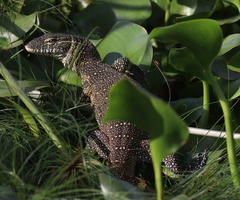
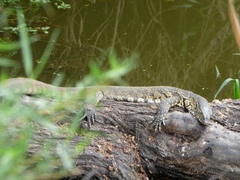
The Nile monitor (Varanus niloticus) is a large member of the monitor family (Varanidae) found throughout most of Sub-Saharan Africa, particularly in drier regions, and along the Nile River and its tributaries in East Africa. Additionally, there are modern, invasive populations in North America. The population found in West African forests and savannahs is sometimes recognized as a separate species, the West African Nile monitor (V. niloticus stellatus) and Ornate monitor (V. niloticus ornatus). While it is dwarfed by its larger relatives, such as the Komodo dragon, the Asian water monitor or the crocodile monitor, it is still one of the largest lizards in the world, reaching (and even surpassing) Australia's perentie in size. Other common names include the African small-grain lizard, as well as iguana and various forms derived from it, such as guana, water leguaan or river leguaan (leguan, leguaan, and likkewaan mean monitor lizard in South African English, and can be used interchangeably).

A feral population of Nile monitors (descended from escaped or intentionally-released pets) has become established in several locations in South Florida. In addition to any illegally-released animals, it is speculated that during particularly intense hurricane seasons in Florida, many reptiles potentially escape when their enclosures are damaged or inadvertently unlocked; as Florida has a semi-tropical to tropical climate, many reptiles are housed outdoors, and poorly-secured enclosures may become damaged during bad storms. Along with Nile monitors, Florida is infamous for its feral populations of agamas, Argentine black and white tegus, Burmese pythons, green iguanas, Madagascar giant day geckos, and panther and veiled chameleons, among others. Many of these species are thought to be descendants of hurricane escapees. Wikipedia →

Global Distribution

Parks Where Found

# Park Country Daily sighting probability
1 Niokolo-Koba National Park 🇸🇳 Senegal
~60%
2 Queen Elizabeth National Park 🇺🇬 Uganda
~60%
3 Liwonde National Park 🇲🇼 Malawi
~60%
4 South Luangwa National Park 🇿🇲 Zambia
~50%
5 Chobe National Park 🇧🇼 Botswana
~50%
6 Akagera National Park 🇷🇼 Rwanda
~50%
7 Tarangire National Park 🇹🇿 Tanzania
~50%
8 Lake Manyara National Park 🇹🇿 Tanzania
~40%
9 Kafue National Park 🇿🇲 Zambia
~40%
10 Nairobi National Park 🇰🇪 Kenya
~40%
11 Gonarezhou National Park 🇿🇼 Zimbabwe
~40%
12 Lower Zambezi National Park 🇿🇲 Zambia
~40%
13 Murchison Falls National Park 🇺🇬 Uganda
~40%
14 Kruger National Park 🇿🇦 South Africa
~40%
15 Mana Pools National Park 🇿🇼 Zimbabwe
~40%
16 Samburu National Reserve 🇰🇪 Kenya
~30%
17 Gorongosa National Park 🇲🇿 Mozambique
~30%
18 Tsavo West National Park 🇰🇪 Kenya
~30%
19 Hluhluwe-Imfolozi Park 🇿🇦 South Africa
~30%
20 Hwange National Park 🇿🇼 Zimbabwe
~30%
21 Masai Mara National Reserve 🇰🇪 Kenya
~30%
22 iSimangaliso Wetland Park 🇿🇦 South Africa
~30%
23 Pilanesberg National Park 🇿🇦 South Africa
~30%
24 Moremi Game Reserve 🇧🇼 Botswana
~30%
25 Odzala-Kokoua National Park 🇨🇬 Republic of the Congo
~30%
26 uMkhuze Game Reserve 🇿🇦 South Africa
~30%
27 Serengeti National Park 🇹🇿 Tanzania
~20%
28 Lake Nakuru National Park 🇰🇪 Kenya
~20%
29 Addo Elephant National Park 🇿🇦 South Africa
~10%

Cities Where Found

# City Country Daily sighting probability
1 Lagos 🇳🇬 Nigeria
~50%
2 Serrekunda 🇬🇲 Gambia
~40%
3 Ouagadougou 🇧🇫 Burkina Faso
~30%
4 Kampala 🇺🇬 Uganda
~30%
5 Luxor 🇪🇬 Egypt
~20%
6 Harare 🇿🇼 Zimbabwe
~10%
7 Durban 🇿🇦 South Africa
~10%

Zoos & Centres Where Found

# Zoo / Centre Country
1 Pairi Daiza 🇧🇪 Belgium In captivity
2 Denver Zoo 🇺🇸 United States In captivity
3 Réserve africaine de Sigean 🇫🇷 France In captivity
4 Zoo de Doué 🇫🇷 France In captivity
5 Toronto Zoo 🇨🇦 Canada In captivity
6 Haller Park 🇰🇪 Kenya In captivity
7 Bronx Zoo 🇺🇸 United States In captivity
8 Zoological Garden of Belo Horizonte 🇧🇷 Brazil In captivity
9 Safari Madrid 🇪🇸 Spain In captivity
10 Nanjing Hongshan Forest Zoo 🇨🇳 China In captivity
11 National Zoological Garden of South Africa 🇿🇦 South Africa In captivity
12 Zoo de Lubumbashi 🇨🇩 Congo - Kinshasa In captivity
13 Kyiv Zoo 🇺🇦 Ukraine In captivity
14 Wrocław Zoological Garden 🇵🇱 Poland In captivity
15 Lisbon Zoo 🇵🇹 Portugal In captivity
16 Parc de l'Auxois 🇫🇷 France In captivity
17 Nikolaev Zoo 🇺🇦 Ukraine In captivity
18 Chapultepec Zoo 🇲🇽 Mexico In captivity
19 Ecopark 🇦🇷 Argentina In captivity
20 Honolulu Zoo 🇺🇸 United States In captivity
21 Zoo d'Amnéville 🇫🇷 France In captivity
22 Bandung Zoo 🇮🇩 Indonesia In captivity
23 Reserva Zoológica Oasys MiniHollywood 🇪🇸 Spain In captivity
24 Tennōji Zoo 🇯🇵 Japan In captivity
25 Tbilisi Zoo 🇬🇪 Georgia In captivity
26 Giraffe House 🇿🇦 South Africa In captivity
27 Santa Ana Zoo 🇺🇸 United States In captivity
28 Leningrad Zoo 🇷🇺 Russia In captivity
29 Ménagerie du Jardin des Plantes 🇫🇷 France In captivity
30 Alligator Adventure 🇺🇸 United States In captivity
31 Chilean National Zoo 🇨🇱 Chile In captivity
32 Capron Park Zoo 🇺🇸 United States In captivity
33 Hartbeespoort Dam Snake and Animal Park 🇿🇦 South Africa In captivity
34 Africarium 🇵🇱 Poland In captivity
35 Zoo Gyöngyös 🇭🇺 Hungary In captivity
36 Acuario de Sevilla 🇪🇸 Spain In captivity
37 The Reptile Zoo 🇺🇸 United States In captivity
38 Aquarium d'Amnéville 🇫🇷 France In captivity
39 Idaho Aquarium 🇺🇸 United States In captivity
40 terrarium ogrodu zoologicznego we Wrocławiu 🇵🇱 Poland In captivity

Before you go

What are the chances of seeing a Nile Monitor in Serrekunda?

Likely

About 40% of wildlife watchers report a Nile Monitor sighting in Serrekunda on a given day, based on 25 verified sightings from GBIF citizen-science data. Over three days the chance rises to about 80%, and over a week to over 90%, if each day is a fresh chance.

When is the best time to see a Nile Monitor in Serrekunda?

September

In that month about 60% of wildlife watchers report a Nile Monitor in Serrekunda on a given day, against about 20% in March and June, the lowest months. That is one of Serrekunda's wettest months, with about 220 mm of rain against almost none in January. July and August have too few records to rate.

What time of day is best to see a Nile Monitor?

Between 11 am and 2 pm

Across all the parks we cover, that three-hour window holds the most Nile Monitor sightings with a recorded time, and about 9 in 10 of them come between 6 am and 6 pm: it is a daytime animal.

Is Serrekunda the best place to see a Nile Monitor?

2nd of 7

Of the 7 cities where we can rate Nile Monitor sightings, Serrekunda ranks 2nd at about 40%. The best odds are in Lagos (Nigeria, about 50%).

Where does the Nile Monitor sighting chance come from?

GBIF citizen-science records

It is estimated from how often the Nile Monitor is recorded against all the reptiles logged in Serrekunda (25 verified sightings), calibrated against known sighting rates. Figures are rounded to the nearest 10% because citizen-science data supports honest approximations, not decimals, and months with records from fewer than five people show "—". How it works.

← Back to Serrekunda