Arctic Warbler

Arctic Warbler

Phylloscopus borealis

Silhouette: Jiekun He · PhyloPic

LCLeast ConcernNTVUENCR
Daily sighting probability ~20% · Possible
at Singapore

In 3 days ~50% in a week ~80%

2,761 Verified sightings at Singapore
927 In all 18 parks From 2019 to 2026
November Best month
☀️ Diurnal When it's spotted

About the Arctic Warbler

The Arctic warbler (Phylloscopus borealis) is a widespread leaf warbler in birch or mixed birch forest near water throughout its breeding range in Fennoscandia and the northern Palearctic. It has established a foothold in North America, breeding in Alaska. This warbler is strongly migratory; the entire population winters in southeast Asia. It therefore has one of the longest migrations of any Old World insectivorous bird.

It traditionally included populations that breed in Kamchatka, the Kuril Islands and Japan, but genetic and vocal evidence strongly suggested these should be treated as separate species, and are all now considered distinct with the Kamchatka leaf warbler in Kamchatka, Hokkaido and the Kuril Islands, and the Japanese leaf warbler in Japan (except Hokkaido).

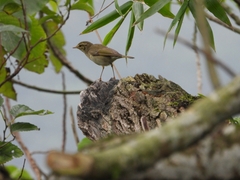
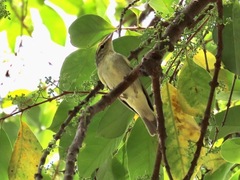
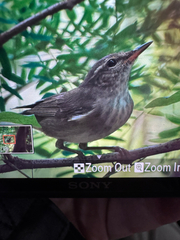
The nest is on the ground in a low shrub. Like most Old World warblers, this small passerine is insectivorous. This is a typical leaf warbler in appearance, greyish-green above and off-white below. Its single wing bar distinguishes it from most similar species except the greenish warbler, Phylloscopus trochiloides. It is larger than that species and has a heavier, dagger-like bill, with a dark tip to the lower mandible. Its song is a fast trill.

This species occurs as an autumn vagrant in western Europe and is annual on Great Britain. There were 225 confirmed arctic warbler sightings in Britain between 1958 and 2001. The genus name Phylloscopus is from Ancient Greek phullon, "leaf", and skopos, "seeker" (from skopeo, "to watch"). The specific borealis is from Latin and means "northern". Wikipedia →

Sounds

Song0:49

Sweden · 2026

© Fredrik Grahn · XC1163042 · CC BY-NC-SA 4.0

Call0:23

Sweden · 2026

© Brian Löfkvist · XC1148936 · CC BY-NC-SA 4.0

Subsong0:41

Malaysia · 2024

© Ding Li Yong · XC899459 · CC BY-NC-ND 4.0

Global Distribution

Parks Where Found

# Park Country Daily sighting probability
1 Khao Luang National Park 🇹🇭 Thailand
~10%
2 Khao Sok National Park 🇹🇭 Thailand
~10%
3 Denali National Park 🇺🇸 United States
~10%
4 Way Kambas National Park 🇮🇩 Indonesia
~10%
5 Danum Valley Conservation Area 🇲🇾 Malaysia
~10%
6 Gobi Gurvansaikhan National Park 🇲🇳 Mongolia
~10%
7 Gunung Leuser National Park 🇮🇩 Indonesia
~10%
8 Taman Negara National Park 🇲🇾 Malaysia
~10%
9 Khao Yai National Park 🇹🇭 Thailand
~10%
10 Kerinci Seblat National Park 🇮🇩 Indonesia
<5%
11 Kaeng Krachan National Park 🇹🇭 Thailand
<5%
12 Cuc Phuong National Park 🇻🇳 Vietnam
<5%
13 Cat Tien National Park 🇻🇳 Vietnam
<5%
14 Taroko National Park 🇹🇼 Taiwan
<5%
15 Sepilok 🇲🇾 Malaysia
<5%
16 Bali Barat National Park 🇮🇩 Indonesia
<5%
17 Kinabalu Park 🇲🇾 Malaysia
<5%
18 Doi Inthanon National Park 🇹🇭 Thailand
<5%

Cities Where Found

# City Country Daily sighting probability
1 Kaohsiung 🇹🇼 Taiwan
~20%
2 Singapore 🇸🇬 Singapore
~20%
3 Ningbo 🇨🇳 China
~20%
4 Manila 🇵🇭 Philippines
~10%
5 Taipei 🇹🇼 Taiwan
~10%
6 Kuala Lumpur 🇲🇾 Malaysia
~10%
7 Jinan 🇨🇳 China
~10%
8 Davao City 🇵🇭 Philippines
~10%
9 Taichung 🇹🇼 Taiwan
~10%
10 Novosibirsk 🇷🇺 Russia
~10%

Before you go

What are the chances of seeing an Arctic Warbler in Singapore?

Possible

About 20% of wildlife watchers report an Arctic Warbler sighting in Singapore on a given day, based on 2,761 verified sightings from GBIF citizen-science data. It is the 42nd most-seen of the 298 birds we can rate there. Over three days the chance rises to about 50%, and over a week to about 80%, if each day is a fresh chance.

When is the best time to see an Arctic Warbler in Singapore?

November and December

In those months about 40% of wildlife watchers report an Arctic Warbler in Singapore on a given day, against under 5% in June to August, the lowest months. Those are among Singapore's wettest months, with about 290 mm of rain a month against 100 mm in February.

What time of day is best to see an Arctic Warbler?

Between 8 and 11 am

Across all the parks we cover, that three-hour window holds the most Arctic Warbler sightings with a recorded time, and about 9 in 10 of them come between 6 am and 6 pm: it is a daytime animal.

Is Singapore the best place to see an Arctic Warbler?

Among the best

Of the 31 cities where we can rate Arctic Warbler sightings, Singapore ranks 2nd at about 20%, level with the leaders once rounded. The best odds are in Kaohsiung (Taiwan, about 20%).

Where does the Arctic Warbler sighting chance come from?

GBIF citizen-science records

It is estimated from how often the Arctic Warbler is recorded against all the birds logged in Singapore (2,761 verified sightings), calibrated against known sighting rates. Figures are rounded to the nearest 10% because citizen-science data supports honest approximations, not decimals, and months with records from fewer than five people show "—". How it works.

← Back to Singapore