Grey-backed Shrike

Grey-backed Shrike

Lanius tephronotus

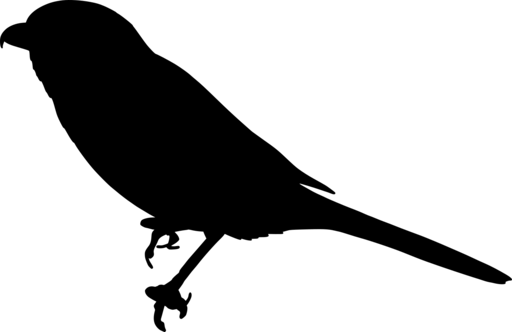
Silhouette: Andy Wilson · PhyloPic

LCLeast ConcernNTVUENCR
Daily sighting probability <5% · Rare
at Tamluk

In 3 days ~10%

7 Verified sightings at Tamluk
3,341 In all 12 parks From 2019 to 2026
March Best month
🌅 Crepuscular When it's spotted

About the Grey-backed Shrike

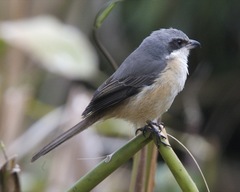
The grey-backed shrike (Lanius tephronotus) is a bird in the family Laniidae inhabiting South-east Asia. The grey-backed shrike was first described in 1831 by Nicholas Aylward Vigors as L. tephronotus collected near Darjeeling, India. It is closely allied with L. schach, and formerly treated as conspecific, but differs in morphology; moreover, the two species are largely sympatric and, although race lahulensis sometimes considered to represent a hybrid population between them, there is no definite proof of interbreeding.

The species is 21–25 cm long and weighs 39-54 g. It is a shrike with long tail. The nominate race has black lowermost forehead (just over base of bill) and facial mask through lores and eye to rear ear-coverts; crown to nape and most of upperparts dark grey, small rufous rump patch; upperwing black, most wing-coverts, secondaries and tertials fringed pale rufous to whitish, sometimes tiny white patch at base of primaries (often lacking); tail chestnut-brown, tipped buffish, outermost pair of rectrices light brown; throat and undertail brownish-grey... Wikipedia →

Sounds

Alarm call0:14

China · 2024

© Dave GUO · XC971282 · CC BY-NC-SA 4.0

Call0:08

Laos · 2024

© Bram Piot · XC864735 · CC BY-NC-SA 4.0

Song0:28

China · 2019

© Peter Boesman · XC491290 · CC BY-NC-ND 4.0

Global Distribution

Parks Where Found

# Park Country Daily sighting probability
1 Kaziranga National Park 🇮🇳 India
~50%
2 Jiuzhaigou National Park 🇨🇳 China
~40%
3 Manas National Park 🇮🇳 India
~30%
4 Royal Manas National Park 🇧🇹 Bhutan
~30%
5 Chitwan National Park 🇳🇵 Nepal
~30%
6 Namdapha National Park 🇮🇳 India
~20%
7 Langtang National Park 🇳🇵 Nepal
~10%
8 Khao Yai National Park 🇹🇭 Thailand
~10%
9 Doi Inthanon National Park 🇹🇭 Thailand
~10%
10 Royal Bardia National Park 🇳🇵 Nepal
~10%
11 Cuc Phuong National Park 🇻🇳 Vietnam
<5%
12 Jim Corbett National Park 🇮🇳 India
<5%

Cities Where Found

# City Country Daily sighting probability
1 Xining 🇨🇳 China
~30%
2 Kathmandu 🇳🇵 Nepal
~20%
3 Guwahati 🇮🇳 India
~10%
4 Savar 🇧🇩 Bangladesh
~10%
5 Dhaka 🇧🇩 Bangladesh
<5%
6 Tamluk 🇮🇳 India
<5%
7 Kolkata 🇮🇳 India
<5%
8 Dehradun 🇮🇳 India
<5%

Before you go

What are the chances of seeing a Grey-backed Shrike in Tamluk?

Rare

Under 5% of wildlife watchers report a Grey-backed Shrike sighting in Tamluk on a given day, based on 7 verified sightings from GBIF citizen-science data. It is the 119th most-seen of the 136 birds we can rate there. Over three days the chance rises to about 10%, if each day is a fresh chance.

When is the best time to see a Grey-backed Shrike in Tamluk?

March

In that month about 10% of wildlife watchers report a Grey-backed Shrike in Tamluk on a given day, against under 5% in April to February, the lowest months. That is one of Tamluk's driest months, with about 30 mm of rain against 330 mm in July.

What time of day is best to see a Grey-backed Shrike?

Between 2 and 5 am

Across all the parks we cover, that three-hour window holds the most Grey-backed Shrike sightings with a recorded time, and about 6 in 10 of them come between 6 am and 6 pm: it is most active around dawn and dusk.

Is Tamluk the best place to see a Grey-backed Shrike?

6th of 8

Of the 8 cities where we can rate Grey-backed Shrike sightings, Tamluk ranks 6th at under 5%. The best odds are in Xining (China, about 30%), Kathmandu (Nepal, about 20%) and Guwahati (India, about 10%).

Where does the Grey-backed Shrike sighting chance come from?

GBIF citizen-science records

It is estimated from how often the Grey-backed Shrike is recorded against all the birds logged in Tamluk (7 verified sightings), calibrated against known sighting rates. Figures are rounded to the nearest 10% because citizen-science data supports honest approximations, not decimals, and months with records from fewer than five people show "—". How it works.

← Back to Tamluk