Grey-headed Lapwing

Grey-headed Lapwing

Vanellus cinereus

Silhouette: Rebecca Groom · PhyloPic

LCLeast ConcernNTVUENCR
Daily sighting probability <5% · Rare
at Tamluk

In 3 days ~10% in a week ~20%

15 Verified sightings at Tamluk
1,298 In all 8 parks From 2019 to 2026
October Best month
🌅 Crepuscular When it's spotted

About the Grey-headed Lapwing

The grey-headed lapwing (Vanellus cinereus) is a lapwing species which breeds in northeast China and Japan. The mainland population winters in northern Southeast Asia from northeastern India to Cambodia. The Japanese population winters, at least partially, in southern Honshū.

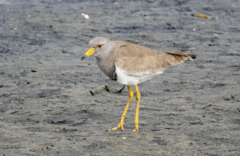
This species has occurred as a vagrant in Russia, the Philippines, Indonesia, New South Wales, Australia, Telangana and Sri Lanka, as well as Sweden and England. The grey-headed lapwing is 34–37 cm long. It has a grey head and neck, darker grey breast band and white belly. The back is brown, the rump is white and the tail is black. This is a striking species in flight, with black primaries, white under wings and upper wing secondaries, and brown upper wing coverts.

Adults of both sexes are similarly plumaged, but males are slightly larger than females. Young birds have the white areas of plumage tinged with grey, a less distinct breast band, and pale fringes to the upperpart and wing covert feathers. The call of the grey-headed lapwing is a sharp chee-it.

This species nests from April to July in wet grassland, rice fields and marshland edges. It winters in similar habitat and... Wikipedia →

Sounds

Call0:39

China · 2026

© Lim Ying Hien 林勇贤 · XC1148253 · CC BY-NC-ND 4.0

Alarm call0:15

China · 2024

© Dave GUO · XC908333 · CC BY-NC-SA 4.0

Flight call0:32

China · 2016

© Frank Lambert · XC414502 · CC BY-NC-ND 4.0

Global Distribution

Parks Where Found

# Park Country Daily sighting probability
1 Kaziranga National Park 🇮🇳 India
~40%
2 Manas National Park 🇮🇳 India
~10%
3 Keoladeo National Park 🇮🇳 India
~10%
4 Sundarbans National Park 🇮🇳 India
~10%
5 Chitwan National Park 🇳🇵 Nepal
<5%
6 Kaeng Krachan National Park 🇹🇭 Thailand
<5%
7 Doi Inthanon National Park 🇹🇭 Thailand
<5%
8 Kanha National Park 🇮🇳 India
<5%

Cities Where Found

# City Country Daily sighting probability
1 Nanchang 🇨🇳 China
~20%
2 Nagoya 🇯🇵 Japan
~10%
3 Chattogram 🇧🇩 Bangladesh
~10%
4 Osaka 🇯🇵 Japan
~10%
5 Nanjing 🇨🇳 China
~10%
6 Kathmandu 🇳🇵 Nepal
~10%
7 Tuen Mun 🇨🇳 China
~10%
8 Chennai 🇮🇳 India
~10%
9 Wuhan 🇨🇳 China
~10%
10 Dhaka 🇧🇩 Bangladesh
<5%

Before you go

What are the chances of seeing a Grey-headed Lapwing in Tamluk?

Rare

Under 5% of wildlife watchers report a Grey-headed Lapwing sighting in Tamluk on a given day, based on 15 verified sightings from GBIF citizen-science data. It is the 103rd most-seen of the 136 birds we can rate there. Over three days the chance rises to about 10%, and over a week to about 20%, if each day is a fresh chance.

When is the best time to see a Grey-headed Lapwing in Tamluk?

March and October–December

In those months about 10% of wildlife watchers report a Grey-headed Lapwing in Tamluk on a given day, against under 5% in January–February and April–September, the lowest months. Those are among Tamluk's driest months, with about 50 mm of rain a month against 330 mm in July.

What time of day is best to see a Grey-headed Lapwing?

Between 9 am and noon

Across all the parks we cover, that three-hour window holds the most Grey-headed Lapwing sightings with a recorded time, and about 6 in 10 of them come between 6 am and 6 pm: it is most active around dawn and dusk.

Is Tamluk the best place to see a Grey-headed Lapwing?

13th of 29

Of the 29 cities where we can rate Grey-headed Lapwing sightings, Tamluk ranks 13th at under 5%. The best odds are in Nanchang (China, about 20%), Nagoya (Japan, about 10%) and Chattogram (Bangladesh, about 10%).

Where does the Grey-headed Lapwing sighting chance come from?

GBIF citizen-science records

It is estimated from how often the Grey-headed Lapwing is recorded against all the birds logged in Tamluk (15 verified sightings), calibrated against known sighting rates. Figures are rounded to the nearest 10% because citizen-science data supports honest approximations, not decimals, and months with records from fewer than five people show "—". How it works.

← Back to Tamluk