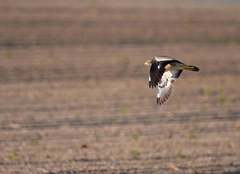
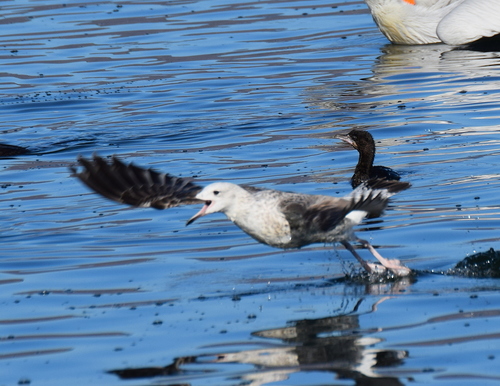
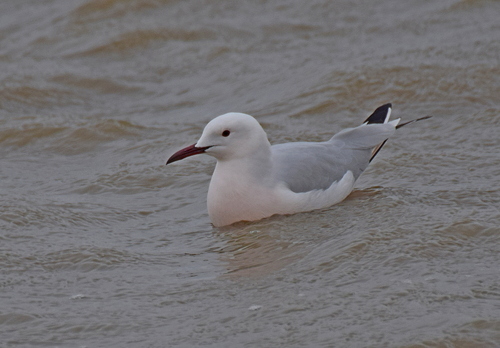
Eurasian Stone-curlew

Eurasian Stone-curlew

Burhinus oedicnemus

Silhouette: Auckland Museum · PhyloPic

LCLeast ConcernNTVUENCR
Daily sighting probability ~10% · With luck
at Tel Aviv

In 3 days ~30% in a week ~60%

534 Verified sightings at Tel Aviv
248 In all 7 parks From 2019 to 2026
August Best month
☀️🌙 Day & Night When it's spotted

About the Eurasian Stone-curlew

The Eurasian stone-curlew, Eurasian thick-knee, or simply stone-curlew (Burhinus oedicnemus), is a northern species of the Burhinidae (stone-curlew) bird family. The Eurasian stone-curlew was formally described by the Swedish naturalist Carl Linnaeus in 1758 in the tenth edition of his Systema Naturae under the binomial name Charadrius oedicnemus. He specified the locality as England. The name Oedicnemus had been used earlier by the French naturalist Pierre Belon in 1655. The species is now placed in the genus Burhinus that was introduced by the German zoologist Johann Karl Wilhelm Illiger in 1811. The genus name combines the Greek bous meaning "ox" with rhis meaning "nose". The species name oedicnemus combines the Greek oidio meaning "to swell", and kneme meaning "shin" or "leg", referring to the bird's prominent tibiotarsal joints, which also give it the common name of "thick-knee". This is an abbreviated form of Thomas Pennant's 1776 coinage "thick-kneed bustard".

The name "stone curlew" was recorded by Francis Willughby in 1678 as a "third sort of Godwit, which in Cornwall they call the Stone-Curlew, differing from the precedent in that it hath a much shorter and... Wikipedia →

Sounds

Call0:07

France · 2026

© Sébastien Reeber · XC1185091 · CC BY-NC-SA 4.0

Nocturnal flight call0:11

France · 2026

© MILLON Xavier · XC1169898 · CC BY-NC-SA 4.0

Flight call0:25

Spain · 2026

© Esperanza Poveda · XC1163523 · CC BY-NC-SA 4.0

Global Distribution

Parks Where Found

# Park Country Daily sighting probability
1 Kiskunság National Park 🇭🇺 Hungary
~10%
2 Cévennes National Park 🇫🇷 France
<5%
3 Doñana National Park 🇪🇸 Spain
<5%
4 Camargue 🇫🇷 France
<5%
5 Monfragüe National Park 🇪🇸 Spain
<5%
6 Murchison Falls National Park 🇺🇬 Uganda
<5%
7 Sierra de Guadarrama National Park 🇪🇸 Spain
<5%

Cities Where Found

# City Country Daily sighting probability
1 Tel Aviv 🇮🇱 Israel
~10%
2 Tunis 🇹🇳 Tunisia
~10%
3 Ramallah 🇵🇸 Palestine
~10%
4 Lyon 🇫🇷 France
~10%
5 Rabat 🇲🇦 Morocco
<5%
6 Antalya 🇹🇷 Turkey
<5%
7 Jerusalem 🇮🇱 Israel
<5%
8 Valencia 🇪🇸 Spain
<5%
9 Madrid 🇪🇸 Spain
<5%
10 Barcelona 🇪🇸 Spain
<5%

Zoos & Centres Where Found

# Zoo / Centre Country
1 Natura Artis Magistra 🇳🇱 Netherlands In captivity
2 Zoo Hluboka 🇨🇿 Czechia In captivity
3 Tier- und Freizeitpark Thüle 🇩🇪 Germany In captivity
4 Tbilisi Zoo 🇬🇪 Georgia In captivity
5 Oasi Naturalistica di Sant'Alessio 🇮🇹 Italy In captivity
6 Ménagerie du Jardin des Plantes 🇫🇷 France In captivity
7 Santillana Zoo 🇪🇸 Spain In captivity
8 Alpenzoo Innsbruck 🇦🇹 Austria In captivity
9 akwarium warszawskiego ZOO 🇵🇱 Poland In captivity
10 Ogród zoologiczny w Lubinie 🇵🇱 Poland In captivity

Before you go

What are the chances of seeing a Eurasian Stone-curlew in Tel Aviv?

With luck

About 10% of wildlife watchers report a Eurasian Stone-curlew sighting in Tel Aviv on a given day, based on 534 verified sightings from GBIF citizen-science data. It is the 49th most-seen of the 232 birds we can rate there. Over three days the chance rises to about 30%, and over a week to about 60%, if each day is a fresh chance.

When is the best time to see a Eurasian Stone-curlew in Tel Aviv?

March–April and June–August

In those months about 20% of wildlife watchers report a Eurasian Stone-curlew in Tel Aviv on a given day, against under 5% in December and January, the lowest months. Those are among Tel Aviv's driest months, with about 10 mm of rain a month against 90 mm in January.

What time of day is best to see a Eurasian Stone-curlew?

Between 7 and 10 am

Across all the parks we cover, that three-hour window holds the most Eurasian Stone-curlew sightings with a recorded time, and about 7 in 10 of them come between 6 am and 6 pm: it is seen both by day and at night.

Is Tel Aviv the best place to see a Eurasian Stone-curlew?

Yes

Of the 10 cities where we can rate Eurasian Stone-curlew sightings, Tel Aviv has the highest daily chance: about 10%. Next come Tunis (Tunisia, about 10%) and Ramallah (Palestine, about 10%).

Which relatives of the Eurasian Stone-curlew live in Tel Aviv?

Same order: Charadriiformes

The closest relatives of the Eurasian Stone-curlew that you can see in Tel Aviv (order Charadriiformes, Shorebirds and Allies) are Spur-winged Lapwing (about 30%), Yellow-legged Gull (about 30%) and Black-headed Gull (about 20%), with each one's daily chance of a sighting.

Where does the Eurasian Stone-curlew sighting chance come from?

GBIF citizen-science records

It is estimated from how often the Eurasian Stone-curlew is recorded against all the birds logged in Tel Aviv (534 verified sightings), calibrated against known sighting rates. Figures are rounded to the nearest 10% because citizen-science data supports honest approximations, not decimals, and months with records from fewer than five people show "—". How it works.

← Back to Tel Aviv