Silver-Washed Fritillary

Silver-Washed Fritillary

Argynnis paphia

Daily sighting probability <5% · Rare
at Tokyo

In 3 days ~10% in a week ~20%

24 Verified sightings at Tokyo
1,625 In all 19 parks From 2019 to 2026
September Best month
☀️ Diurnal When it's spotted

About the Silver-Washed Fritillary

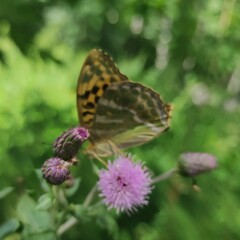
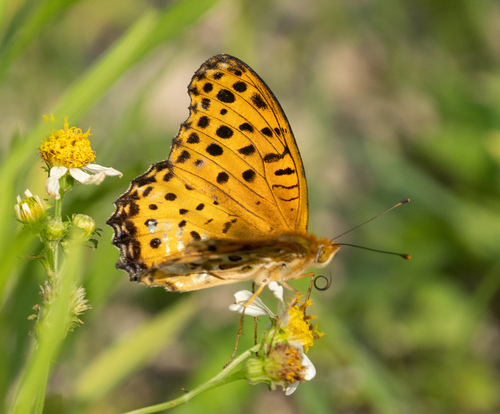
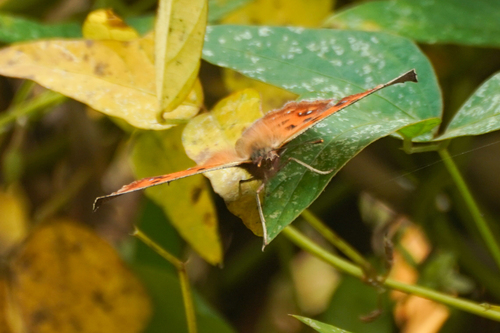
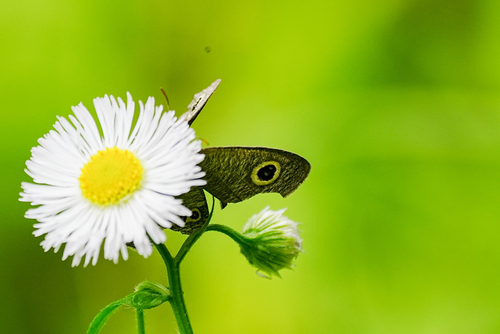
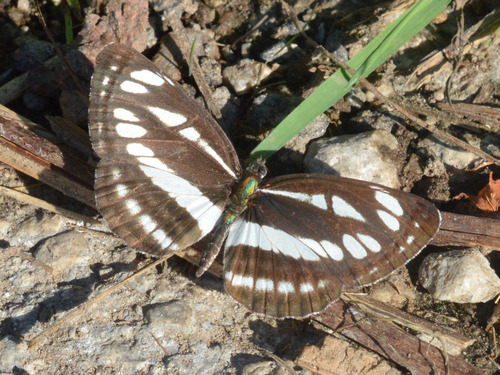
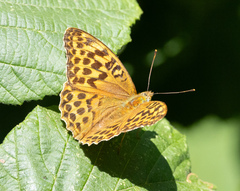
The silver-washed fritillary (Argynnis paphia) is a common and variable butterfly found over much of the Palearctic realm – Algeria, Europe and across the Palearctic to Japan. The silver-washed fritillary butterfly is deep orange with black spots on the upperside of its wings. It has a wingspan of 54–70 mm, with the male's being smaller and paler than the female's. The underside is green (verdigris) with a metallic gloss and broad silver bands which are partly curved, hence the name silver-washed. In the male the forewings are rather pointed whereas in the female they are more rounded. On females of the minority valesina form, recurrent in most European populations, the ground color is not fawn but grey with greenish reflections. The caterpillar is black brown with two yellow lines along its back and long reddish-brown spines.

The male possesses scent scales on the upperside of the forewing that run along veins one to four as three distinct scent-streaks. The scent produced from these scales attracts females and helps to distinguish it from other species.

Adults feed on the nectar of bramble, thistles, and knapweeds, and also on aphid honeydew... Wikipedia →

Global Distribution

Parks Where Found

# Park Country Daily sighting probability
1 Triglav National Park 🇸🇮 Slovenia
~60%
2 Plitvice Lakes National Park 🇭🇷 Croatia
~50%
3 Aigüestortes National Park 🇪🇸 Spain
~50%
4 Ordesa y Monte Perdido National Park 🇪🇸 Spain
~50%
5 Białowieża National Park 🇵🇱 Poland
~40%
6 Picos de Europa National Park 🇪🇸 Spain
~40%
7 Pyrénées National Park 🇫🇷 France
~30%
8 Cévennes National Park 🇫🇷 France
~30%
9 Ecrins National Park 🇫🇷 France
~30%
10 Tatra National Park 🇸🇰 Slovakia
~30%
11 Mercantour National Park 🇫🇷 France
~20%
12 Gauja National Park 🇱🇻 Latvia
~20%
13 Hohe Tauern National Park 🇦🇹 Austria
~20%
14 Vanoise National Park 🇫🇷 France
~20%
15 Nikko National Park 🇯🇵 Japan
~20%
16 Bavarian Forest National Park 🇩🇪 Germany
~20%
17 Sierra de Guadarrama National Park 🇪🇸 Spain
~20%
18 Biebrza National Park 🇵🇱 Poland
~20%
19 Fertő-Hanság National Park 🇭🇺 Hungary
~10%

Cities Where Found

# City Country Daily sighting probability
1 Budapest 🇭🇺 Hungary
~10%
2 Prague 🇨🇿 Czechia
~10%
3 Vienna 🇦🇹 Austria
~10%
4 Munich 🇩🇪 Germany
~10%
5 Sapporo 🇯🇵 Japan
~10%
6 Stockholm 🇸🇪 Sweden
~10%
7 Novosibirsk 🇷🇺 Russia
~10%
8 Kharkiv 🇺🇦 Ukraine
~10%
9 Turin 🇮🇹 Italy
~10%
10 Yekaterinburg 🇷🇺 Russia
~10%

Before you go

What are the chances of seeing a Silver-Washed Fritillary in Tokyo?

Rare

Under 5% of wildlife watchers report a Silver-Washed Fritillary sighting in Tokyo on a given day, based on 24 verified sightings from GBIF citizen-science data. It is the 431st most-seen of the 1013 insects we can rate there. Over three days the chance rises to about 10%, and over a week to about 20%, if each day is a fresh chance.

When is the best time to see a Silver-Washed Fritillary in Tokyo?

September and October

In those months about 10% of wildlife watchers report a Silver-Washed Fritillary in Tokyo on a given day, against under 5% in November to August, the lowest months. Those are among Tokyo's wettest months, with about 230 mm of rain a month against 75 mm in February.

What time of day is best to see a Silver-Washed Fritillary?

Between 11 am and 2 pm

Across all the parks we cover, that three-hour window holds the most Silver-Washed Fritillary sightings with a recorded time, and about 9 in 10 of them come between 6 am and 6 pm: it is a daytime animal.

Is Tokyo the best place to see a Silver-Washed Fritillary?

27th of 27

Of the 27 cities where we can rate Silver-Washed Fritillary sightings, Tokyo ranks 27th at under 5%. The best odds are in Budapest (Hungary, about 10%), Prague (Czechia, about 10%) and Vienna (Austria, about 10%).

Where does the Silver-Washed Fritillary sighting chance come from?

GBIF citizen-science records

It is estimated from how often the Silver-Washed Fritillary is recorded against all the insects logged in Tokyo (24 verified sightings), calibrated against known sighting rates. Figures are rounded to the nearest 10% because citizen-science data supports honest approximations, not decimals, and months with records from fewer than five people show "—". How it works.

← Back to Tokyo