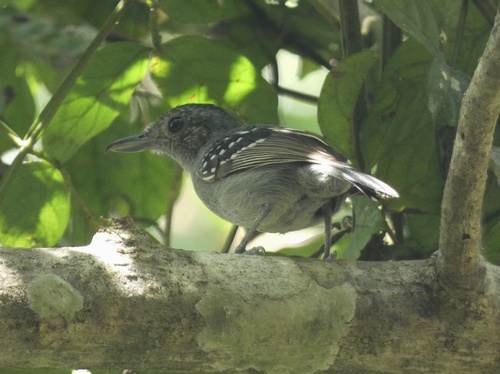
Marbled Wood Quail

Marbled Wood Quail

Odontophorus gujanensis

Silhouette: Sheatherius · PhyloPic

LCLeast ConcernNTVUENCR
Daily sighting probability ~10% · With luck
at Darién National Park

In 3 days ~30% in a week ~60%

65 Verified sightings at Darién National Park From 2019 to 2026
710 In all 12 parks
April Best month
☀️ Diurnal When it's spotted

About the Marbled Wood Quail

The marbled wood quail (Odontophorus gujanensis), also known as the Amazonian wood quail, is a species of bird in the New World quail family. It has an extensive distribution in Central America and the northern part of South America. Its natural habitat is subtropical or tropical moist lowland forests.

The marbled wood quail was formally described in 1789 by the German naturalist Johann Friedrich Gmelin in his revised and expanded edition of Carl Linnaeus's Systema Naturae. He placed it with the other quail like birds in the genus Tetrao and coined the binomial name Tetrao gujanensis. Gmelin based his description on the Comte de Buffon's "Le Tocro ou Perdrix de la Guyane" and John Latham's "Guiana partridge". The marbled wood quail is now placed with around 14 other species in the genus Odontophorus that was introduced in 1816 by the French ornithologist Louis Pierre Vieillot. The genus name Odontophorus is from Ancient Greek meaning "bearing teeth", from odous "tooth" and pherō "to carry". The specific epithet gujanensis means "from the Guianas".

Eight subspecies are recognised: Wikipedia →

Sounds

Song0:23

Brazil · 2026

© Jose Martin · XC1163423 · CC BY-NC-SA 4.0

Canto0:25

Brazil · 2017

© Caio Brito · XC427718 · CC BY-NC-SA 4.0

Call1:01

Brazil · 2017

© FilhoManfredini · XC370564 · CC BY-NC-SA 4.0

Global Distribution

Parks Where Found

# Park Country Daily sighting probability
1 Darién National Park 🇵🇦 Panama
~10%
2 Brownsberg Nature Park 🇸🇷 Suriname
~10%
3 Corcovado National Park 🇨🇷 Costa Rica
~10%
4 Carara National Park 🇨🇷 Costa Rica
<5%
5 Sierra de la Macarena National Park 🇨🇴 Colombia
<5%
6 Amacayacu National Natural Park 🇨🇴 Colombia
<5%
7 Yasuní National Park 🇪🇨 Ecuador
<5%
8 Piedras Blancas National Park 🇨🇷 Costa Rica
<5%
9 Cuyabeno Wildlife Reserve 🇪🇨 Ecuador
<5%
10 Chagres National Park 🇵🇦 Panama
<5%
11 La Amistad International Park (Panama) 🇵🇦 Panama
<5%
12 Soberanía National Park 🇵🇦 Panama
<5%

Before you go

What are the chances of seeing a Marbled Wood Quail in Darién National Park?

With luck

About 10% of wildlife watchers report a Marbled Wood Quail sighting in Darién National Park on a given day, based on 65 verified sightings from GBIF citizen-science data from 2019 to 2026. It is the 111th most-seen of the 397 birds we can rate there. Over three days the chance rises to about 30%, and over a week to about 60%, if each day is a fresh chance.

When is the best time to see a Marbled Wood Quail in Darién National Park?

February and April

In those months about 30% of wildlife watchers report a Marbled Wood Quail in Darién National Park on a given day, against under 5% in June and October–December, the lowest months. Those are among Darién National Park's driest months, with about 190 mm of rain a month against 450 mm in November.

What time of day is best to see a Marbled Wood Quail?

Between 8 and 11 am

Across all the parks we cover, that three-hour window holds the most Marbled Wood Quail sightings with a recorded time, and about 9 in 10 of them come between 6 am and 6 pm: it is a daytime animal.

Is Darién National Park the best place to see a Marbled Wood Quail?

Yes

Of the 12 parks where we can rate Marbled Wood Quail sightings, Darién National Park has the highest daily chance: about 10%. Next come Brownsberg Nature Park (Suriname, about 10%) and Corcovado National Park (Costa Rica, about 10%).

Where does the Marbled Wood Quail sighting chance come from?

GBIF citizen-science records

It is estimated from how often the Marbled Wood Quail is recorded against all the birds logged in Darién National Park (65 verified sightings from 2019 to 2026), calibrated against known sighting rates. Figures are rounded to the nearest 10% because citizen-science data supports honest approximations, not decimals, and months with records from fewer than five people show "—". How it works.
← Back to Darién National Park