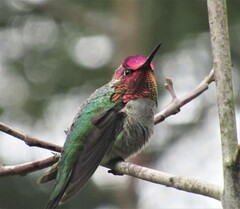
Anna's Hummingbird

Anna's Hummingbird

Calypte anna

Silhouette: Margot Michaud · PhyloPic

LCLeast ConcernNTVUENCR
Daily sighting probability ~30% · Possible
at Death Valley National Park

In 3 days ~70% in a week ~90%

419 Verified sightings at Death Valley National Park From 2019 to 2026
11,316 In all 15 parks
October Best month
☀️ Diurnal When it's spotted

About the Anna's Hummingbird

Anna's hummingbird (Calypte anna) is a North American species of hummingbird named after Anna Masséna, Duchess of Rivoli. It is native to western coastal regions of North America. Until the late 20th century, Anna's hummingbirds migrated from locations as far north as Alaska and coastal British Columbia, returning south to breed in Baja California and Southern California.

Since the 1970s, ornamental plants in residential areas along the Pacific coast and inland deserts provided expanded nectar and nesting sites, allowing the species to expand its breeding range to northern coastal regions without migrating. Year-round residence of Anna's hummingbirds in the Pacific Northwest is an example of ecological release dependent on acclimation to colder winter temperatures, introduced plants, and human provision of nectar feeders during winter.

These birds feed on nectar from flowers using a long extendable tongue. They also consume small insects and other arthropods caught in flight or gleaned from vegetation. Anna's hummingbird was formally described and illustrated in 1829 by the French naturalist René Lesson in his Histoire naturelle des Oiseaux-Mouches from a specimen that... Wikipedia →

Sounds

Call0:39

United States · 2026

© Greg Irving · XC1083908 · CC BY-NC-SA 4.0

Flight call0:05

United States · 2022

© Paul Marvin · XC697495 · CC BY-NC-SA 4.0

Mechanical dive display sound0:21

United States · 2020

© Ed Pandolfino · XC603659 · CC BY-NC-SA 4.0

Global Distribution

Parks Where Found

# Park Country Daily sighting probability
1 Channel Islands National Park 🇺🇸 United States
~40%
2 Sequoia and Kings Canyon National Parks 🇺🇸 United States
~40%
3 Joshua Tree National Park 🇺🇸 United States
~40%
4 Saguaro National Park 🇺🇸 United States
~30%
5 Death Valley National Park 🇺🇸 United States
~30%
6 El Vizcaíno Biosphere Reserve 🇲🇽 Mexico
~20%
7 Yosemite National Park 🇺🇸 United States
~20%
8 Olympic National Park 🇺🇸 United States
~20%
9 Great Bear Rainforest 🇨🇦 Canada
~20%
10 Redwood National Park 🇺🇸 United States
~10%
11 Pacific Rim National Park Reserve 🇨🇦 Canada
~10%
12 Kluane National Park 🇨🇦 Canada
<5%
13 Bahía de Loreto National Park 🇲🇽 Mexico
<5%
14 Zion National Park 🇺🇸 United States
<5%
15 Big Bend National Park 🇺🇸 United States
<5%

Cities Where Found

# City Country Daily sighting probability
1 Mesa 🇺🇸 United States
~80%
2 Tijuana 🇲🇽 México
~80%
3 San Francisco 🇺🇸 United States
~80%
4 Sacramento 🇺🇸 United States
~70%
5 Las Vegas 🇺🇸 United States
~70%
6 Phoenix 🇺🇸 United States
~70%
7 San Diego 🇺🇸 United States
~70%
8 Portland 🇺🇸 United States
~70%
9 Seattle 🇺🇸 United States
~70%
10 Vancouver 🇨🇦 Canada
~60%

Zoos & Centres Where Found

# Zoo / Centre Country
1 San Diego Zoo 🇺🇸 United States In captivity
2 Toledo Zoo 🇺🇸 United States In captivity
3 Arizona-Sonora Desert Museum 🇺🇸 United States In captivity
4 Mountainaire Avian Rescue Society 🇨🇦 Canada In captivity

Before you go

What are the chances of seeing an Anna's Hummingbird in Death Valley National Park?

Possible

About 30% of wildlife watchers report an Anna's Hummingbird sighting in Death Valley National Park on a given day, based on 419 verified sightings from GBIF citizen-science data from 2019 to 2026. It is the 15th most-seen of the 213 birds we can rate there. Over three days the chance rises to about 70%, and over a week to about 90%, if each day is a fresh chance.

When is the best time to see an Anna's Hummingbird in Death Valley National Park?

October

In that month about 50% of wildlife watchers report an Anna's Hummingbird in Death Valley National Park on a given day, against about 10% in July, the lowest month.

What time of day is best to see an Anna's Hummingbird?

Between 8 and 11 am

Across all the parks we cover, that three-hour window holds the most Anna's Hummingbird sightings with a recorded time, and about 8 in 10 of them come between 6 am and 6 pm: it is a daytime animal.

Where does the Anna's Hummingbird sighting chance come from?

GBIF citizen-science records

It is estimated from how often the Anna's Hummingbird is recorded against all the birds logged in Death Valley National Park (419 verified sightings from 2019 to 2026), calibrated against known sighting rates. Figures are rounded to the nearest 10% because citizen-science data supports honest approximations, not decimals, and months with records from fewer than five people show "—". How it works.

← Back to Death Valley National Park