Bullock's Oriole

Bullock's Oriole

Icterus bullockii

Silhouette: Matt Wilkins · PhyloPic

Daily sighting probability ~10% · With luck
at Death Valley National Park

In 3 days ~20% in a week ~40%

83 Verified sightings at Death Valley National Park From 2019 to 2026
1,643 In all 20 parks
May Best month
☀️ Diurnal When it's spotted

About the Bullock's Oriole

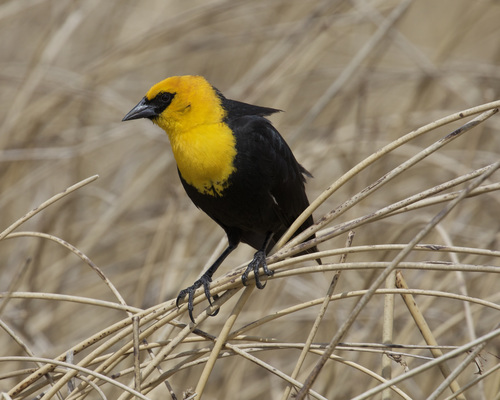
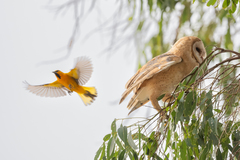
Bullock's oriole (Icterus bullockiorum, also known as Icterus bullockii) is a small New World blackbird. At one time, this species and the Baltimore oriole were considered to be a single species, the northern oriole. This bird is named after William Bullock, an English amateur naturalist.

Bullock's orioles are sexually dimorphic, with males being more brightly colored than females. In addition, adult males tend to be slightly larger and heavier than females. Measurements: Length: 6.7–7.5 inches (17–19 cm)

Weight: 1.0–1.5 ounces (28–43 g) Wingspan: 12.2 inches (31 cm) Adults have a pointed bill with a straight culmen. In adult males, the tail is long, square, and jet black. All exposed skin is black, as are the claws and bill, though the base of the lower mandible lightens to bluish-gray.

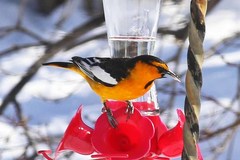
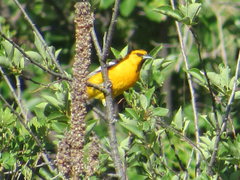
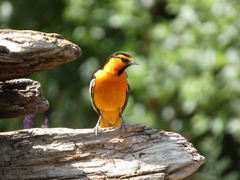
Adult males are characterized by contrasting yellow-orange and black plumage, a black throat patch, and a white wing patch on the wing coverts. The underparts, breast, and face are orange or yellow; by contrast, the back, wings, and tail are black. A black line extends from each eye to the black crown. Adult females, by contrast, have gray-brown upperparts, duller yellow on the breast... Wikipedia →

Sounds

Call0:50

United States · 2023

© Richard E. Webster · XC1038999 · CC BY-NC-SA 4.0

Song0:15

United States · 2021

© Ed Pandolfino · XC644408 · CC BY-NC-SA 4.0

Begging call0:28

United States · 2018

© Rachel Hudson · XC440254 · CC BY-NC-SA 4.0

Global Distribution

Parks Where Found

# Park Country Daily sighting probability
1 Zion National Park 🇺🇸 United States
~10%
2 Sequoia and Kings Canyon National Parks 🇺🇸 United States
~10%
3 Death Valley National Park 🇺🇸 United States
~10%
4 Yosemite National Park 🇺🇸 United States
~10%
5 Big Bend National Park 🇺🇸 United States
~10%
6 Reserva de la Biosfera Mariposa Monarca 🇲🇽 Mexico
~10%
7 Saguaro National Park 🇺🇸 United States
<5%
8 Joshua Tree National Park 🇺🇸 United States
<5%
9 Grand Teton National Park 🇺🇸 United States
<5%
10 Channel Islands National Park 🇺🇸 United States
<5%
11 Grand Canyon National Park 🇺🇸 United States
<5%
12 Guadalupe Mountains National Park 🇺🇸 United States
<5%
13 Badlands National Park 🇺🇸 United States
<5%
14 Cañón del Sumidero National Park 🇲🇽 Mexico
<5%
15 El Vizcaíno Biosphere Reserve 🇲🇽 Mexico
<5%
16 Yellowstone National Park 🇺🇸 United States
<5%
17 Redwood National Park 🇺🇸 United States
<5%
18 Rocky Mountain National Park 🇺🇸 United States
<5%
19 Great Bear Rainforest 🇨🇦 Canada
<5%
20 Everglades National Park 🇺🇸 United States
<5%

Cities Where Found

# City Country Daily sighting probability
1 Guadalajara 🇲🇽 México
~20%
2 Toluca 🇲🇽 México
~10%
3 Puebla 🇲🇽 México
~10%
4 Salt Lake City 🇺🇸 United States
~10%
5 Mexico City 🇲🇽 México
~10%
6 Tijuana 🇲🇽 México
~10%
7 Denver 🇺🇸 United States
~10%
8 Sacramento 🇺🇸 United States
~10%
9 Los Angeles 🇺🇸 United States
~10%
10 Las Vegas 🇺🇸 United States
<5%

Zoos & Centres Where Found

# Zoo / Centre Country
1 Tracy Aviary 🇺🇸 United States In captivity
2 Bloedel Conservatory 🇨🇦 Canada In captivity
3 Seaside Seabird Sanctuary 🇺🇸 United States In captivity

Before you go

What are the chances of seeing a Bullock's Oriole in Death Valley National Park?

With luck

About 10% of wildlife watchers report a Bullock's Oriole sighting in Death Valley National Park on a given day, based on 83 verified sightings from GBIF citizen-science data from 2019 to 2026. It is the 88th most-seen of the 213 birds we can rate there. Over three days the chance rises to about 20%, and over a week to about 40%, if each day is a fresh chance.

When is the best time to see a Bullock's Oriole in Death Valley National Park?

May

In that month about 30% of wildlife watchers report a Bullock's Oriole in Death Valley National Park on a given day, against under 5% in June, August and October–April, the lowest months.

What time of day is best to see a Bullock's Oriole?

Between 7 and 10 am

Across all the parks we cover, that three-hour window holds the most Bullock's Oriole sightings with a recorded time, and about 9 in 10 of them come between 6 am and 6 pm: it is a daytime animal.

Is Death Valley National Park the best place to see a Bullock's Oriole?

Among the best

Of the 20 parks where we can rate Bullock's Oriole sightings, Death Valley National Park ranks 3rd at about 10%, level with the leaders once rounded. The best odds are in Zion National Park (United States, about 10%) and Sequoia and Kings Canyon National Parks (United States, about 10%).

Where does the Bullock's Oriole sighting chance come from?

GBIF citizen-science records

It is estimated from how often the Bullock's Oriole is recorded against all the birds logged in Death Valley National Park (83 verified sightings from 2019 to 2026), calibrated against known sighting rates. Figures are rounded to the nearest 10% because citizen-science data supports honest approximations, not decimals, and months with records from fewer than five people show "—". How it works.

← Back to Death Valley National Park