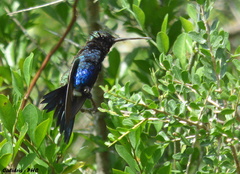
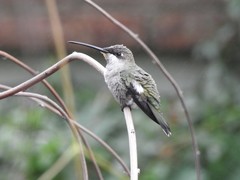
Blue-tufted Starthroat

Blue-tufted Starthroat

Heliomaster furcifer

Silhouette: Cristian Gutierrez-Ibanez · PhyloPic

LCLeast ConcernNTVUENCR
Daily sighting probability ~20% · Possible
at El Palmar National Park

In 3 days ~40% in a week ~70%

61 Verified sightings at El Palmar National Park From 2019 to 2026
331 In all 7 parks
February Best month
☀️ Diurnal When it's spotted

About the Blue-tufted Starthroat

The blue-tufted starthroat (Heliomaster furcifer) is a species of hummingbird in the "mountain gems", tribe Lampornithini in subfamily Trochilinae. It is found in Argentina, Bolivia, Brazil, Colombia, Paraguay, Peru, Uruguay and possibly Ecuador.

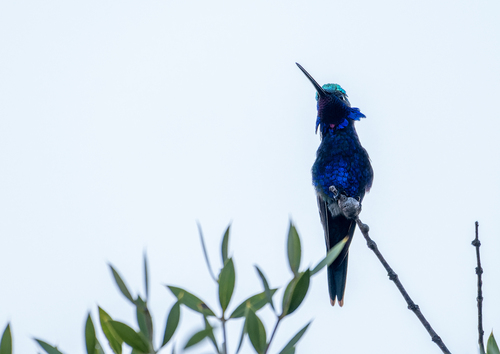
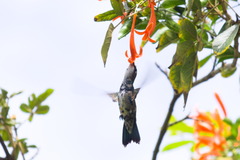
At one time the blue-tufted starthroat was the only species in genus Heliomaster, but since the mid-1900s three other species have been reassigned to it. The blue-tufted starthroat is monotypic. The blue-tufted starthroat is 12.6 to 13 cm (5.0 to 5.1 in) long and weighs 5 to 6.5 g (0.18 to 0.23 oz). Both sexes of all subspecies have a long, decurved, black bill and a small white spot behind the eye. Both have a forked tail but the female's is less deeply indented than the male's. Males in breeding plumage have an emerald green crown, nape, and upper back; the rest of the upperparts are shining coppery green. The throat is glittering violet. The underparts and elongated feathers on the sides of the neck are iridescent ultramarine. The tail is dark green on its upper side and blue-green below. Non-breeding males are grayish below like females. Females have coppery green upperparts. The throat and... Wikipedia →
Sounds

Call0:14

Brazil · 2025

© JAYRSON ARAUJO DE OLIVEIRA · XC1017274 · CC BY-NC-SA 4.0

Call0:10

Paraguay · 2014

© Fabrice Schmitt · XC616315 · CC BY-NC-SA 4.0

Call0:26

Argentina

© Bernabe Lopez-Lanus · XC48793 · CC BY-NC-SA 3.0

Global Distribution

Parks Where Found

# Park Country Daily sighting probability
1 El Palmar National Park 🇦🇷 Argentina
~20%
2 El Impenetrable National Park 🇦🇷 Argentina
~10%
3 Iberá National Park 🇦🇷 Argentina
~10%
4 Amboró National Park 🇧🇴 Bolivia
<5%
5 Chapada dos Guimarães National Park 🇧🇷 Brazil
<5%
6 Iguazú National Park 🇦🇷 Argentina
<5%
7 Iguaçu National Park 🇧🇷 Brazil
<5%

Cities Where Found

# City Country Daily sighting probability
1 Cordoba 🇦🇷 Argentina
~20%
2 Rosario 🇦🇷 Argentina
~10%
3 Asuncion 🇵🇾 Paraguay
~10%
4 Campo Grande 🇧🇷 Brazil
<5%
5 Santa Cruz de la Sierra 🇧🇴 Bolivia
<5%
6 Buenos Aires 🇦🇷 Argentina
<5%

Before you go

What are the chances of seeing a Blue-tufted Starthroat in El Palmar National Park?

Possible

About 20% of wildlife watchers report a Blue-tufted Starthroat sighting in El Palmar National Park on a given day, based on 61 verified sightings from GBIF citizen-science data from 2019 to 2026. It is the 66th most-seen of the 151 birds we can rate there. Over three days the chance rises to about 40%, and over a week to about 70%, if each day is a fresh chance.

When is the best time to see a Blue-tufted Starthroat in El Palmar National Park?

February

In that month about 40% of wildlife watchers report a Blue-tufted Starthroat in El Palmar National Park on a given day, against about 10% in April–August and October, the lowest months.

What time of day is best to see a Blue-tufted Starthroat?

Between 8 and 11 am

Across all the parks we cover, that three-hour window holds the most Blue-tufted Starthroat sightings with a recorded time, and about 9 in 10 of them come between 6 am and 6 pm: it is a daytime animal.

Is El Palmar National Park the best place to see a Blue-tufted Starthroat?

Yes

Of the 7 parks where we can rate Blue-tufted Starthroat sightings, El Palmar National Park has the highest daily chance: about 20%. Next come El Impenetrable National Park (Argentina, about 10%) and Iberá National Park (Argentina, about 10%).

Where does the Blue-tufted Starthroat sighting chance come from?

GBIF citizen-science records

It is estimated from how often the Blue-tufted Starthroat is recorded against all the birds logged in El Palmar National Park (61 verified sightings from 2019 to 2026), calibrated against known sighting rates. Figures are rounded to the nearest 10% because citizen-science data supports honest approximations, not decimals, and months with records from fewer than five people show "—". How it works.

← Back to El Palmar National Park