Thicket Tinamou

Thicket Tinamou

Crypturellus cinnamomeus

Silhouette: J. N. Wiegers · PhyloPic

LCLeast ConcernNTVUENCR
Daily sighting probability ~10% · With luck
at El Triunfo

In 3 days ~40% in a week ~60%

27 Verified sightings at El Triunfo From 2019 to 2026
1,496 In all 18 parks
April Best month
☀️ Diurnal When it's spotted

About the Thicket Tinamou

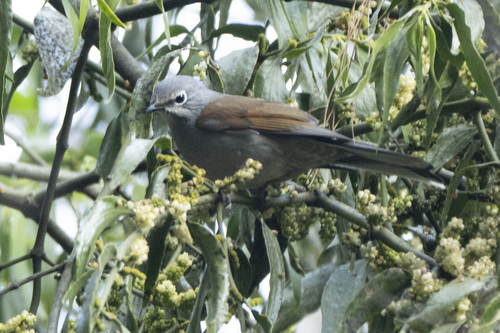
The thicket tinamou or rufescent tinamou (Crypturellus cinnamomeus) is a type of tinamou commonly found in moist forests in subtropical and tropical central Mexico. All tinamou are from the family Tinamidae, and in the larger scheme are also ratites. Unlike other ratites, tinamous can fly, although in general, they are not strong fliers. All ratites evolved from prehistoric flying birds, and tinamous are the closest living relative of these birds.

René-Primevère Lesson identified the thicket tinamou from a specimen from La Unión, El Salvador., in 1842. The thicket tinamou has many subspecies as follows: C. c. cinnamomeus (Nominate race) occurs in coastal southeastern Mexico (Chiapas) State, El Salvador, Guatemala, and Honduras.

C. c. occidentalis occurs on the coastal western Mexico; Sinaloa, Nayarit, Jalisco, Colima, Michoacán, and Guerrero States. C. c. mexicanus occurs in coastal northeastern Mexico; Tamaulipas, northern Veracruz, and Puebla States.

C. c. sallaei occurs in southern Mexico; Puebla, Chiapas, Oaxaca, and southern Veracruz States. C. c. goldmani occurs in southeastern Mexico, on the Yucatan Peninsula; Yucatán, Quintana Roo, Campeche,... Wikipedia →


Sounds

Song1:08

Mexico · 2026

© Manuel Grosselet · XC1099294 · CC BY-NC-SA 4.0

Song1:14

Guatemala · 2023

© Scott Olmstead · XC811846 · CC BY-NC-SA 4.0

Song0:04

Nicaragua · 2017

© Liliana Chavarria-Duriaux · XC362986 · CC BY-NC-SA 4.0

Global Distribution

Parks Where Found

# Park Country Daily sighting probability
1 Santa Rosa National Park 🇨🇷 Costa Rica
~30%
2 Rincón de la Vieja National Park 🇨🇷 Costa Rica
~20%
3 Calakmul Biosphere Reserve 🇲🇽 Mexico
~20%
4 El Triunfo 🇲🇽 Mexico
~10%
5 Cañón del Sumidero National Park 🇲🇽 Mexico
~10%
6 Biotopo Cerro Cahuí 🇬🇹 Guatemala
~10%
7 Palo Verde National Park 🇨🇷 Costa Rica
~10%
8 Cumbres de Monterrey National Park 🇲🇽 Mexico
~10%
9 Tikal National Park 🇬🇹 Guatemala
~10%
10 Ostional Wildlife Refuge 🇨🇷 Costa Rica
<5%
11 Las Baulas Marine National Park 🇨🇷 Costa Rica
<5%
12 Cabo Blanco Absolute Nature Reserve 🇨🇷 Costa Rica
<5%
13 Sian Ka'an Biosphere Reserve 🇲🇽 Mexico
<5%
14 Ría Lagartos Biosphere Reserve 🇲🇽 Mexico
<5%
15 Celestún Biosphere Reserve 🇲🇽 Mexico
<5%
16 Monteverde Cloud Forest Reserve 🇨🇷 Costa Rica
<5%
17 Masaya Volcano National Park 🇳🇮 Nicaragua
<5%
18 Tenorio Volcano National Park 🇨🇷 Costa Rica
<5%

Cities Where Found

# City Country Daily sighting probability
1 San Salvador 🇸🇻 El Salvador
<5%

Before you go

What are the chances of seeing a Thicket Tinamou in El Triunfo?

With luck

About 10% of wildlife watchers report a Thicket Tinamou sighting in El Triunfo on a given day, based on 27 verified sightings from GBIF citizen-science data from 2019 to 2026. It is the 135th most-seen of the 221 birds we can rate there. Over three days the chance rises to about 40%, and over a week to about 60%, if each day is a fresh chance.

When is the best time to see a Thicket Tinamou in El Triunfo?

April

In that month about 50% of wildlife watchers report a Thicket Tinamou in El Triunfo on a given day, against under 5% in November and December, the lowest months. That is one of El Triunfo's driest months, with about 65 mm of rain against 420 mm in June. June has too few records to rate.

What time of day is best to see a Thicket Tinamou?

Between 7 and 10 am

Across all the parks we cover, that three-hour window holds the most Thicket Tinamou sightings with a recorded time, and about 8 in 10 of them come between 6 am and 6 pm: it is a daytime animal.

Where does the Thicket Tinamou sighting chance come from?

GBIF citizen-science records

It is estimated from how often the Thicket Tinamou is recorded against all the birds logged in El Triunfo (27 verified sightings from 2019 to 2026), calibrated against known sighting rates. Figures are rounded to the nearest 10% because citizen-science data supports honest approximations, not decimals, and months with records from fewer than five people show "—". How it works.

← Back to El Triunfo