Ardea modesta

Ardea modesta

Ardea modesta

Silhouette: Giles Laurent · PhyloPic

Daily sighting probability ~30% · Possible
at Fiordland National Park

In 3 days ~60% in a week ~90%

52 Verified sightings at Fiordland National Park From 2019 to 2026
87 In all 5 parks
June Best month
☀️ Diurnal When it's spotted

About the Ardea modesta

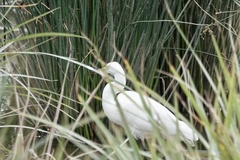
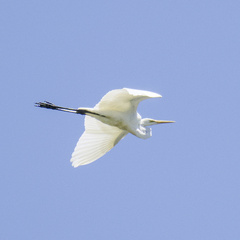
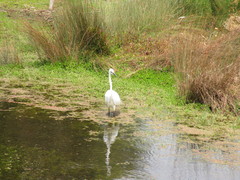
The eastern great egret (Ardea alba modesta) is a species of heron from the genus Ardea, usually considered a subspecies of the great egret (A. alba). In New Zealand it is known as the white heron or by its Māori name kōtuku. It was first described by British ornithologist John Edward Gray in 1831.

This species was originally described as the "pure white heron of India", Ardea modesta, by Gray in 1831, but was later generally considered a synonym of Ardea alba, by Ellman in 1861 through to the Peters checklist in 1979. It was elevated to species status again by Sibley and Monroe in 1990, and this was supported by a 2005 revision of the herons. It is still sometimes considered a subspecies of the great egret Ardea alba.

Measuring 83–103 centimetres (33–41 in) in length and weighing 0.7–1.2 kilograms (1 lb 9 oz – 2 lb 10 oz), the eastern great egret is a large heron with all-white plumage. Its bill is black in the breeding season and yellow at other times, and its long legs are red or black. The colours of the bare parts of the face change to green during the breeding season. The breeding plumage is also marked by long neck plumes and a green facial area... Wikipedia →

Sounds

Recording0:04

Australia · 2023

© Vermilingua_pygmaeus · iNaturalist · CC BY-NC 4.0

Global Distribution

Parks Where Found

# Park Country Daily sighting probability
1 Fiordland National Park 🇳🇿 New Zealand
~30%
2 Kakadu National Park 🇦🇺 Australia
~20%
3 Kinabatangan Wildlife Sanctuary 🇲🇾 Malaysia
~10%
4 Abel Tasman National Park 🇳🇿 New Zealand
~10%
5 Daintree National Park 🇦🇺 Australia
~10%

Cities Where Found

# City Country Daily sighting probability
1 Sendai 🇯🇵 Japan
~40%
2 Fukuoka 🇯🇵 Japan
~20%
3 Denpasar 🇮🇩 Indonesia
~20%
4 Perth 🇦🇺 Australia
~10%
5 Brisbane 🇦🇺 Australia
~10%
6 Bangkok 🇹🇭 Thailand
~10%
7 Tokyo 🇯🇵 Japan
~10%
8 Guangzhou 🇨🇳 China
~10%
9 Mumbai 🇮🇳 India
~10%
10 Melbourne 🇦🇺 Australia
~10%

Before you go

What are the chances of seeing an Ardea modesta in Fiordland National Park?

Possible

About 30% of wildlife watchers report an Ardea modesta sighting in Fiordland National Park on a given day, based on 52 verified sightings from GBIF citizen-science data from 2019 to 2026. It is the 30th most-seen of the 94 birds we can rate there. Over three days the chance rises to about 60%, and over a week to about 90%, if each day is a fresh chance.

When is the best time to see an Ardea modesta in Fiordland National Park?

June

In that month about 50% of wildlife watchers report an Ardea modesta in Fiordland National Park on a given day, against under 5% in November and December, the lowest months.

What time of day is best to see an Ardea modesta?

Between 5 and 8 am

Across all the parks we cover, that three-hour window holds the most Ardea modesta sightings with a recorded time, and about 9 in 10 of them come between 6 am and 6 pm: it is a daytime animal.

Is Fiordland National Park the best place to see an Ardea modesta?

Yes

Of the 5 parks where we can rate Ardea modesta sightings, Fiordland National Park has the highest daily chance: about 30%. Next come Kakadu National Park (Australia, about 20%) and Kinabatangan Wildlife Sanctuary (Malaysia, about 10%).

Where does the Ardea modesta sighting chance come from?

GBIF citizen-science records

It is estimated from how often the Ardea modesta is recorded against all the birds logged in Fiordland National Park (52 verified sightings from 2019 to 2026), calibrated against known sighting rates. Figures are rounded to the nearest 10% because citizen-science data supports honest approximations, not decimals, and months with records from fewer than five people show "—". How it works.

← Back to Fiordland National Park