Little Raven

Little Raven

Corvus mellori

Silhouette: Peileppe · PhyloPic

LCLeast ConcernNTVUENCR Endemic
Daily sighting probability ~40% · Likely
at Flinders Chase

In 3 days ~80% in a week >90%

48 Verified sightings at Flinders Chase From 2019 to 2026
2,264 In all 8 parks
October Best month
☀️ Diurnal When it's spotted

About the Little Raven

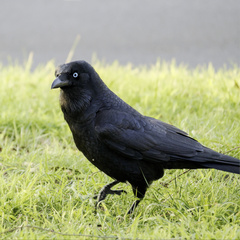
The little raven (Corvus mellori) is a species of the family Corvidae that is native to southeastern Australia. An adult individual is about 48–50 cm (19–19.5 in) in length, with completely black plumage, beak, and legs; as with all Australian species of Corvus, the black feathers have a grey base, and the iris of the adult bird is white (typical also of some related species from islands to the north of Australia). Although the little raven was first named by Gregory Mathews in 1912, it was only in 1967 that there was consensus to separate it from the Australian raven (C. coronoides) as a distinct species.

In the 1960s, the CSIRO were intensively studying Australian raven populations and their relationship to lambing and sheep in southeastern Australia. It became evident that there was a smaller species of raven living alongside the Australian raven. These birds lived in smaller trees, had smaller throat hackles and lacked the bare skin of their larger relative. They were also nomadic and made different calls. Ian Rowley investigated old scientific names assigned to type specimens and concluded that they matched Corvus mellori as described by Gregory Mathews in 1912 as... Wikipedia →

Sounds

Call0:23

Australia · 2024

© Romuald Mikusek · XC1170155 · CC BY-NC-SA 4.0

Flight call0:24

Australia · 2025

© Étienne Leroy · XC1069907 · CC BY-NC-SA 4.0

Begging call0:11

Australia · 2025

© Nick Talbot · XC1069409 · CC BY-NC-SA 4.0

Global Distribution

Parks Where Found

# Park Country Daily sighting probability
1 Great Otway National Park 🇦🇺 Australia
~40%
2 Flinders Chase 🇦🇺 Australia
~40%
3 Kosciuszko National Park 🇦🇺 Australia
~30%
4 Wilsons Promontory National Park 🇦🇺 Australia
~30%
5 Grampians National Park 🇦🇺 Australia
~20%
6 Flinders Ranges National Park 🇦🇺 Australia
~10%
7 Hattah-Kulkyne National Park 🇦🇺 Australia
~10%
8 Blue Mountains National Park 🇦🇺 Australia
<5%

Cities Where Found

# City Country Daily sighting probability
1 Melbourne 🇦🇺 Australia
~80%
2 Sydney 🇦🇺 Australia
<5%

Before you go

What are the chances of seeing a Little Raven in Flinders Chase?

Likely

About 40% of wildlife watchers report a Little Raven sighting in Flinders Chase on a given day, based on 48 verified sightings from GBIF citizen-science data from 2019 to 2026. It is the 17th most-seen of the 68 birds we can rate there. Over three days the chance rises to about 80%, and over a week to over 90%, if each day is a fresh chance.

When is the best time to see a Little Raven in Flinders Chase?

March and October

In those months about 60% of wildlife watchers report a Little Raven in Flinders Chase on a given day, against about 30% in April–June and December–January, the lowest months. August has too few records to rate.

What time of day is best to see a Little Raven?

Between 1 and 4 pm

Across all the parks we cover, that three-hour window holds the most Little Raven sightings with a recorded time, and nearly all of them come between 6 am and 6 pm: it is a daytime animal.

Is Flinders Chase the best place to see a Little Raven?

Among the best

Of the 8 parks where we can rate Little Raven sightings, Flinders Chase ranks 2nd at about 40%, level with the leaders once rounded. The best odds are in Great Otway National Park (Australia, about 40%). All parks ranked.

Where does the Little Raven sighting chance come from?

GBIF citizen-science records

It is estimated from how often the Little Raven is recorded against all the birds logged in Flinders Chase (48 verified sightings from 2019 to 2026), calibrated against known sighting rates. Figures are rounded to the nearest 10% because citizen-science data supports honest approximations, not decimals, and months with records from fewer than five people show "—". How it works.

← Back to Flinders Chase