Black-headed Grosbeak

Black-headed Grosbeak

Pheucticus melanocephalus

Silhouette: Sheatherius · PhyloPic

LCLeast ConcernNTVUENCR
Daily sighting probability ~10% · With luck
at Glacier National Park

In 3 days ~40% in a week ~60%

365 Verified sightings at Glacier National Park From 2019 to 2026
9,020 In all 26 parks
June Best month
☀️ Diurnal When it's spotted

About the Black-headed Grosbeak

The black-headed grosbeak (Pheucticus melanocephalus) is a medium-sized, seed-eating bird in the family Cardinalidae. It is sometimes considered conspecific with the rose-breasted grosbeak (P. ludovicianus) with which it hybridizes on the American Great Plains.

The 19 cm (7.5 in) long, 47 g (1.7 oz) black-headed grosbeak is a migratory bird, with nesting grounds from southwestern British Columbia, through the western half of the United States, into central Mexico. It occurs as a vagrant further south in Central America.

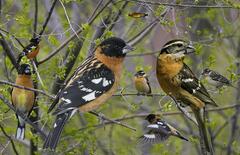
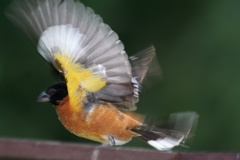
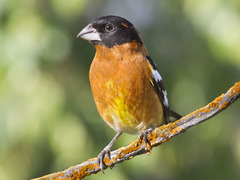
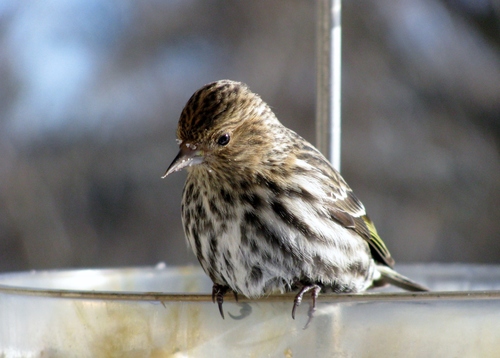
Measurements: Length: 7.1–7.5 in (18–19 cm) Weight: 1.2–1.7 oz (34–48 g) Wingspan: 12.6 inches (32 cm) The black-headed grosbeak is similar in size to a common starling. As per its name, the male has a black head, and black wings and tail with prominent white patches. Its breast is dark to tawny orange in color, and its belly is yellow. The female has a brown head, neck, and back with sparrow-like black streaks. She also has white streaks down the middle of her head, over her eyes, and on her cheeks. Her breast is white, and wings and tail are grayish-brown with two white wing bars and yellowish wing edges.

The black-headed grosbeak... Wikipedia →

Sounds

Song1:21

United States · 2026

© Greg Irving · XC1150136 · CC BY-NC-SA 4.0

Call0:25

Mexico · 2024

© Matthew L. Brady · XC978332 · CC BY-NC-SA 4.0

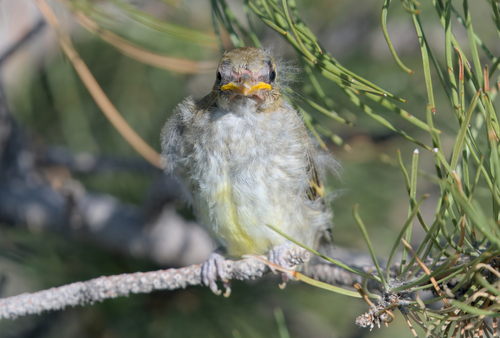
Begging call0:34

United States · 2022

© Richard E. Webster · XC771206 · CC BY-NC-SA 4.0

Global Distribution

Parks Where Found

# Park Country Daily sighting probability
1 Yosemite National Park 🇺🇸 United States
~40%
2 Zion National Park 🇺🇸 United States
~30%
3 Big Bend National Park 🇺🇸 United States
~20%
4 Guadalupe Mountains National Park 🇺🇸 United States
~20%
5 Grand Teton National Park 🇺🇸 United States
~20%
6 Sequoia and Kings Canyon National Parks 🇺🇸 United States
~20%
7 Reserva de la Biosfera Mariposa Monarca 🇲🇽 Mexico
~20%
8 Cabo Pulmo National Park 🇲🇽 Mexico
~20%
9 Grand Canyon National Park 🇺🇸 United States
~10%
10 Glacier National Park 🇺🇸 United States
~10%
11 Cumbres de Monterrey National Park 🇲🇽 Mexico
~10%
12 Redwood National Park 🇺🇸 United States
~10%
13 Rocky Mountain National Park 🇺🇸 United States
~10%
14 Saguaro National Park 🇺🇸 United States
~10%
15 Death Valley National Park 🇺🇸 United States
~10%
16 Olympic National Park 🇺🇸 United States
~10%
17 Channel Islands National Park 🇺🇸 United States
<5%
18 Joshua Tree National Park 🇺🇸 United States
<5%
19 Pacific Rim National Park Reserve 🇨🇦 Canada
<5%
20 Kluane National Park 🇨🇦 Canada
<5%
21 Bahía de Loreto National Park 🇲🇽 Mexico
<5%
22 Great Bear Rainforest 🇨🇦 Canada
<5%
23 Badlands National Park 🇺🇸 United States
<5%
24 Yellowstone National Park 🇺🇸 United States
<5%
25 Banff National Park 🇨🇦 Canada
<5%
26 El Vizcaíno Biosphere Reserve 🇲🇽 Mexico
<5%

Cities Where Found

# City Country Daily sighting probability
1 Toluca 🇲🇽 México
~40%
2 Mexico City 🇲🇽 México
~20%
3 Puebla 🇲🇽 México
~20%
4 Guadalajara 🇲🇽 México
~10%
5 Salt Lake City 🇺🇸 United States
~10%
6 Portland 🇺🇸 United States
~10%
7 Vancouver 🇨🇦 Canada
~10%
8 Sacramento 🇺🇸 United States
~10%
9 Las Vegas 🇺🇸 United States
~10%
10 Los Angeles 🇺🇸 United States
~10%

Zoos & Centres Where Found

# Zoo / Centre Country
1 Parque Zoológico de León - Zooleón 🇲🇽 Mexico In captivity
2 Xcaret 🇲🇽 Mexico In captivity
3 Arizona-Sonora Desert Museum 🇺🇸 United States In captivity
4 Parque museo La Venta 🇲🇽 Mexico In captivity

Before you go

What are the chances of seeing a Black-headed Grosbeak in Glacier National Park?

With luck

About 10% of wildlife watchers report a Black-headed Grosbeak sighting in Glacier National Park on a given day, based on 365 verified sightings from GBIF citizen-science data from 2019 to 2026. It is the 54th most-seen of the 174 birds we can rate there. Over three days the chance rises to about 40%, and over a week to about 60%, if each day is a fresh chance.

When is the best time to see a Black-headed Grosbeak in Glacier National Park?

June

In that month about 30% of wildlife watchers report a Black-headed Grosbeak in Glacier National Park on a given day, against under 5% in January–February, April–May and September–November, the lowest months.

What time of day is best to see a Black-headed Grosbeak?

Between 7 and 10 am

Across all the parks we cover, that three-hour window holds the most Black-headed Grosbeak sightings with a recorded time, and about 9 in 10 of them come between 6 am and 6 pm: it is a daytime animal.

Is Glacier National Park the best place to see a Black-headed Grosbeak?

10th of 26

Of the 26 parks where we can rate Black-headed Grosbeak sightings, Glacier National Park ranks 10th at about 10%. The best odds are in Yosemite National Park (United States, about 40%), Zion National Park (United States, about 30%) and Big Bend National Park (United States, about 20%).

Which relatives of the Black-headed Grosbeak live in Glacier National Park?

Same family: Cardinalidae

The closest relatives of the Black-headed Grosbeak that you can see in Glacier National Park (family Cardinalidae, Cardinals and Allies) are Western Tanager (about 40%) and Lazuli Bunting (about 10%), with each one's daily chance of a sighting.

Where does the Black-headed Grosbeak sighting chance come from?

GBIF citizen-science records

It is estimated from how often the Black-headed Grosbeak is recorded against all the birds logged in Glacier National Park (365 verified sightings from 2019 to 2026), calibrated against known sighting rates. Figures are rounded to the nearest 10% because citizen-science data supports honest approximations, not decimals, and months with records from fewer than five people show "—". How it works.

← Back to Glacier National Park