Vesper Sparrow

Vesper Sparrow

Pooecetes gramineus

Silhouette: L. Shyamal · PhyloPic

LCLeast ConcernNTVUENCR
Daily sighting probability <5% · Rare
at Grand Canyon National Park

In 3 days ~10%

47 Verified sightings at Grand Canyon National Park From 2019 to 2026
3,677 In all 25 parks
September Best month
☀️ Diurnal When it's spotted

About the Vesper Sparrow

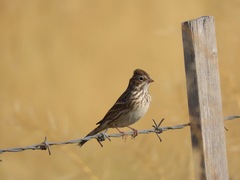
The vesper sparrow (Pooecetes gramineus) is a medium-sized New World sparrow. The only member of the genus Pooecetes, it is a pale sparrow with brown streaks that breeds across the grasslands of northern North America. It migrates to winter in the southern United States and Mexico.

The vesper sparrow was formally described in 1789 by the German naturalist Johann Friedrich Gmelin in his revised and expanded edition of Carl Linnaeus's Systema Naturae. He placed it with the finches in the genus Fringilla and coined the binomial name Fringilla graminea. He gave the locality as New York. Gmelin based his own description on those for the "grass finch" that had been described by John Latham in 1783 and by Thomas Pennant in 1785. The vesper sparrow is now the only species placed in the genus Pooecetes that was introduced in 1858 by the American naturalist Spencer Baird. The genus name combines the Ancient Greek ποα (poa) meaning "grass" with οικητης (oikētēs) meaning "dweller". The specific epithet gramineus is Latin meaning "grassy" or "grass-like".

Three subspecies are recognised. Wikipedia →

Sounds

Song1:09

United States · 2026

© Valerie Heemstra · XC1154980 · CC BY-NC-SA 4.0

Call0:07

United States · 2020

© Richard E. Webster · XC611675 · CC BY-NC-SA 4.0

Canto0:46

United States · 2019

© Caio Brito · XC556523 · CC BY-NC-SA 4.0

Global Distribution

Parks Where Found

# Park Country Daily sighting probability
1 Yellowstone National Park 🇺🇸 United States
~20%
2 Big Bend National Park 🇺🇸 United States
~10%
3 Grand Teton National Park 🇺🇸 United States
~10%
4 Rocky Mountain National Park 🇺🇸 United States
~10%
5 Badlands National Park 🇺🇸 United States
~10%
6 Zion National Park 🇺🇸 United States
~10%
7 Death Valley National Park 🇺🇸 United States
<5%
8 Riding Mountain National Park 🇨🇦 Canada
<5%
9 Guadalupe Mountains National Park 🇺🇸 United States
<5%
10 Glacier National Park 🇺🇸 United States
<5%
11 Joshua Tree National Park 🇺🇸 United States
<5%
12 Grand Canyon National Park 🇺🇸 United States
<5%
13 El Vizcaíno Biosphere Reserve 🇲🇽 Mexico
<5%
14 Padre Island National Seashore 🇺🇸 United States
<5%
15 Jasper National Park 🇨🇦 Canada
<5%
16 Saguaro National Park 🇺🇸 United States
<5%
17 Cumbres de Monterrey National Park 🇲🇽 Mexico
<5%
18 Banff National Park 🇨🇦 Canada
<5%
19 Point Pelee National Park 🇨🇦 Canada
<5%
20 Congaree National Park 🇺🇸 United States
<5%
21 Great Smoky Mountains National Park 🇺🇸 United States
<5%
22 Channel Islands National Park 🇺🇸 United States
<5%
23 Sequoia and Kings Canyon National Parks 🇺🇸 United States
<5%
24 Merritt Island National Wildlife Refuge 🇺🇸 United States
<5%
25 Yosemite National Park 🇺🇸 United States
<5%

Cities Where Found

# City Country Daily sighting probability
1 León 🇲🇽 México
~10%
2 Denver 🇺🇸 United States
<5%
3 San Antonio 🇺🇸 United States
<5%
4 Austin 🇺🇸 United States
<5%
5 Salt Lake City 🇺🇸 United States
<5%
6 Mexico City 🇲🇽 México
<5%
7 Monterrey 🇲🇽 México
<5%
8 Mesa 🇺🇸 United States
<5%
9 Phoenix 🇺🇸 United States
<5%
10 Guadalajara 🇲🇽 México
<5%

Before you go

What are the chances of seeing a Vesper Sparrow in Grand Canyon National Park?

Rare

Under 5% of wildlife watchers report a Vesper Sparrow sighting in Grand Canyon National Park on a given day, based on 47 verified sightings from GBIF citizen-science data from 2019 to 2026. It is the 112th most-seen of the 194 birds we can rate there. Over three days the chance rises to about 10%, if each day is a fresh chance.

When is the best time to see a Vesper Sparrow in Grand Canyon National Park?

September

In that month about 10% of wildlife watchers report a Vesper Sparrow in Grand Canyon National Park on a given day, against under 5% in October to August, the lowest months.

What time of day is best to see a Vesper Sparrow?

Between 9 am and noon

Across all the parks we cover, that three-hour window holds the most Vesper Sparrow sightings with a recorded time, and about 9 in 10 of them come between 6 am and 6 pm: it is a daytime animal.

Is Grand Canyon National Park the best place to see a Vesper Sparrow?

12th of 25

Of the 25 parks where we can rate Vesper Sparrow sightings, Grand Canyon National Park ranks 12th at under 5%. The best odds are in Yellowstone National Park (United States, about 20%), Big Bend National Park (United States, about 10%) and Grand Teton National Park (United States, about 10%).

Which relatives of the Vesper Sparrow live in Grand Canyon National Park?

Same family: Passerellidae

The closest relatives of the Vesper Sparrow that you can see in Grand Canyon National Park (family Passerellidae, New World Sparrows) are Dark-eyed Junco (about 50%), Spotted Towhee (about 40%) and Chipping Sparrow (about 30%), with each one's daily chance of a sighting.

Where does the Vesper Sparrow sighting chance come from?

GBIF citizen-science records

It is estimated from how often the Vesper Sparrow is recorded against all the birds logged in Grand Canyon National Park (47 verified sightings from 2019 to 2026), calibrated against known sighting rates. Figures are rounded to the nearest 10% because citizen-science data supports honest approximations, not decimals, and months with records from fewer than five people show "—". How it works.

← Back to Grand Canyon National Park