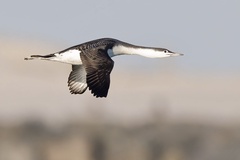
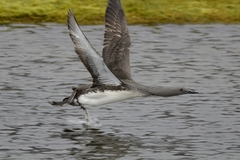
Red-throated Loon

Red-throated Loon

Gavia stellata

Silhouette: Andy Wilson · PhyloPic

LCLeast ConcernNTVUENCR
Daily sighting probability ~10% · With luck
at Great Bear Rainforest

In 3 days ~30% in a week ~50%

697 Verified sightings at Great Bear Rainforest From 2019 to 2026
4,639 In all 19 parks
July Best month
☀️ Diurnal When it's spotted

About the Red-throated Loon

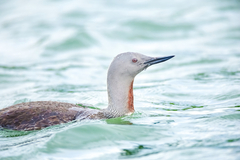
The red-throated loon (North America) or red-throated diver (Britain and Ireland) (Gavia stellata) is a migratory aquatic bird found in the Northern Hemisphere. The most widely distributed member of the loon or diver family, it breeds primarily in Arctic regions, and it winters in northern coastal waters. Ranging from 55 to 67 centimetres (22 to 26 in) in length, the red-throated loon is the smallest and lightest of the world's loons. In winter, it is a nondescript bird, greyish above, fading to white below. During the breeding season, it acquires the distinctive reddish throat patch, which is the basis for its common name. Fish form the bulk of its diet, though amphibians, invertebrates, and plant material are sometimes eaten as well. A monogamous species, red-throated loons form long-term pair bonds. Both members of the pair help to build the nest, incubate the eggs (generally two per clutch), and feed the hatched young.

The red-throated loon has a large global population and a significant global range, though some populations are declining. Oil spills, habitat degradation, pollution, and fishing nets are among the major threats this species faces. Natural predators—including various gull species, and both red and Arctic foxes, will take eggs and young. The species is protected by international treaties. Wikipedia →

Sounds

Flight call0:24

Sweden · 2026

© Teet Sirotkin · XC1156172 · CC BY-NC-SA 4.0

Song0:15

Sweden · 2022

© Marc Anderson · XC1080427 · CC BY-NC-ND 4.0

Recording1:27

Finland · 2017

© Markku Miettinen · XC975871 · CC BY-NC-SA 4.0

Global Distribution

Parks Where Found

# Park Country Daily sighting probability
1 Svalbard 🇳🇴 Norway
~50%
2 Vatnajokull National Park 🇮🇸 Iceland
~40%
3 Redwood National Park 🇺🇸 United States
~10%
4 Pacific Rim National Park Reserve 🇨🇦 Canada
~10%
5 Great Bear Rainforest 🇨🇦 Canada
~10%
6 Wadden Sea National Park 🇩🇪 Germany
~10%
7 Olympic National Park 🇺🇸 United States
~10%
8 Acadia National Park 🇺🇸 United States
~10%
9 Kenai Fjords National Park 🇺🇸 United States
~10%
10 Channel Islands National Park 🇺🇸 United States
<5%
11 Katmai National Park 🇺🇸 United States
<5%
12 Cairngorms National Park 🇬🇧 United Kingdom
<5%
13 Kluane National Park 🇨🇦 Canada
<5%
14 Snowdonia National Park 🇬🇧 United Kingdom
<5%
15 Gros Morne National Park 🇨🇦 Canada
<5%
16 Cape Breton Highlands National Park 🇨🇦 Canada
<5%
17 Point Pelee National Park 🇨🇦 Canada
<5%
18 Triglav National Park 🇸🇮 Slovenia
<5%
19 El Vizcaíno Biosphere Reserve 🇲🇽 Mexico
<5%

Cities Where Found

# City Country Daily sighting probability
1 Antalya 🇹🇷 Turkey
~10%
2 Dublin 🇮🇪 Ireland
<5%
3 Moscow 🇷🇺 Russia
<5%
4 Boston 🇺🇸 United States
<5%
5 San Francisco 🇺🇸 United States
<5%
6 Rotterdam [The Hague] 🇳🇱 Netherlands
<5%
7 San Diego 🇺🇸 United States
<5%
8 New York City 🇺🇸 United States
<5%
9 Bucharest 🇷🇴 Romania
<5%
10 Seattle 🇺🇸 United States
<5%

Before you go

What are the chances of seeing a Red-throated Loon in Great Bear Rainforest?

With luck

About 10% of wildlife watchers report a Red-throated Loon sighting in Great Bear Rainforest on a given day, based on 697 verified sightings from GBIF citizen-science data from 2019 to 2026. It is the 70th most-seen of the 239 birds we can rate there. Over three days the chance rises to about 30%, and over a week to about 50%, if each day is a fresh chance.

When is the best time to see a Red-throated Loon in Great Bear Rainforest?

March to January

In those months about 10% of wildlife watchers report a Red-throated Loon in Great Bear Rainforest on a given day, against under 5% in February, the lowest month.

What time of day is best to see a Red-throated Loon?

Between 9 am and noon

Across all the parks we cover, that three-hour window holds the most Red-throated Loon sightings with a recorded time, and about 8 in 10 of them come between 6 am and 6 pm: it is a daytime animal.

Is Great Bear Rainforest the best place to see a Red-throated Loon?

5th of 19

Of the 19 parks where we can rate Red-throated Loon sightings, Great Bear Rainforest ranks 5th at about 10%. The best odds are in Svalbard (Norway, about 50%), Vatnajokull National Park (Iceland, about 40%) and Redwood National Park (United States, about 10%).

Which relatives of the Red-throated Loon live in Great Bear Rainforest?

Same genus: Gavia

The closest relatives of the Red-throated Loon that you can see in Great Bear Rainforest (genus Gavia, Loons) are Common Loon (about 30%) and Pacific Loon (about 20%), with each one's daily chance of a sighting.

Where does the Red-throated Loon sighting chance come from?

GBIF citizen-science records

It is estimated from how often the Red-throated Loon is recorded against all the birds logged in Great Bear Rainforest (697 verified sightings from 2019 to 2026), calibrated against known sighting rates. Figures are rounded to the nearest 10% because citizen-science data supports honest approximations, not decimals, and months with records from fewer than five people show "—". How it works.

← Back to Great Bear Rainforest