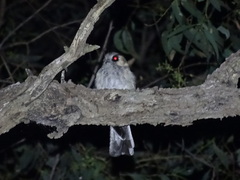
Australian Owlet-nightjar

Australian Owlet-nightjar

Aegotheles cristatus

Silhouette: Christopher Watson (photo) and T. Michael Keesey (vectorization) · PhyloPic

LCLeast ConcernNTVUENCR
Daily sighting probability <5% · Rare
at Great Otway National Park

In 3 days <5% in a week ~10%

31 Verified sightings at Great Otway National Park From 2019 to 2026
523 In all 9 parks
January Best month
☀️🌙 Day & Night When it's spotted

About the Australian Owlet-nightjar

The Australian owlet-nightjar (Aegotheles cristatus) is a nocturnal bird found in open woodland across Australia and in southern New Guinea. It is the smallest nocturnal bird found in Australia, making it prone to predation. It is colloquially known as the moth owl or fairy owl and Jarlajirrpi by the Warlpiri people. It is the most common nocturnal bird in Australia. Despite suffering from predation and competition by introduced species, it is not considered threatened.

The Australian owlet-nightjar was formally described as Caprimulgus cristatus in 1790 by the English naturalist George Shaw based on a specimen collected in New South Wales, Australia. The species was described in the same year by John Latham as Caprimulgus novaehollandiae but Shaw's account is believed to be earlier and thus has precedence. The Australian owlet-nightjar was previously placed in Caprimulgiformes but updated taxonomy now places it in Aegotheliformes. The Australian owlet-nightjar is now one of ten species placed in the genus Aegotheles that was introduced in 1827 by the naturalists Nicholas Vigors and Thomas Horsfield. It is the type species of the genus. The specific epithet cristatus... Wikipedia →

Sounds

Call0:41

Australia · 2023

© Romuald Mikusek · XC1173984 · CC BY-NC-SA 4.0

Song0:57

Australia · 2019

© Marc Anderson · XC600066 · CC BY-NC-ND 4.0

Call0:35

Australia · 2025

© Peter Boesman · XC1066338 · CC BY-NC-ND 4.0

Global Distribution

Parks Where Found

# Park Country Daily sighting probability
1 Hattah-Kulkyne National Park 🇦🇺 Australia
~10%
2 Nitmiluk National Park 🇦🇺 Australia
<5%
3 Kosciuszko National Park 🇦🇺 Australia
<5%
4 Lamington National Park 🇦🇺 Australia
<5%
5 Flinders Ranges National Park 🇦🇺 Australia
<5%
6 Kakadu National Park 🇦🇺 Australia
<5%
7 Blue Mountains National Park 🇦🇺 Australia
<5%
8 Great Otway National Park 🇦🇺 Australia
<5%
9 Royal National Park 🇦🇺 Australia
<5%

Cities Where Found

# City Country Daily sighting probability
1 Melbourne 🇦🇺 Australia
<5%
2 Sydney 🇦🇺 Australia
<5%
3 Brisbane 🇦🇺 Australia
<5%

Zoos & Centres Where Found

# Zoo / Centre Country
1 Territory Wildlife Park 🇦🇺 Australia In captivity

Before you go

What are the chances of seeing an Australian Owlet-nightjar in Great Otway National Park?

Rare

Under 5% of wildlife watchers report an Australian Owlet-nightjar sighting in Great Otway National Park on a given day, based on 31 verified sightings from GBIF citizen-science data from 2019 to 2026. It is the 150th most-seen of the 175 birds we can rate there. Over three days the chance rises to under 5%, and over a week to about 10%, if each day is a fresh chance.

When is the best time to see an Australian Owlet-nightjar in Great Otway National Park?

Any time of year

In every month with enough records, under 5% of wildlife watchers report an Australian Owlet-nightjar in Great Otway National Park on a given day, so our monthly data shows no clear season.

What time of day is best to see an Australian Owlet-nightjar?

Between 8 and 11 pm

Across all the parks we cover, that three-hour window holds the most Australian Owlet-nightjar sightings with a recorded time, and about 6 in 10 of them come between 6 am and 6 pm: it is seen both by day and at night.

Is Great Otway National Park the best place to see an Australian Owlet-nightjar?

8th of 9

Of the 9 parks where we can rate Australian Owlet-nightjar sightings, Great Otway National Park ranks 8th at under 5%. The best odds are in Hattah-Kulkyne National Park (Australia, about 10%), Nitmiluk National Park (Australia, under 5%) and Kosciuszko National Park (Australia, under 5%).

Where does the Australian Owlet-nightjar sighting chance come from?

GBIF citizen-science records

It is estimated from how often the Australian Owlet-nightjar is recorded against all the birds logged in Great Otway National Park (31 verified sightings from 2019 to 2026), calibrated against known sighting rates. Figures are rounded to the nearest 10% because citizen-science data supports honest approximations, not decimals, and months with records from fewer than five people show "—". How it works.

← Back to Great Otway National Park