
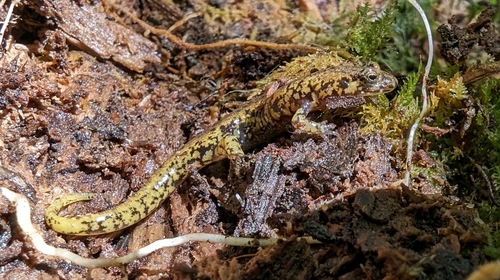
Hellbender

Hellbender

Cryptobranchus alleganiensis

Silhouette: Y. de Hoev. (vectorized by T. Michael Keesey) · PhyloPic

LCNTVUVulnerableENCR Endemic
Daily sighting probability ~10% · With luck
at Great Smoky Mountains National Park

In 3 days ~20% in a week ~40%

27 Verified sightings at Great Smoky Mountains National Park From 2019 to 2026
27 In 1 park
July Best month
☀️ Diurnal When it's spotted

About the Hellbender

The hellbender (Cryptobranchus alleganiensis), also known as the hellbender salamander, is a species of aquatic giant salamander endemic to the eastern and central United States. It is the largest salamander in North America. A member of the family Cryptobranchidae, the hellbender is the only extant member of the genus Cryptobranchus. Other closely related salamanders in the same family are in the genus Andrias, which contains the Japanese and Chinese giant salamanders. The hellbender is much larger than any other salamander in its geographic range, and employs an unusual adaption for respiration through cutaneous gas exchange via capillaries found in its lateral skin folds. It fills a particular niche—both as a predator and prey—in its ecosystem, which either it or its ancestors have occupied for around 65 million years. The species is listed as Vulnerable on the IUCN Red List of Threatened Species due to the impacts of disease and widespread habitat loss and degradation throughout much of its range. Eastern hellbender populations are dropping quickly across most of their range, nearly 80% are declining or disappearing altogether. A reason for this is the loss of forest along streams, which they rely on to keep their habitats stable and clean. In many places, the populations are mostly older individuals, with few young hellbenders showing up to replace them. Wikipedia →

Global Distribution

Parks Where Found

# Park Country Daily sighting probability
1 Great Smoky Mountains National Park 🇺🇸 United States
~10%

More parks will be added in future updates.

Zoos & Centres Where Found

# Zoo / Centre Country
1 National Zoological Park 🇺🇸 United States In captivity
2 North Carolina Zoo 🇺🇸 United States In captivity
3 The Wilds 🇺🇸 United States In captivity
4 Columbus Zoo and Aquarium 🇺🇸 United States In captivity
5 Bronx Zoo 🇺🇸 United States In captivity
6 Nashville Zoo at Grassmere 🇺🇸 United States In captivity
7 Milwaukee County Zoo 🇺🇸 United States In captivity
8 Dallas Zoo 🇺🇸 United States In captivity
9 The Maryland Zoo 🇺🇸 United States In captivity
10 Toledo Zoo 🇺🇸 United States In captivity
11 Detroit Zoo 🇺🇸 United States In captivity
12 Louisville Zoo 🇺🇸 United States In captivity
13 Fort Worth Zoo 🇺🇸 United States In captivity
14 Indianapolis Zoo 🇺🇸 United States In captivity
15 Zoo Knoxville 🇺🇸 United States In captivity
16 Mesker Park Zoo and Botanic Garden 🇺🇸 United States In captivity
17 Pittsburgh Zoo & Aquarium 🇺🇸 United States In captivity
18 Riverbanks Zoo 🇺🇸 United States In captivity
19 Rosamond Gifford Zoo 🇺🇸 United States In captivity
20 Turtle Back Zoo 🇺🇸 United States In captivity
21 Western North Carolina Nature Center 🇺🇸 United States In captivity
22 Seneca Park Zoo 🇺🇸 United States In captivity
23 Chattanooga Zoo at Warner Park 🇺🇸 United States In captivity
24 Adventure Aquarium 🇺🇸 United States In captivity
25 Tierpark Reinach 🇨🇭 Switzerland In captivity
26 Wonders of Wildlife Museum & Aquarium 🇺🇸 United States In captivity
27 North Carolina Aquarium at Pine Knoll Shores 🇺🇸 United States In captivity
28 Tennessee Aquarium 🇺🇸 United States In captivity
29 Virginia Living Museum 🇺🇸 United States In captivity
30 World Aquarium 🇺🇸 United States In captivity

Closest Relatives at Great Smoky Mountains National Park

Before you go

What are the chances of seeing a Hellbender in Great Smoky Mountains National Park?

With luck

About 10% of wildlife watchers report a Hellbender sighting in Great Smoky Mountains National Park on a given day, based on 27 verified sightings from GBIF citizen-science data from 2019 to 2026. It is the 31st most-seen of the 36 amphibians we can rate there. Over three days the chance rises to about 20%, and over a week to about 40%, if each day is a fresh chance.

When is the best time to see a Hellbender in Great Smoky Mountains National Park?

April, June–July and September

In those months about 10% of wildlife watchers report a Hellbender in Great Smoky Mountains National Park on a given day, against under 5% in May, August and October–March, the lowest months.

What time of day is best to see a Hellbender?

Between 1 and 4 pm

Across all the parks we cover, that three-hour window holds the most Hellbender sightings with a recorded time, and about 8 in 10 of them come between 6 am and 6 pm: it is a daytime animal.

Where else can you see a Hellbender?

Only Great Smoky Mountains National Park, in our data

Great Smoky Mountains National Park is the only park on Wallace's Line with enough records to rate Hellbender sightings: about 10% of wildlife watchers there report one on a given day.

Where does the Hellbender sighting chance come from?

GBIF citizen-science records

It is estimated from how often the Hellbender is recorded against all the amphibians logged in Great Smoky Mountains National Park (27 verified sightings from 2019 to 2026), calibrated against known sighting rates. Figures are rounded to the nearest 10% because citizen-science data supports honest approximations, not decimals, and months with records from fewer than five people show "—". How it works.

← Back to Great Smoky Mountains National Park