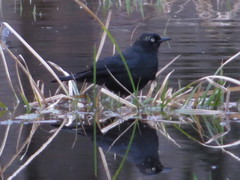
Rusty Blackbird

Rusty Blackbird

Euphagus carolinus

Silhouette: Sheatherius · PhyloPic

LCNTVUVulnerableENCR
Daily sighting probability <5% · Rare
at Great Smoky Mountains National Park

In 3 days <5% in a week ~10%

40 Verified sightings at Great Smoky Mountains National Park From 2019 to 2026
1,609 In all 13 parks
November Best month
☀️ Diurnal When it's spotted

About the Rusty Blackbird

The rusty blackbird (Euphagus carolinus) is a medium-sized New World blackbird, closely related to grackles ("rusty grackle" is an older name for the species). It is a bird that prefers wet forested areas, breeding in the boreal forest and muskeg across northern Canada, and migrating southeast to the United States during winter.

Formerly abundant, the rusty blackbird has undergone one of the most rapid declines of any abundant bird species in North America in recent years, for reasons that are not well understood. Adults have a pointed bill and a pale yellow eye. They have black plumage with faint green and purple gloss; the female is greyer. "Rusty" refers to the brownish winter plumage. They resemble the western member of the same genus, the Brewer's blackbird; however, Brewer's has a longer bill and the male's head is iridescent green.

Their breeding habitat is wet temperate coniferous forests and muskeg across Canada, New England, the Upper Peninsula of Michigan, the Adirondack Mountains in New York and Alaska. Birds usually nest at the edge of ponds and wetlands with the cup nest located in a tree or dense shrub, often over the water. Emerging dragonflies... Wikipedia →

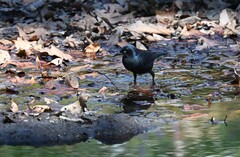
Sounds

Call0:55

United States · 2023

© Valerie Heemstra · XC793958 · CC BY-NC-SA 4.0

Song1:01

United States · 2020

© William Whitehead · XC549771 · CC BY-NC-SA 4.0

Call1:16

United States · 2022

© Jim Berry · XC721774 · CC BY-NC-SA 4.0

Global Distribution

Parks Where Found

# Park Country Daily sighting probability
1 Wrangell-St. Elias National Park 🇺🇸 United States
~20%
2 Wood Buffalo National Park 🇨🇦 Canada
~10%
3 Point Pelee National Park 🇨🇦 Canada
~10%
4 Kluane National Park 🇨🇦 Canada
~10%
5 Congaree National Park 🇺🇸 United States
<5%
6 Gros Morne National Park 🇨🇦 Canada
<5%
7 Cape Breton Highlands National Park 🇨🇦 Canada
<5%
8 Great Smoky Mountains National Park 🇺🇸 United States
<5%
9 Death Valley National Park 🇺🇸 United States
<5%
10 Banff National Park 🇨🇦 Canada
<5%
11 Acadia National Park 🇺🇸 United States
<5%
12 Shenandoah National Park 🇺🇸 United States
<5%
13 Great Bear Rainforest 🇨🇦 Canada
<5%

Cities Where Found

# City Country Daily sighting probability
1 Montreal 🇨🇦 Canada
<5%
2 Washington 🇺🇸 United States
<5%
3 New York City 🇺🇸 United States
<5%
4 Anchorage 🇺🇸 United States
<5%
5 Toronto 🇨🇦 Canada
<5%
6 Chicago 🇺🇸 United States
<5%
7 Dallas 🇺🇸 United States
<5%
8 Calgary 🇨🇦 Canada
<5%
9 Detroit 🇺🇸 United States
<5%
10 Minneapolis [Saint Paul] 🇺🇸 United States
<5%

Before you go

What are the chances of seeing a Rusty Blackbird in Great Smoky Mountains National Park?

Rare

Under 5% of wildlife watchers report a Rusty Blackbird sighting in Great Smoky Mountains National Park on a given day, based on 40 verified sightings from GBIF citizen-science data from 2019 to 2026. It is the 141st most-seen of the 173 birds we can rate there. Over three days the chance rises to under 5%, and over a week to about 10%, if each day is a fresh chance.

When is the best time to see a Rusty Blackbird in Great Smoky Mountains National Park?

November

In that month about 10% of wildlife watchers report a Rusty Blackbird in Great Smoky Mountains National Park on a given day, against under 5% in December to October, the lowest months.

What time of day is best to see a Rusty Blackbird?

Between 1 and 4 pm

Across all the parks we cover, that three-hour window holds the most Rusty Blackbird sightings with a recorded time, and about 8 in 10 of them come between 6 am and 6 pm: it is a daytime animal.

Which relatives of the Rusty Blackbird live in Great Smoky Mountains National Park?

Same family: Icteridae

The closest relatives of the Rusty Blackbird that you can see in Great Smoky Mountains National Park (family Icteridae, New World Blackbirds and Orioles) are Red-winged Blackbird (about 20%), Eastern Meadowlark (about 20%) and Common Grackle (about 10%), with each one's daily chance of a sighting.

Where does the Rusty Blackbird sighting chance come from?

GBIF citizen-science records

It is estimated from how often the Rusty Blackbird is recorded against all the birds logged in Great Smoky Mountains National Park (40 verified sightings from 2019 to 2026), calibrated against known sighting rates. Figures are rounded to the nearest 10% because citizen-science data supports honest approximations, not decimals, and months with records from fewer than five people show "—". How it works.

← Back to Great Smoky Mountains National Park