Orchard Oriole

Orchard Oriole

Icterus spurius

Silhouette: Matt Wilkins · PhyloPic

LCLeast ConcernNTVUENCR
Daily sighting probability <5% · Rare
at Great Smoky Mountains National Park

In 3 days <5% in a week ~10%

52 Verified sightings at Great Smoky Mountains National Park From 2019 to 2026
9,898 In all 48 parks
May Best month
☀️ Diurnal When it's spotted

About the Orchard Oriole

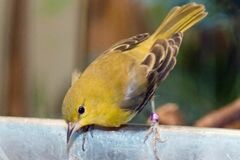
The orchard oriole (Icterus spurius) is the smallest species of icterid. The subspecies of the Caribbean coast of Mexico, I. s. fuertesi, is sometimes considered a separate species, the ochre oriole or Fuertes's oriole. The orchard oriole is a small bird with a length of 5.9-7.1 inches, a weight of 0.6-1.0 ounces, and a wingspan of 9.8 inches. Adult males have chestnut or ochre underparts, while adult females and juveniles have olive-green upper parts and yellowish breasts and bellies. They inhabit semi-open areas with deciduous trees in eastern North America, southern Tamaulipas, and Veracruz. Their winter range extends from central Sinaloa and southern Veracruz to northern Colombia and northwestern Venezuela.

Orchard orioles prefer living near lakes and streams, nesting in tightly woven pouches attached to horizontal tree branches. They are nocturnal migrants and feed on insects, spiders, fruit, nectar, and seeds depending on the season. During flight, they usually swoop close to the ground and fly at or below treetop level. Courtship displays include bowing, seesawing, and begging. The species name "spurius" refers to their original misidentification as female Baltimore orioles, and they are sometimes mistaken for New World warblers. Wikipedia →

Sounds

Song0:04

Canada · 2023

© Tom Cooney · XC1103919 · CC BY-NC-SA 4.0

Call0:13

Mexico · 2024

© Étienne Leroy · XC956455 · CC BY-NC-SA 4.0

Subsong1:22

United States · 2023

© Richard E. Webster · XC820127 · CC BY-NC-SA 4.0

Global Distribution

Parks Where Found

# Park Country Daily sighting probability
1 Point Pelee National Park 🇨🇦 Canada
~40%
2 Lago de Yojoa 🇭🇳 Honduras
~20%
3 Badlands National Park 🇺🇸 United States
~20%
4 El Triunfo 🇲🇽 Mexico
~20%
5 Cerro Azul Meámbar National Park 🇭🇳 Honduras
~20%
6 Masaya Volcano National Park 🇳🇮 Nicaragua
~10%
7 Biotopo Cerro Cahuí 🇬🇹 Guatemala
~10%
8 Celestún Biosphere Reserve 🇲🇽 Mexico
~10%
9 Calakmul Biosphere Reserve 🇲🇽 Mexico
~10%
10 Montes Azules Biosphere Reserve 🇲🇽 Mexico
~10%
11 Big Bend National Park 🇺🇸 United States
~10%
12 Cañón del Sumidero National Park 🇲🇽 Mexico
~10%
13 Tikal National Park 🇬🇹 Guatemala
~10%
14 Pico Bonito National Park 🇭🇳 Honduras
~10%
15 Sian Ka'an Biosphere Reserve 🇲🇽 Mexico
<5%
16 Cockscomb Basin Wildlife Sanctuary 🇧🇿 Belize
<5%
17 San Lorenzo Protected Forest 🇵🇦 Panama
<5%
18 Arrecifes de Cozumel National Park 🇲🇽 Mexico
<5%
19 Ría Lagartos Biosphere Reserve 🇲🇽 Mexico
<5%
20 Las Baulas Marine National Park 🇨🇷 Costa Rica
<5%
21 Soberanía National Park 🇵🇦 Panama
<5%
22 Shenandoah National Park 🇺🇸 United States
<5%
23 La Amistad International Park (Panama) 🇵🇦 Panama
<5%
24 Cabo Blanco Absolute Nature Reserve 🇨🇷 Costa Rica
<5%
25 Carara National Park 🇨🇷 Costa Rica
<5%
26 Congaree National Park 🇺🇸 United States
<5%
27 Piedras Blancas National Park 🇨🇷 Costa Rica
<5%
28 Gandoca-Manzanillo Wildlife Refuge 🇨🇷 Costa Rica
<5%
29 El Vizcaíno Biosphere Reserve 🇲🇽 Mexico
<5%
30 Palo Verde National Park 🇨🇷 Costa Rica
<5%
31 Chagres National Park 🇵🇦 Panama
<5%
32 Manuel Antonio National Park 🇨🇷 Costa Rica
<5%
33 Bastimentos Island National Marine Park 🇵🇦 Panama
<5%
34 Santa Rosa National Park 🇨🇷 Costa Rica
<5%
35 Marino Ballena National Park 🇨🇷 Costa Rica
<5%
36 Arenal Volcano National Park 🇨🇷 Costa Rica
<5%
37 Padre Island National Seashore 🇺🇸 United States
<5%
38 Great Smoky Mountains National Park 🇺🇸 United States
<5%
39 Cumbres de Monterrey National Park 🇲🇽 Mexico
<5%
40 Tortuguero National Park 🇨🇷 Costa Rica
<5%
41 Braulio Carrillo National Park 🇨🇷 Costa Rica
<5%
42 Parque Natural Metropolitano 🇵🇦 Panama
<5%
43 Death Valley National Park 🇺🇸 United States
<5%
44 Rincón de la Vieja National Park 🇨🇷 Costa Rica
<5%
45 Tenorio Volcano National Park 🇨🇷 Costa Rica
<5%
46 Everglades National Park 🇺🇸 United States
<5%
47 Los Quetzales National Park 🇨🇷 Costa Rica
<5%
48 Monteverde Cloud Forest Reserve 🇨🇷 Costa Rica
<5%

Cities Where Found

# City Country Daily sighting probability
1 San Pedro Sula 🇭🇳 Honduras
~20%
2 Guatemala City 🇬🇹 Guatemala
~20%
3 San Salvador 🇸🇻 El Salvador
~10%
4 León 🇲🇽 México
~10%
5 Puebla 🇲🇽 México
~10%
6 Toluca 🇲🇽 México
~10%
7 Baltimore 🇺🇸 United States
~10%
8 Managua 🇳🇮 Nicaragua
~10%
9 Mexico City 🇲🇽 México
~10%
10 Washington 🇺🇸 United States
~10%

Zoos & Centres Where Found

# Zoo / Centre Country
1 National Zoological Park 🇺🇸 United States In captivity
2 Florida Aquarium 🇺🇸 United States In captivity

Before you go

What are the chances of seeing an Orchard Oriole in Great Smoky Mountains National Park?

Rare

Under 5% of wildlife watchers report an Orchard Oriole sighting in Great Smoky Mountains National Park on a given day, based on 52 verified sightings from GBIF citizen-science data from 2019 to 2026. It is the 127th most-seen of the 173 birds we can rate there. Over three days the chance rises to under 5%, and over a week to about 10%, if each day is a fresh chance.

When is the best time to see an Orchard Oriole in Great Smoky Mountains National Park?

Any time of year

In every month with enough records, under 5% of wildlife watchers report an Orchard Oriole in Great Smoky Mountains National Park on a given day, so our monthly data shows no clear season.

What time of day is best to see an Orchard Oriole?

Between 7 and 10 am

Across all the parks we cover, that three-hour window holds the most Orchard Oriole sightings with a recorded time, and about 9 in 10 of them come between 6 am and 6 pm: it is a daytime animal.

Is Great Smoky Mountains National Park the best place to see an Orchard Oriole?

38th of 48

Of the 48 parks where we can rate Orchard Oriole sightings, Great Smoky Mountains National Park ranks 38th at under 5%. The best odds are in Point Pelee National Park (Canada, about 40%), Lago de Yojoa (Honduras, about 20%) and Badlands National Park (United States, about 20%). All parks ranked.

Where does the Orchard Oriole sighting chance come from?

GBIF citizen-science records

It is estimated from how often the Orchard Oriole is recorded against all the birds logged in Great Smoky Mountains National Park (52 verified sightings from 2019 to 2026), calibrated against known sighting rates. Figures are rounded to the nearest 10% because citizen-science data supports honest approximations, not decimals, and months with records from fewer than five people show "—". How it works.

← Back to Great Smoky Mountains National Park