About the Gopher Snake
Pituophis catenifer, the gopher snake, is a species of nonvenomous colubrid snake endemic to North America. Nine subspecies are currently recognized. The specific name, catenifer, is Latin for "chain-bearing", referring to the dorsal color pattern.
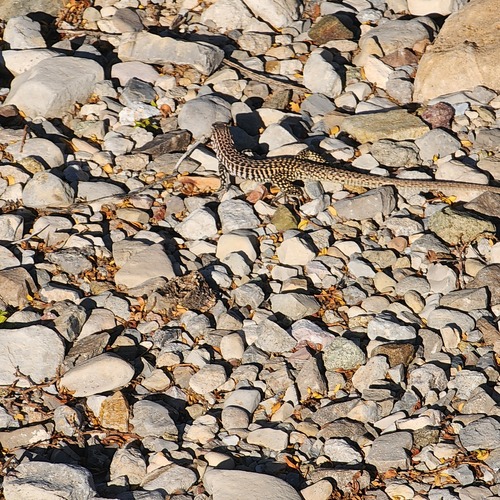
Adult gopher snakes are typically 36-84 in (91–213 cm) in length, when fully mature. Dorsally, gopher snakes are yellowish or a light, sandy brown, with a series of large, dark brown or black markings and smaller, darker spots along the sides. Ventrally, they are a lighter yellowish, either uniformly or with brown markings. They also come in several morphs, depending on the subspecies.
This snake is often mistaken for the prairie rattlesnake (Crotalus viridus), but can be easily distinguished from a rattlesnake by the lack of a tail rattle, no black-and-white banding on its tail, and the shape of its head, which is narrower than a rattlesnake's. Additionally, rattlesnakes (and indeed most vipers) possess a large venom gland located behind each eye, giving their heads a much rounder, more angular shape, as opposed to the more cylindrical, slender head shape of a gopher snake or other colubrid. Wikipedia →