Banded Orange Heliconian

Banded Orange Heliconian

Dryadula phaetusa

Daily sighting probability ~40% · Likely
at Iberá National Park

In 3 days ~70% in a week >90%

36 Verified sightings at Iberá National Park From 2019 to 2026
234 In all 9 parks
June Best month
☀️ Diurnal When it's spotted

About the Banded Orange Heliconian

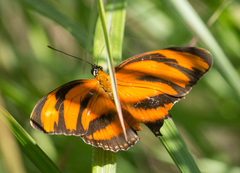
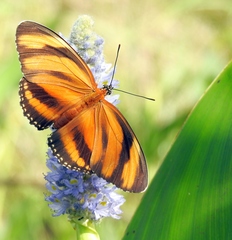
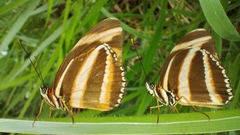
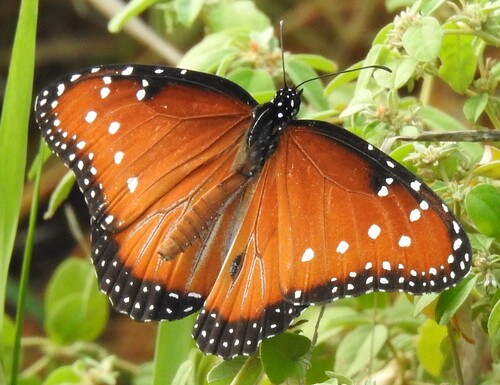
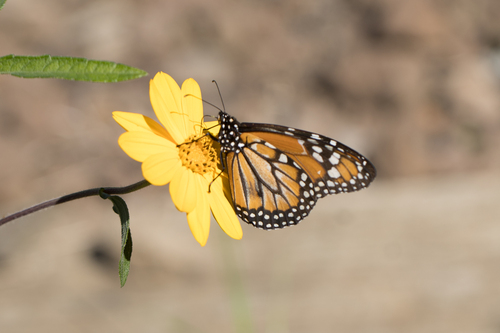
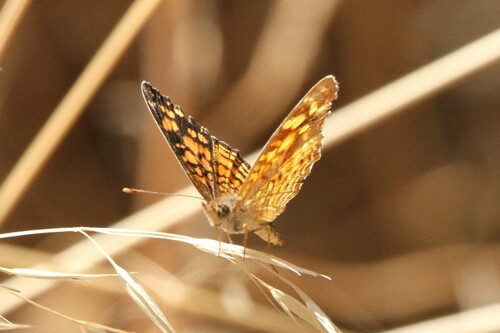
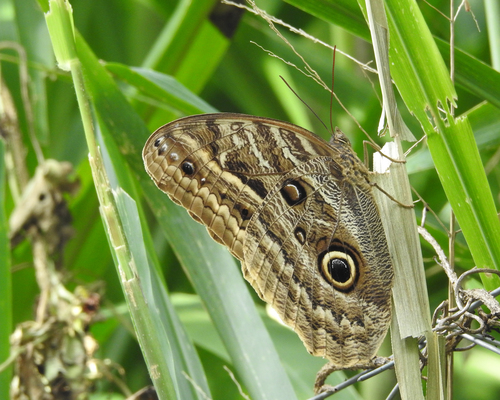
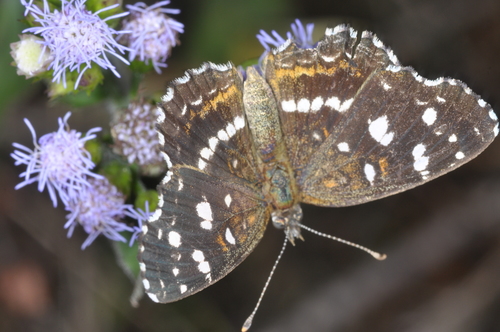
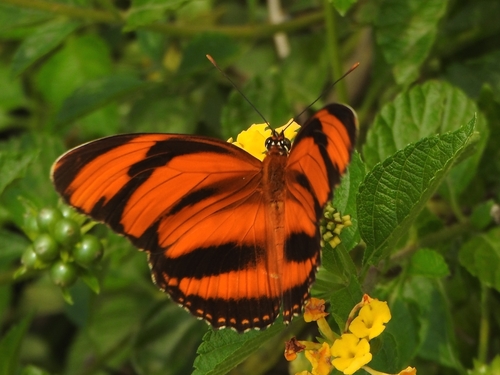
Dryadula is a monotypic genus of the butterfly family Nymphalidae. Its single species, Dryadula phaetusa, known as the banded orange heliconian, banded orange, or orange tiger, is native from Brazil to central Mexico, and in summer can be found rarely as far north as central Florida. Its wingspan ranges from 86 to 89 mm, and it is colored a bright orange with thick black stripes in males and a duller orange with fuzzier black stripes in females.

It feeds primarily on the nectar of flowers and on bird droppings; its caterpillar feeds on passion vines including Passiflora tetrastylis. It is generally found in lowland tropical fields and valleys. This species is unpalatable to birds and belongs to the "orange" Müllerian mimicry complex.

Prior to their mating season, males of this species congregate by the hundreds on patches of moist soil that contain mineral salts, a behavior known as mud-puddling. When they cannot find such deposits, the insects visit various animals to drink salty secretions from their skin and nostrils.

Nat. 10 ed., 1: 478). The... Wikipedia →
Global Distribution

Parks Where Found

# Park Country Daily sighting probability
1 Iberá National Park 🇦🇷 Argentina
~40%
2 Soberanía National Park 🇵🇦 Panama
~20%
3 Iguazú National Park 🇦🇷 Argentina
~20%
4 Iguaçu National Park 🇧🇷 Brazil
~10%
5 Chirripó National Park 🇨🇷 Costa Rica
~10%
6 La Amistad International Park (Panama) 🇵🇦 Panama
~10%
7 Arenal Volcano National Park 🇨🇷 Costa Rica
~10%
8 Carara National Park 🇨🇷 Costa Rica
~10%
9 Monteverde Cloud Forest Reserve 🇨🇷 Costa Rica
~10%

Cities Where Found

# City Country Daily sighting probability
1 São Luís 🇧🇷 Brazil
~10%
2 Porto Alegre 🇧🇷 Brazil
~10%
3 San José 🇨🇷 Costa Rica
<5%
4 São Paulo 🇧🇷 Brazil
<5%

Before you go

What are the chances of seeing a Banded Orange Heliconian in Iberá National Park?

Likely

About 40% of wildlife watchers report a Banded Orange Heliconian sighting in Iberá National Park on a given day, based on 36 verified sightings from GBIF citizen-science data from 2019 to 2026. It is the 3rd most-seen of the 35 insects we can rate there. Over three days the chance rises to about 70%, and over a week to over 90%, if each day is a fresh chance.

When is the best time to see a Banded Orange Heliconian in Iberá National Park?

June

In that month about 60% of wildlife watchers report a Banded Orange Heliconian in Iberá National Park on a given day, against under 5% in December, the lowest month.

What time of day is best to see a Banded Orange Heliconian?

Between 10 am and 1 pm

Across all the parks we cover, that three-hour window holds the most Banded Orange Heliconian sightings with a recorded time, and about 9 in 10 of them come between 6 am and 6 pm: it is a daytime animal.

Is Iberá National Park the best place to see a Banded Orange Heliconian?

Yes

Of the 9 parks where we can rate Banded Orange Heliconian sightings, Iberá National Park has the highest daily chance: about 40%. Next come Soberanía National Park (Panama, about 20%) and Iguazú National Park (Argentina, about 20%).

Which relatives of the Banded Orange Heliconian live in Iberá National Park?

Same family: Nymphalidae

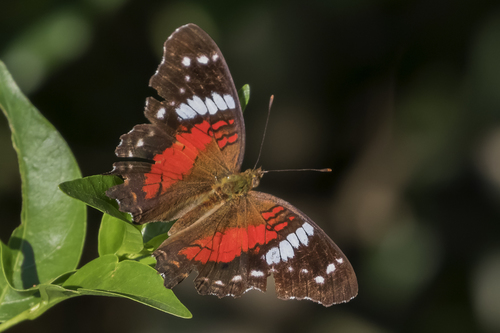
The closest relatives of the Banded Orange Heliconian that you can see in Iberá National Park (family Nymphalidae, Brush-footed Butterflies) are Red Peacock (about 40%), White Peacock (about 40%) and Gulf Fritillary (about 40%), with each one's daily chance of a sighting.

Where does the Banded Orange Heliconian sighting chance come from?

GBIF citizen-science records

It is estimated from how often the Banded Orange Heliconian is recorded against all the insects logged in Iberá National Park (36 verified sightings from 2019 to 2026), calibrated against known sighting rates. Figures are rounded to the nearest 10% because citizen-science data supports honest approximations, not decimals, and months with records from fewer than five people show "—". How it works.

← Back to Iberá National Park