
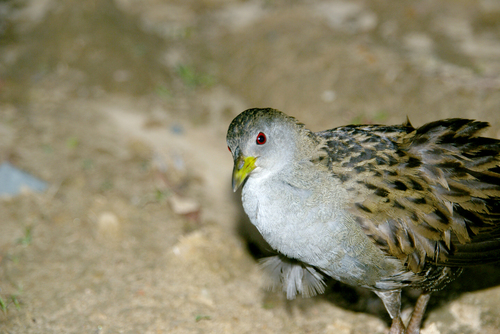
Rufous-sided Crake

Rufous-sided Crake

Laterallus melanophaius

Silhouette: Sheatherius · PhyloPic

LCLeast ConcernNTVUENCR
Daily sighting probability ~20% · Possible
at Iberá National Park

In 3 days ~50% in a week ~80%

355 Verified sightings at Iberá National Park From 2019 to 2026
1,419 In all 9 parks
May Best month
☀️ Diurnal When it's spotted

About the Rufous-sided Crake

The rufous-sided crake (Laterallus melanophaius) is a species of bird in subfamily Rallinae of family Rallidae, the rails, gallinules, and coots. It is found in every mainland South American country except Chile. What is now the white-throated crake (L. albigularis) was for a time treated as a third subspecies.

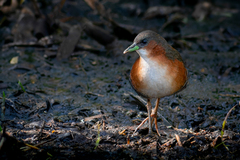
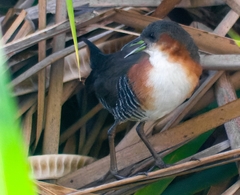
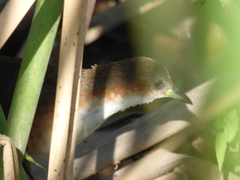
The rufous-sided crake is 14 to 18 cm (5.5 to 7.1 in) long and weighs about 50 to 60 g (1.8 to 2.1 oz). The sexes are alike. Both subspecies' bills have a gray maxilla with a pea green cutting edge and a pale pea green mandible with a white tip. Their legs and feet are light gray brown to olive brown. The nominate subspecies has dark olive brown upperparts with a gray tinge around the eye. The face and sides of the breast are rufous to cinnamon rufous. The throat and center of the breast are white, the flanks and belly barred white and blackish brown, and the undertail coverts are dark cinnamon rufous. Subspecies L. m. oenops is similar to the nominate, but has paler upperparts and is rufous on the forecrown and around the eye. Wikipedia →

Sounds

Song0:23

Brazil · 2026

© JAYRSON ARAUJO DE OLIVEIRA · XC1136278 · CC BY-NC-SA 4.0

Duet0:51

Brazil · 2024

© Robson Silva e Silva · XC1018776 · CC BY-NC-SA 4.0

Call0:24

French Guiana · 2025

© Paul Lenrumé · XC979222 · CC BY-NC-SA 4.0

Global Distribution

Parks Where Found

# Park Country Daily sighting probability
1 Iberá National Park 🇦🇷 Argentina
~20%
2 Manu National Park 🇵🇪 Peru
~10%
3 Iguazú National Park 🇦🇷 Argentina
~10%
4 Iguaçu National Park 🇧🇷 Brazil
~10%
5 El Impenetrable National Park 🇦🇷 Argentina
~10%
6 Serra da Canastra National Park 🇧🇷 Brazil
<5%
7 Chapada Diamantina National Park 🇧🇷 Brazil
<5%
8 Tambopata National Reserve 🇵🇪 Peru
<5%
9 Yasuní National Park 🇪🇨 Ecuador
<5%

Cities Where Found

# City Country Daily sighting probability
1 Buenos Aires 🇦🇷 Argentina
~10%
2 Porto Alegre 🇧🇷 Brazil
~10%
3 Recife 🇧🇷 Brazil
~10%
4 Curitiba 🇧🇷 Brazil
~10%
5 Rosario 🇦🇷 Argentina
~10%
6 Fortaleza 🇧🇷 Brazil
<5%
7 Rio de Janeiro 🇧🇷 Brazil
<5%
8 Montevideo 🇺🇾 Uruguay
<5%
9 São Paulo 🇧🇷 Brazil
<5%
10 Santa Cruz de la Sierra 🇧🇴 Bolivia
<5%

Before you go

What are the chances of seeing a Rufous-sided Crake in Iberá National Park?

Possible

About 20% of wildlife watchers report a Rufous-sided Crake sighting in Iberá National Park on a given day, based on 355 verified sightings from GBIF citizen-science data from 2019 to 2026. It is the 102nd most-seen of the 284 birds we can rate there. Over three days the chance rises to about 50%, and over a week to about 80%, if each day is a fresh chance.

When is the best time to see a Rufous-sided Crake in Iberá National Park?

January, March and May

In those months about 30% of wildlife watchers report a Rufous-sided Crake in Iberá National Park on a given day, against about 10% in February, April and August, the lowest months.

What time of day is best to see a Rufous-sided Crake?

Between 8 and 11 am

Across all the parks we cover, that three-hour window holds the most Rufous-sided Crake sightings with a recorded time, and about 8 in 10 of them come between 6 am and 6 pm: it is a daytime animal.

Is Iberá National Park the best place to see a Rufous-sided Crake?

Yes

Of the 9 parks where we can rate Rufous-sided Crake sightings, Iberá National Park has the highest daily chance: about 20%. Next come Manu National Park (Peru, about 10%) and Iguazú National Park (Argentina, about 10%).

Which relatives of the Rufous-sided Crake live in Iberá National Park?

Same family: Rallidae

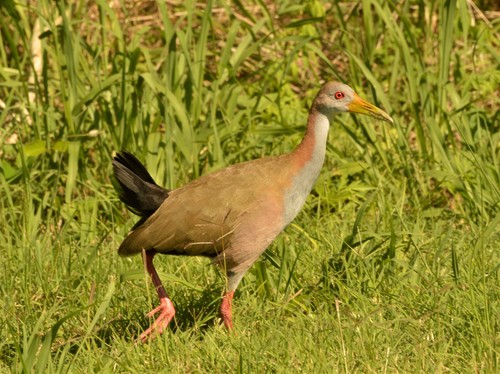
The closest relatives of the Rufous-sided Crake that you can see in Iberá National Park (family Rallidae, Rails, Gallinules, and Coots) are Giant Wood-Rail (about 80%), Common Moorhen (about 10%) and Ash-throated Crake (about 10%), with each one's daily chance of a sighting.

Where does the Rufous-sided Crake sighting chance come from?

GBIF citizen-science records

It is estimated from how often the Rufous-sided Crake is recorded against all the birds logged in Iberá National Park (355 verified sightings from 2019 to 2026), calibrated against known sighting rates. Figures are rounded to the nearest 10% because citizen-science data supports honest approximations, not decimals, and months with records from fewer than five people show "—". How it works.

← Back to Iberá National Park