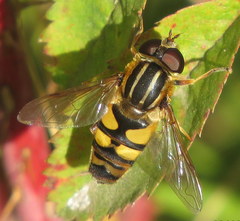
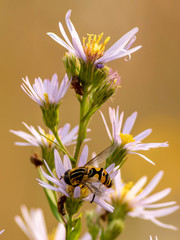
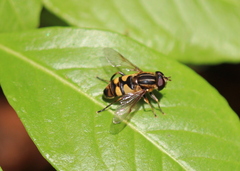
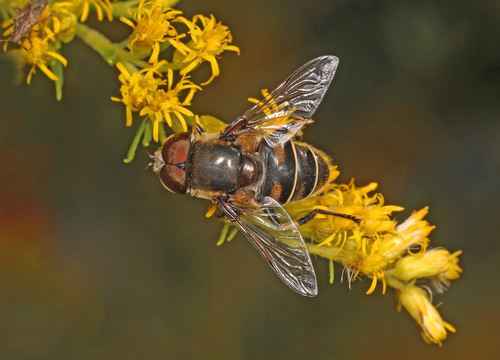
Narrow-Headed Marsh Fly

Narrow-Headed Marsh Fly

Helophilus fasciatus

Daily sighting probability ~20% · Possible
at Isle Royale National Park

In 3 days ~50% in a week ~80%

12 Verified sightings at Isle Royale National Park From 2019 to 2026
93 In all 7 parks
September Best month
☀️ Diurnal When it's spotted

About the Narrow-Headed Marsh Fly

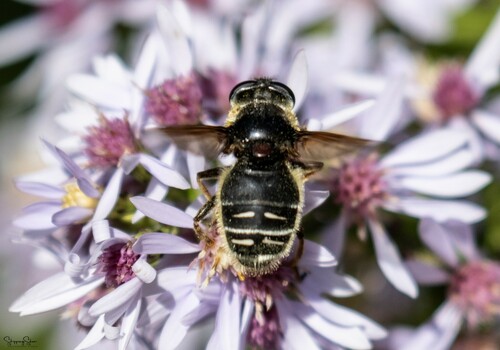
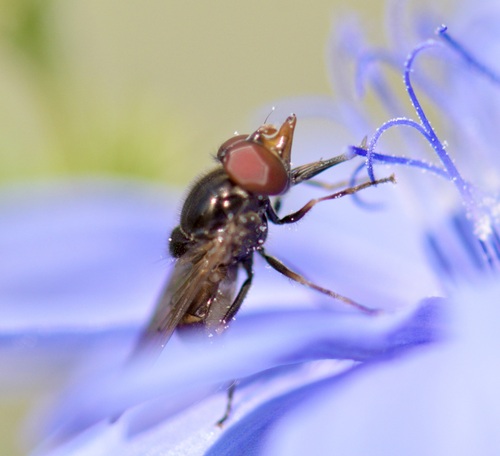
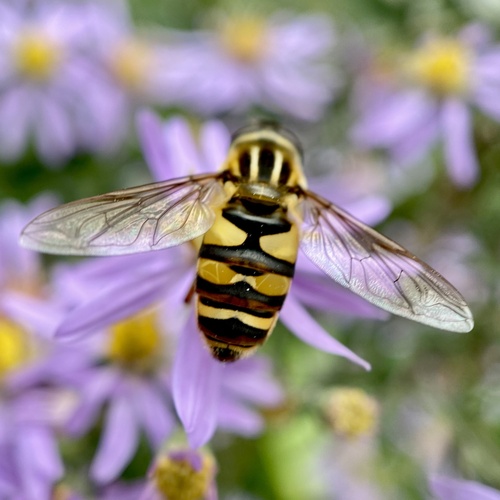
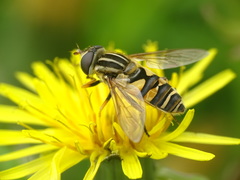
Helophilus fasciatus (Walker, 1849), the narrow-headed marsh fly, is an abundant species of syrphid fly observed throughout the United States and Canada. Hoverflies can remain nearly motionless in flight. The adults are also known as flower flies for they are commonly found on flowers, from which they get both energy-giving nectar and protein-rich pollen. The larvae of this genus are associated with wet decaying organic material, particularly accumulations of decaying vegetation in ponds and mud and farmyard manure or silage. The adults of this species lays eggs on vegetation overhanging the water. The larvae hatch and drop into the water.

For terminology Speight key to genera and glossary Length, 13–15 mm (0.51–0.59 in) The male is dichoptic. The male's face is yellow and thickly yellow pollinose, with the middle line broadly shining reddish yellow to ferruginous but never black. The pile is pale yellowish. In profile, the face is concave on the upper three-fifths, convex below this, and the lower two-thirds convex receding, without distinct tubercle although the formation approaches one. The frons is narrowed above, and the upper portion is... Wikipedia →
Global Distribution

Parks Where Found

# Park Country Daily sighting probability
1 Isle Royale National Park 🇺🇸 United States
~20%
2 Point Pelee National Park 🇨🇦 Canada
~10%
3 Riding Mountain National Park 🇨🇦 Canada
~10%
4 Acadia National Park 🇺🇸 United States
~10%
5 Shenandoah National Park 🇺🇸 United States
~10%
6 Pacific Rim National Park Reserve 🇨🇦 Canada
~10%
7 Great Smoky Mountains National Park 🇺🇸 United States
<5%

Cities Where Found

# City Country Daily sighting probability
1 Minneapolis [Saint Paul] 🇺🇸 United States
~20%
2 Boston 🇺🇸 United States
~10%
3 Chicago 🇺🇸 United States
~10%
4 Montreal 🇨🇦 Canada
~10%
5 New York City 🇺🇸 United States
~10%
6 Detroit 🇺🇸 United States
~10%
7 Toronto 🇨🇦 Canada
~10%
8 Washington 🇺🇸 United States
~10%
9 Vancouver 🇨🇦 Canada
~10%
10 Portland 🇺🇸 United States
<5%

Before you go

What are the chances of seeing a Narrow-Headed Marsh Fly in Isle Royale National Park?

Possible

About 20% of wildlife watchers report a Narrow-Headed Marsh Fly sighting in Isle Royale National Park on a given day, based on 12 verified sightings from GBIF citizen-science data from 2019 to 2026. It is the 25th most-seen of the 48 insects we can rate there. Over three days the chance rises to about 50%, and over a week to about 80%, if each day is a fresh chance.

What time of day is best to see a Narrow-Headed Marsh Fly?

Between noon and 3 pm

Across all the parks we cover, that three-hour window holds the most Narrow-Headed Marsh Fly sightings with a recorded time, and nearly all of them come between 6 am and 6 pm: it is a daytime animal.

Is Isle Royale National Park the best place to see a Narrow-Headed Marsh Fly?

Yes

Of the 7 parks where we can rate Narrow-Headed Marsh Fly sightings, Isle Royale National Park has the highest daily chance: about 20%. Next come Point Pelee National Park (Canada, about 10%) and Riding Mountain National Park (Canada, about 10%).

Which relatives of the Narrow-Headed Marsh Fly live in Isle Royale National Park?

Same family: Syrphidae

The closest relatives of the Narrow-Headed Marsh Fly that you can see in Isle Royale National Park (family Syrphidae, Hover Flies) are Black-Shouldered Drone Fly (about 30%), Narrow-Banded Pond Fly (about 20%) and American Snout Fly (about 10%), with each one's daily chance of a sighting.

Where does the Narrow-Headed Marsh Fly sighting chance come from?

GBIF citizen-science records

It is estimated from how often the Narrow-Headed Marsh Fly is recorded against all the insects logged in Isle Royale National Park (12 verified sightings from 2019 to 2026), calibrated against known sighting rates. Figures are rounded to the nearest 10% because citizen-science data supports honest approximations, not decimals, and months with records from fewer than five people show "—". How it works.

← Back to Isle Royale National Park