About the Two-Striped Grasshopper
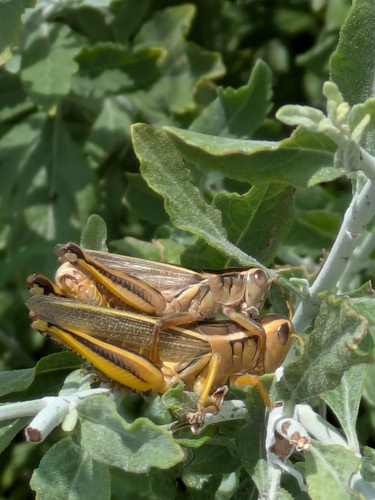
Melanoplus bivittatus, the two-striped grasshopper, is a species of grasshopper belonging to the family Acrididae. It is commonly found in North America, and is especially abundant on the Canadian prairies. Melanoplus bivittatus is a relatively large species with sizes ranging from 30 to 55 mm. A pair of pale yellow stripes run along the top of its body from above its eyes to the hind tip of its wings, which gives it the names two-striped grasshopper or yellow-striped grasshopper. The species often has a yellowish green coloration throughout its body due to chromoprotein and carotenoids. The rest of the body looks similar to that of most grasshopper species, with enlarged hind legs for jumping and two pairs of wings, with one set overlapping the other.
During the winter, eggs are laid in the soil and hatch by late April to early May. At optimal conditions (25 °C, very moist), Melanoplus bivittatus eggs will stop developing at around 21 days. Once development stops, the eggs go into a state of diapause, with development continuing again in spring. Once temperatures are warm enough the eggs start hatching; the maximum rate of hatching occurs between... Wikipedia →