Hume's Warbler

Hume's Warbler

Phylloscopus humei

Silhouette: Jiekun He · PhyloPic

LCLeast ConcernNTVUENCR
Daily sighting probability ~10% · With luck
at Kanha National Park

In 3 days ~30% in a week ~60%

1,293 Verified sightings at Kanha National Park From 2019 to 2026
4,969 In all 15 parks
February Best month
☀️ Diurnal When it's spotted

About the Hume's Warbler

Hume's leaf warbler or Hume's warbler (Phylloscopus humei) is a small leaf warbler which breeds in the mountains of inner Asia. This warbler is migratory and winters mainly in India. The English name and the specific humei commemorate Allan Octavian Hume, a British civil

servant and ornithologist based in India. The genus name Phylloscopus is from Ancient Greek phullon, "leaf", and skopos, "seeker" (from skopeo, "to watch"). Like most similar songbirds, it was formerly included in the "Old World warbler" assemblage.

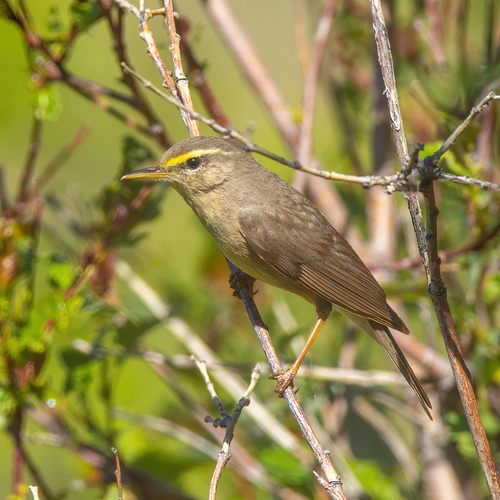
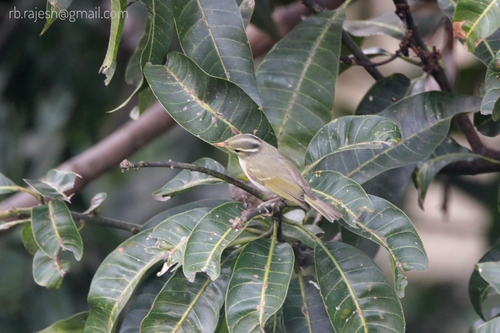
Hume's leaf warbler is one of the smallest "Old World warblers". Like most other leaf warblers, it has greenish upperparts and off-white underparts. With its long supercilium, crown stripe and yellow-margined tertial remiges, it is very similar to the yellow-browed warbler (P. inornatus). However, it has only one prominent light wing bar, just a faint vestige of the second shorter wing bar, and overall duller colours. It also has a dark lower mandible and legs.

Its song is buzzing and high-pitched. The best distinction from the yellow-browed warbler is the more disyllabic call. While the eastern and western Hume's leaf warblers already show noticeable... Wikipedia →
Sounds

Song0:30

China · 2026

© Peter Boesman · XC1147704 · CC BY-NC-ND 4.0

Call0:24

India · 2026

© Ding Li Yong · XC1087910 · CC BY-NC-ND 4.0

Call0:17

Thailand · 2026

© Peter Ericsson · XC1085995 · CC BY-NC-SA 4.0

Global Distribution

Parks Where Found

# Park Country Daily sighting probability
1 Jiuzhaigou National Park 🇨🇳 China
~50%
2 Keoladeo National Park 🇮🇳 India
~30%
3 Bandhavgarh National Park 🇮🇳 India
~20%
4 Ranthambore National Park 🇮🇳 India
~20%
5 Doi Inthanon National Park 🇹🇭 Thailand
~20%
6 Jim Corbett National Park 🇮🇳 India
~20%
7 Satpura National Park 🇮🇳 India
~20%
8 Chitwan National Park 🇳🇵 Nepal
~10%
9 Kanha National Park 🇮🇳 India
~10%
10 Langtang National Park 🇳🇵 Nepal
~10%
11 Hemis National Park 🇮🇳 India
~10%
12 Royal Bardia National Park 🇳🇵 Nepal
~10%
13 Gir National Park 🇮🇳 India
<5%
14 Royal Manas National Park 🇧🇹 Bhutan
<5%
15 Wadden Sea National Park 🇩🇪 Germany
<5%

Cities Where Found

# City Country Daily sighting probability
1 Dushanbe 🇹🇯 Tajikistan
~50%
2 Tashkent 🇺🇿 Uzbekistan
~50%
3 Dehradun 🇮🇳 India
~40%
4 Islamabad 🇵🇰 Pakistan
~40%
5 Almaty 🇰🇿 Kazakhstan
~30%
6 Mashhad 🇮🇷 Iran
~30%
7 Bishkek 🇰🇬 Kyrgyzstan
~30%
8 Chandigarh 🇮🇳 India
~20%
9 Jabalpur 🇮🇳 India
~20%
10 Jammu 🇮🇳 India
~20%

Before you go

What are the chances of seeing a Hume's Warbler in Kanha National Park?

With luck

About 10% of wildlife watchers report a Hume's Warbler sighting in Kanha National Park on a given day, based on 1,293 verified sightings from GBIF citizen-science data from 2019 to 2026. It is the 90th most-seen of the 286 birds we can rate there. Over three days the chance rises to about 30%, and over a week to about 60%, if each day is a fresh chance.

When is the best time to see a Hume's Warbler in Kanha National Park?

February

In that month about 40% of wildlife watchers report a Hume's Warbler in Kanha National Park on a given day, against under 5% in April to October, the lowest months. That is one of Kanha National Park's driest months, with about 15 mm of rain against 430 mm in July.

What time of day is best to see a Hume's Warbler?

Between 4 and 7 am

Across all the parks we cover, that three-hour window holds the most Hume's Warbler sightings with a recorded time, and about 7 in 10 of them come between 6 am and 6 pm: it is a daytime animal.

Where does the Hume's Warbler sighting chance come from?

GBIF citizen-science records

It is estimated from how often the Hume's Warbler is recorded against all the birds logged in Kanha National Park (1,293 verified sightings from 2019 to 2026), calibrated against known sighting rates. Figures are rounded to the nearest 10% because citizen-science data supports honest approximations, not decimals, and months with records from fewer than five people show "—". How it works.

← Back to Kanha National Park