
Ditch Jewel

Ditch Jewel

Brachythemis contaminata

Daily sighting probability ~30% · Possible
at Keoladeo National Park

In 3 days ~70% in a week ~90%

16 Verified sightings at Keoladeo National Park From 2019 to 2026
165 In all 13 parks
March Best month
☀️ Diurnal When it's spotted

About the Ditch Jewel

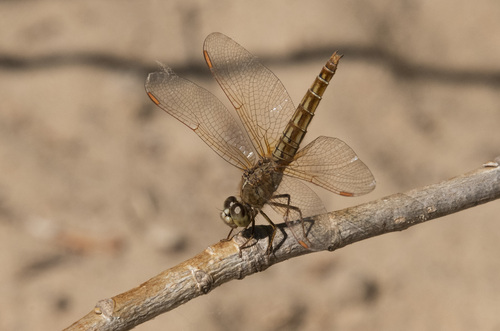
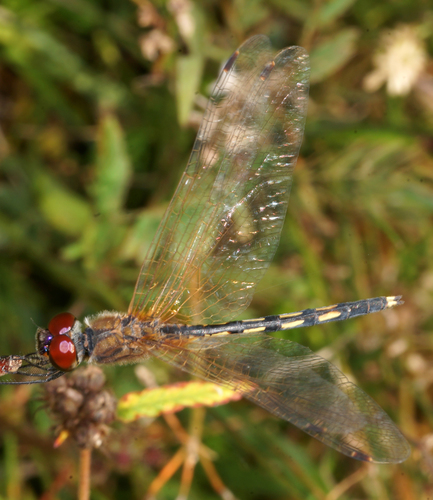
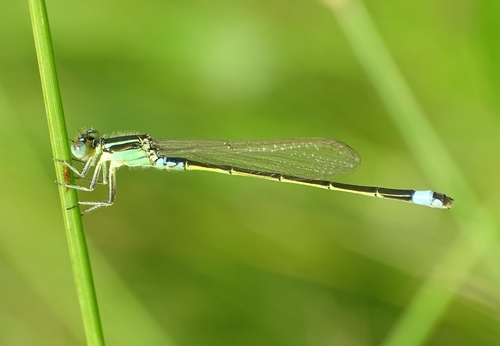
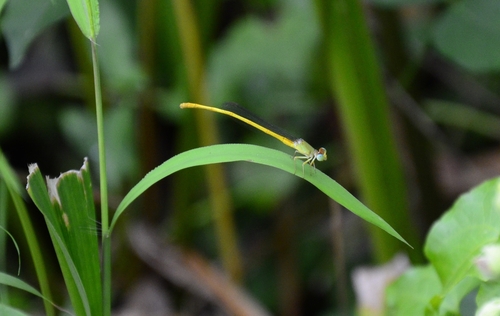
Brachythemis contaminata, ditch jewel, is a species of dragonfly in the family Libellulidae. It is found in many Asian countries. It is a small dragonfly with brown-capped yellowish-green eyes. Its thorax is olivaceous-brown, marked with a reddish-brown humeral stripe and two brownish stripes on each side. Wings are transparent; but with a broad bright orange fascia extending from base to within 2 to 3 cells of reddish pterostigma. Abdomen is ochreous-red, marked with dorsal and sub-dorsal brown

stripes. Anal appendages are in reddish-brown. Female is similar to the male; but in pale yellowish-green color. Wings are transparent, tinted with yellow at extreme base;, but the bright orange fascia seen in the male absent.

It breeds in weedy ponds, lakes, and slowly moving streams; especially in sluggish waters. It is very common along sewage canals, tanks, ponds and ditches. This type of dragonfly has the smallest genome of its kind. The entire circular genome is 15,056 bp in length and represents the smallest in presently known odonatan mitogenomes. (Yu et al 2014). Its first species to have a complete mitochondrial genome among the family Libellulidae.... Wikipedia →

Global Distribution

Parks Where Found

# Park Country Daily sighting probability
1 Sundarbans National Park 🇮🇳 India
~30%
2 Keoladeo National Park 🇮🇳 India
~30%
3 Mudumalai National Park 🇮🇳 India
~30%
4 Udawalawe National Park 🇱🇰 Sri Lanka
~30%
5 Nagarhole National Park 🇮🇳 India
~20%
6 Ranthambore National Park 🇮🇳 India
~20%
7 Minneriya National Park 🇱🇰 Sri Lanka
~20%
8 Cuc Phuong National Park 🇻🇳 Vietnam
~20%
9 Kaeng Krachan National Park 🇹🇭 Thailand
~20%
10 Cat Tien National Park 🇻🇳 Vietnam
~20%
11 Khao Yai National Park 🇹🇭 Thailand
~20%
12 Khao Sok National Park 🇹🇭 Thailand
~10%
13 Kinabatangan Wildlife Sanctuary 🇲🇾 Malaysia
~10%

Cities Where Found

# City Country Daily sighting probability
1 Yogyakarta 🇮🇩 Indonesia
~50%
2 Coimbatore 🇮🇳 India
~40%
3 Yangon 🇲🇲 Myanmar
~40%
4 Kota 🇮🇳 India
~40%
5 Makassar 🇮🇩 Indonesia
~40%
6 Kolkata 🇮🇳 India
~40%
7 Hanoi 🇻🇳 Vietnam
~40%
8 Salem 🇮🇳 India
~30%
9 Thiruvananthapuram 🇮🇳 India
~30%
10 Surat 🇮🇳 India
~30%

Before you go

What are the chances of seeing a Ditch Jewel in Keoladeo National Park?

Possible

About 30% of wildlife watchers report a Ditch Jewel sighting in Keoladeo National Park on a given day, based on 16 verified sightings from GBIF citizen-science data from 2019 to 2026. It is the 9th most-seen of the 23 insects we can rate there. Over three days the chance rises to about 70%, and over a week to about 90%, if each day is a fresh chance.

When is the best time to see a Ditch Jewel in Keoladeo National Park?

March, July and September

In those months about 60% of wildlife watchers report a Ditch Jewel in Keoladeo National Park on a given day, against under 5% in December to February, the lowest months. Those are among Keoladeo National Park's wettest months, with about 120 mm of rain a month against 5 mm in November. June has too few records to rate.

What time of day is best to see a Ditch Jewel?

Between 11 am and 2 pm

Across all the parks we cover, that three-hour window holds the most Ditch Jewel sightings with a recorded time, and about 9 in 10 of them come between 6 am and 6 pm: it is a daytime animal.

Is Keoladeo National Park the best place to see a Ditch Jewel?

Among the best

Of the 13 parks where we can rate Ditch Jewel sightings, Keoladeo National Park ranks 2nd at about 30%, level with the leaders once rounded. The best odds are in Sundarbans National Park (India, about 30%).

Which relatives of the Ditch Jewel live in Keoladeo National Park?

Same family: Libellulidae

The closest relatives of the Ditch Jewel that you can see in Keoladeo National Park (family Libellulidae, Skimmers) are Scarlet Skimmer (about 40%) and Dancing Dropwing (about 20%), with each one's daily chance of a sighting.

Where does the Ditch Jewel sighting chance come from?

GBIF citizen-science records

It is estimated from how often the Ditch Jewel is recorded against all the insects logged in Keoladeo National Park (16 verified sightings from 2019 to 2026), calibrated against known sighting rates. Figures are rounded to the nearest 10% because citizen-science data supports honest approximations, not decimals, and months with records from fewer than five people show "—". How it works.

← Back to Keoladeo National Park